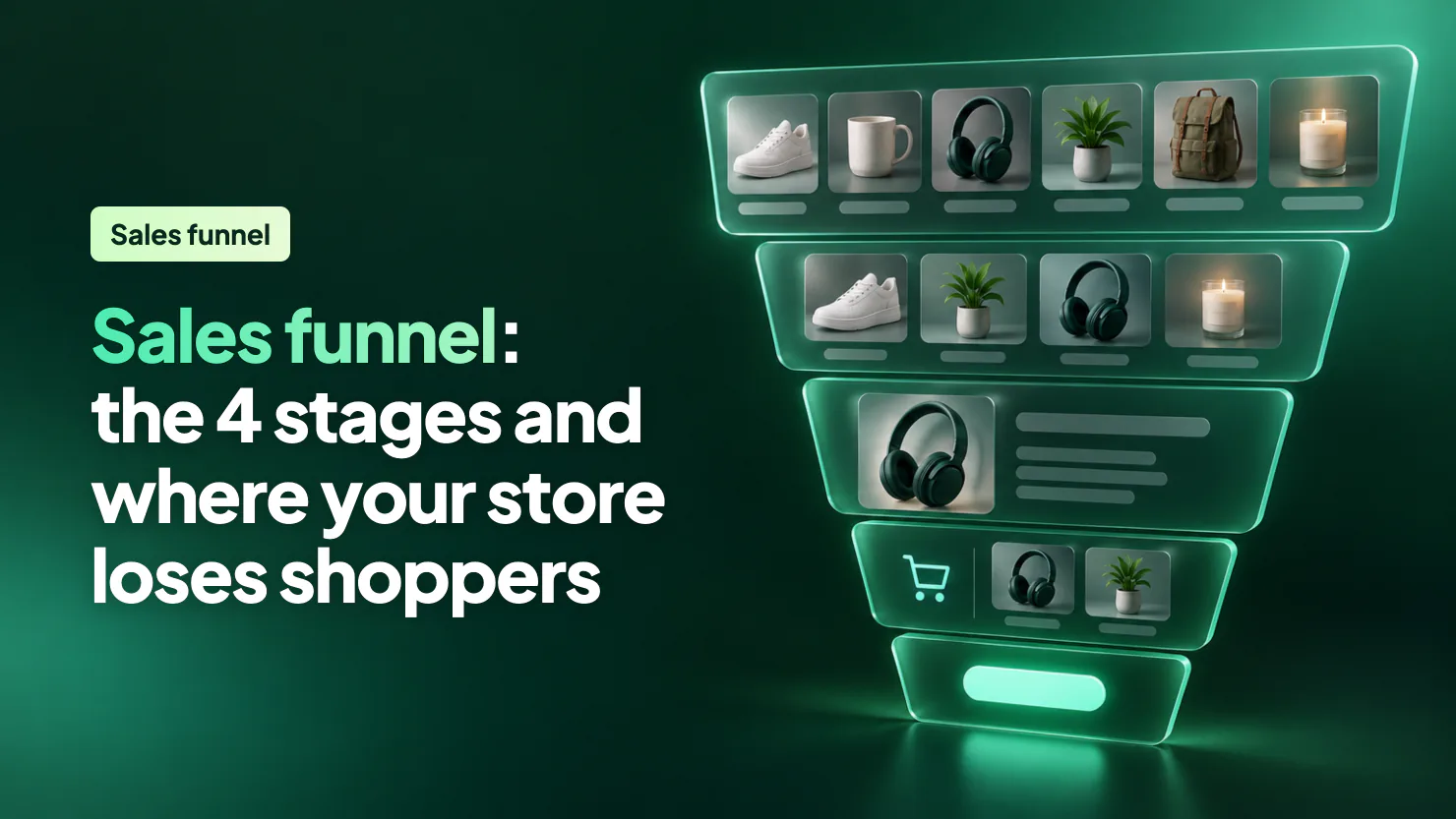
A sales funnel is the path a shopper takes from first hearing of your store to placing an order. It's drawn as a funnel because fewer people reach each step. The common version has four stages: Awareness, Interest, Decision and Action. Inside your store, you count it in visits, from the first page a shopper opens to checkout.
Say 1,000 shoppers visit this week and 15 pay, a 1.5% conversion rate. That number alone doesn't say where the other 985 stopped. Count each step and one stands out: 400 open a product, but only 60 add one to the cart. Your product pages lose 85 of every 100 shoppers who reach them.
What are the 4 stages of a sales funnel?
The four stages are Awareness, Interest, Decision and Action, and only the last three happen inside your store.
| Stage | What the shopper is doing | What you work on |
|---|---|---|
| Awareness | First hears of you: a search result, a video, a friend, an ad | Being found |
| Interest | Browses your collections, searches, maybe signs up for email | A clear path to the right product |
| Decision | Weighs one product: photos, reviews, the price with shipping | Answering doubts |
| Action | Pays | A short checkout |
The four are adapted from AIDA, an early advertising model whose letters stand for Attention, Interest, Desire and Action. Other models add a stage for repeat buyers, so you'll also see funnels of five or six stages. Another four-part list, the 4 Ps of marketing, covers what you decide instead: product, price, place and promotion.
How does a sales funnel look inside an online store?
Your visit counts start at the first page a shopper opens, so Awareness never shows in them. An ad view, a social post or a search result someone scrolled past stays in that platform's reports.
Inside the store, the path runs from the first page to a collection or search, then a product page, the cart, checkout and the order. Each step loses some visits. A visit that ends on its first page is a bounce, and your bounce rate is their share of all visits.
Read the share that moves on, not the raw count. In the example above, the first stretch loses the most shoppers: 600 of 1,000 never open a product. The product page loses a bigger share, 340 of the 400 who reach it. That's the steeper drop, and the page to look at first. One overall conversion rate hides it.
What is the difference between a sales funnel and a conversion funnel?
A sales funnel covers the whole path, including what happens before the visit. A conversion funnel covers only the steps of one action on your site, such as buying, counted in visits.
Shopify draws one for you in its Conversion rate breakdown report, with four steps of its own: "Sessions" (its word for visits), "Added to cart", "Reached checkout" and "Completed checkout". Those steps are not the four stages above, because they start at the visit, after Awareness is over. The Shopify CRO guide shows how to read the report and fix each leak.
How do you create a sales funnel for an online store?
Build it one stage at a time for one product, from how strangers find you to what brings a buyer back.
- Start with one product and one kind of buyer. Every stage then speaks to the same person.
- Pick one or two ways to be found. This is Awareness: search, short video on TikTok Shop, creators or ads. An ecommerce marketing strategy helps you choose.
- Give browsers a clear path. For Interest, keep the menu short, build collections that match what you sell, make sure search finds your products and offer an email sign-up. Landing page examples help with the first page, and newsletter ideas with the emails after it.
- Answer doubts on the product page. Decision happens here, so put photos, reviews, and the price with shipping and returns near Add to cart. The seven parts of a product detail page cover the rest.
- Keep checkout short. For Action, show the full cost before checkout and don't force an account. Among US shoppers who abandoned a cart for a reason other than browsing, 40% blamed extra costs and 18% a forced account, per Baymard Institute. Shopify can email shoppers who leave checkout after typing their email, and the post on abandoned cart email has 24 subject lines to use.
- Ask buyers back after the order. A second order needs no new Awareness, and how to get repeat customers covers the ways to earn one.
How do you track your sales funnel on Shopify?
Start with Shopify's free Conversion rate breakdown report, then find the step with the steepest drop.
In your Shopify admin, open Analytics, then Reports, then Conversion rate breakdown. Turn off "Open Funnel", the switch that lets visits skip steps, so each step counts only the visits that came through the one before. Then hover over a step: Shopify's help page says a tooltip shows the share of visits that reached that step and the share that dropped off.
Pick a date range that starts after September 23, 2026. That week, Shopify changed how it counts sessions, so a range that starts earlier mixes two ways of counting.
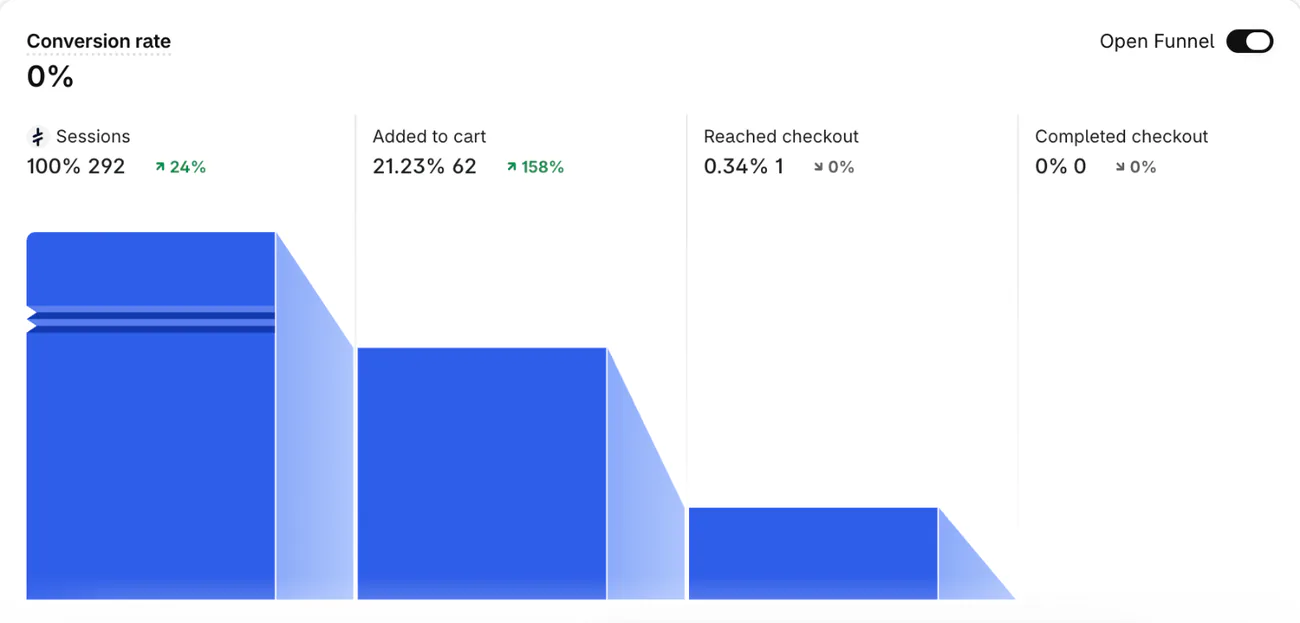
The report's funnel has no step between a visit and a cart. A shopper who opened three products and left looks the same as one who never got past the home page.
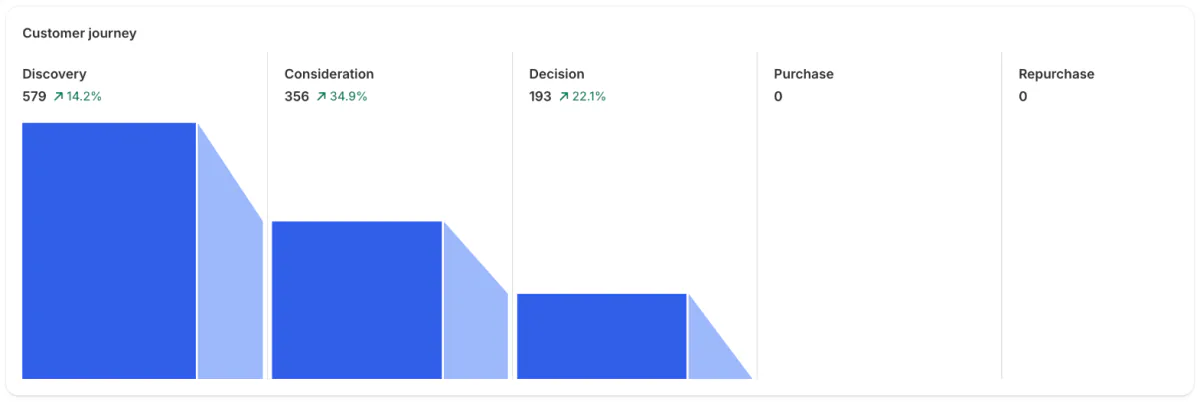
Sledge, a Shopify app for search, filters and merchandising, splits that stretch. The "Customer journey" chart on the Journey tab of Sledge Analytics counts visits at five stages:
- Discovery: the widest bar, because it holds every visit counted further along.
- Consideration: a collection page or search results.
- Decision: a product page, the cart drawer, the cart page or checkout.
- Purchase: a visit that placed an order.
- Repurchase: a visit that placed an order, from a customer with two or more orders.
Each stage counts every visit that got at least that far, so a shopper who lands straight on a product page counts at the first three. Under each stage name, the chart prints its visit count and, for a stage with visits, the change against the period before.
On the same tab, "Where customers drop off" lists the last pages of visits that ended without a purchase, in up to five rows, most common first. Beside it, "Where customers leave" gives each kind of page an exit rate, the share of its views that ended the visit, so you can tell whether shoppers leave more from product pages or from the cart.
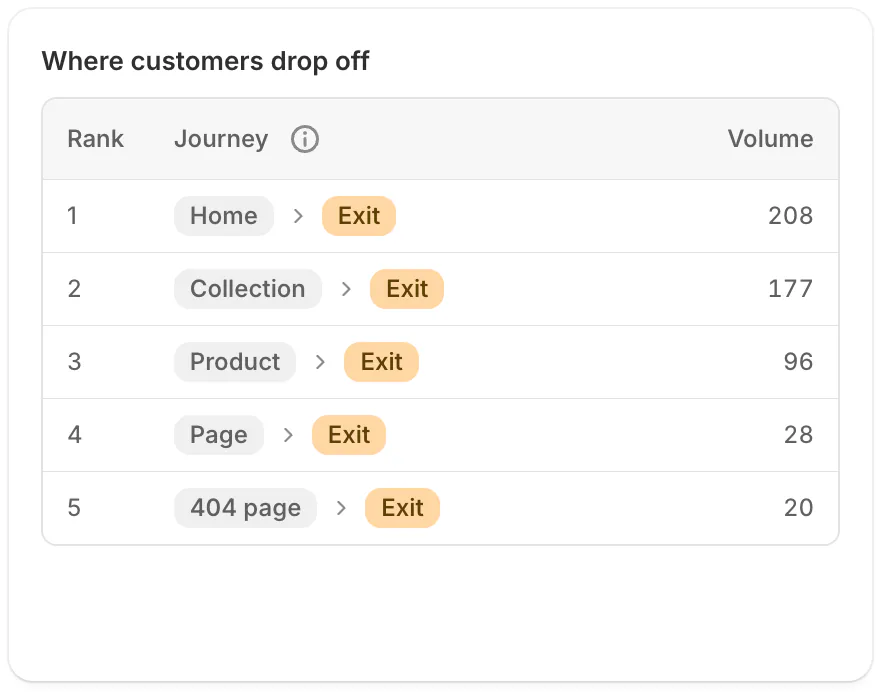
Sledge Analytics is on every paid plan, with 30 to 120 days of history depending on the plan, and you can try it free for 14 days. It counts only what happens inside your store. To open single visits as timelines, see Shopify customer journey.
Where do shoppers drop off, and what fixes each step?
Fix the page behind the steepest drop first, then measure the same step again.
| Where visits stop | What it often means | First check | Read more |
|---|---|---|---|
| First page, nothing else opened | The page doesn't match the ad or post that sent the shopper | The Sessions by landing page report | Landing page examples |
| A collection or search, no product opened | The shopper couldn't find the product | The Searches with no results report | Zero-result search |
| Product page, no cart | Doubts about price, fit, photos or delivery | Your best seller's page, opened on a phone | Product detail page |
| Cart, no checkout | A surprise in the total | Whether the cart shows shipping before checkout | Cart trust signals |
| Checkout, no order | Payment or trust | Orders, then Abandoned checkouts | Abandoned cart email |
When many visits reach the cart or checkout and none become orders, the cause can also be a broken checkout or payment setting. Place a test order before you rewrite any page. The Shopify store audit walks through that check. Once the leak is fixed, track that step beside the other ecommerce KPIs.
FAQ
Questions, answered
-

14-day free trial
Explore Sledge on your store before you decide to commit.
-

No credit card required
Start improving your store with no upfront commitment.
-

Setup in minutes
Get Sledge running without a lengthy setup process.
-

Built to grow sales
Turn shopper behavior into actions that help you sell more.
What is a sales funnel?
A sales funnel is the path from first hearing of a store to placing an order, drawn as a funnel because fewer people reach each step. In marketing it maps what to say at each stage. For an online store it also shows where visits stop: on a collection, a product page, the cart or checkout.
What are the 4 stages of the sales funnel?
The common four are Awareness, Interest, Decision and Action. Awareness is when someone first hears of you, Interest is browsing, Decision is weighing one product, and Action is paying. They're adapted from AIDA, an early advertising model whose letters stand for Attention, Interest, Desire and Action. Other models add a stage for repeat buyers.
What is a sales funnel analysis?
A sales funnel analysis counts how many shoppers move from one step to the next and finds the step that loses the biggest share. In a Shopify store, open the Conversion rate breakdown report, switch Open Funnel off and compare each step with the one before. Fix the page behind the steepest drop first, then measure again.
What is the difference between a sales funnel and a conversion funnel?
A sales funnel covers the whole path, including what happens before a shopper reaches your store. A conversion funnel covers only the steps of one action on your site, such as visit, cart, checkout and order, counted in visits. Shopify's Conversion rate breakdown report is a conversion funnel of four steps.
How do you track a sales funnel on Shopify?
Start with Shopify's free Conversion rate breakdown report, under Analytics, then Reports. It counts visits, carts, checkouts reached and checkouts completed, with no step between a visit and a cart. Sledge Analytics splits that stretch into a collection or search, then a product page or further, and lists the last pages of visits that ended without a sale.
Does Sledge track the funnel before shoppers reach my store?
No. Sledge counts what happens inside your store, from the pages shoppers open to the order. An ad view, a social post or a search result someone saw before clicking stays in that platform's own reports. Sledge's Customer journey chart starts at the first page it records. Sledge has no session recordings or heatmaps.
Which stage of your store loses the most shoppers?
Sledge doesn't run ads, build landing pages or send email campaigns. Inside your store, Sledge Analytics counts visits at five stages, from Discovery to Repurchase, and lists the last pages of visits that ended without a sale. Try it free for 14 days. Growth Intelligence turns on when you pick a paid plan, and its suggested fixes add up to one dollar figure, labeled Est. potential.