Shop Pay vs PayPal isn't a choice of provider for a US store on Shopify Payments: both come with it, land in one payout, and are worth keeping on. On Basic, a standard card through Shop Pay costs 2.9% + 30¢ and PayPal starts at 3.49% + 49¢, so PayPal costs at least 54¢ more on a $60 order.
Your payout lands, and the PayPal sales are inside it instead of in your PayPal balance. Or a shopper who opened a PayPal dispute asks for half back, and only a full refund is on offer. In November 2026, we read Shopify's help pages and both companies' US fee pages, then worked out one store's month.
What is the difference between Shop Pay and PayPal?
Shop Pay is Shopify's saved-details checkout for cards, and PayPal lets a shopper pay from a PayPal account. In the US, both run through Shopify Payments.
Shop Pay remembers a shopper's email, card and address, and each order costs your Shopify Payments rate. What is Shop Pay covers how it works for the shopper.
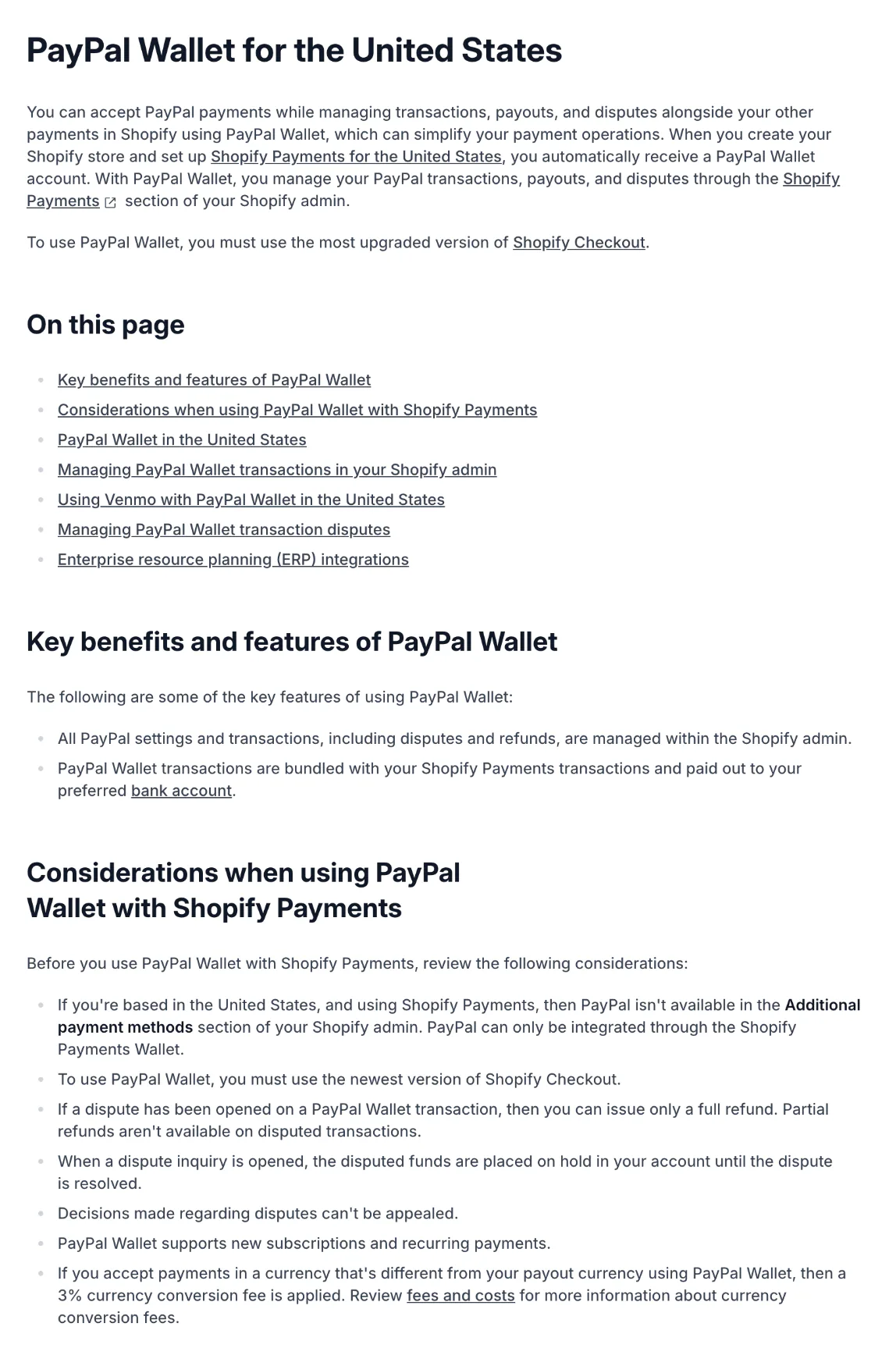
In the US, setting up Shopify Payments gives you a PayPal Wallet account, and its sales, refunds and disputes sit in your Shopify admin. With Shopify Payments on, you can't add PayPal as a separate provider.
| Detail | Shop Pay | PayPal in the US |
|---|---|---|
| Who takes the payment | Shopify Payments | PayPal, connected through Shopify Payments |
| What the shopper uses | Saved email, card and address | A PayPal account, or Venmo |
| Fee on Basic | 2.9% + 30¢ for a standard card; 3.5% + 30¢ for business cards and American Express | From 3.49% + 49¢ |
| Shopify's transaction fee | None | None while Shopify Payments is your main provider |
| Payout | Your Shopify Payments payout | The same payout |
| Disputes | Card chargebacks, answered in your admin | PayPal inquiries and claims, answered in your admin |
| Fraud cover | Shopify Protect on eligible orders | PayPal Seller Protection on eligible orders |
| Currency conversion | 1.5% | 3% |
From Shopify's US pricing page as archived November 9, 2026, and Shopify's Help Center, read November 11, 2026.
Outside the US and France, PayPal runs as its own provider, PayPal Express Checkout, at PayPal's own fees. Refunds through it wait until you finish setting up your PayPal account.
Shop Pay vs PayPal fees: what does each cost your store?
On Shopify's Basic plan, a Shop Pay card sale costs 2.9% + 30¢, and a PayPal sale starts at 3.49% + 49¢. Business cards and American Express cost 3.5% + 30¢ through Shop Pay. On Shopify's US pricing page, PayPal's rate stays the same on every plan while card rates fall on the higher ones, as our Shopify pricing guide lists.
Say a made-up store on Basic takes 300 orders of $60 in a month, and 60 of them come through PayPal.
| Fees | Shop Pay, standard card | Shop Pay, business card or Amex | PayPal |
|---|---|---|---|
| One $60 order | $2.04 | $2.40 | From $2.58 |
| 60 orders | $122.40 | $144.00 | From $155.04 |
A made-up store, worked from Shopify's US pricing page as archived November 9, 2026. Shipping and tax left out.
So those 60 PayPal orders cost at least $32.64 more than the same orders on a standard card through Shop Pay. Some of those shoppers might not have bought without PayPal, and that is the trade you weigh.
Small orders feel the 49¢ most. On a $20 order, PayPal takes at least $1.19, about 5.9%, against 88¢ through Shop Pay. A sale in another currency adds a conversion fee: 3% on PayPal and 1.5% on Shopify Payments.
Shopify adds no transaction fee to PayPal orders while Shopify Payments is your main provider. If another provider is your main one, PayPal orders pay Shopify's third-party fee on top of PayPal's rate, 2% on the US Basic plan. PayPal's own US fee page, last updated November 4, 2026, lists PayPal Checkout at the same 3.49% plus a 49¢ fixed fee.
How do disputes and fraud cover compare?
A Shop Pay dispute is a card chargeback, while a PayPal dispute starts as an inquiry inside PayPal. In the US, you answer both from your Shopify admin, and each has its own fraud cover: Shopify Protect for Shop Pay, PayPal Seller Protection for PayPal.
A card chargeback takes the amount and a $15 fee at once. The fee comes back if you win, and the review can take up to 75 days after you reply. Shopify chargebacks walks through the whole process.
A PayPal Wallet inquiry gives you 20 days to settle it with the shopper, and the money is held meanwhile. Within those 20 days, the shopper can escalate it to a claim. On a disputed PayPal order you can refund only the full amount. Shopify's PayPal Wallet page also says decisions on these disputes can't be appealed.
- Shopify Protect is free for US stores on Shopify Payments. On eligible Shop Pay orders that hold only items you ship, it pays back fraudulent or unrecognized chargebacks and their fee. Among its conditions, tracking must be added within 7 days.
- PayPal Seller Protection covers unauthorized payments and items not received on eligible PayPal orders. You ship to the address on the order, and an item-not-received claim on an order of $750 or more needs signature confirmation.
When does PayPal money reach your bank?
In the US, PayPal sales arrive in your Shopify Payments payout with your card sales, usually 3 to 5 business days after payment. No separate PayPal balance fills up first. Your PayPal reports come from the Shopify admin too, not from PayPal's Business Center.
Outside the US and France, PayPal Express Checkout pays into your PayPal account instead. Payout schedules and holds are in our Shopify Payments guide.
Does a shopper see Shop Pay or PayPal first?
Shopify picks which express buttons each shopper sees, and in what order, so two people on the same page can see different ones.
On the product page, the branded button that shows depends on your payment settings, the shopper's browser and device, and their payment history, as Shopify's Help Center lists. At checkout, the express buttons sit at the top, in the order Shopify judges fastest for that shopper.
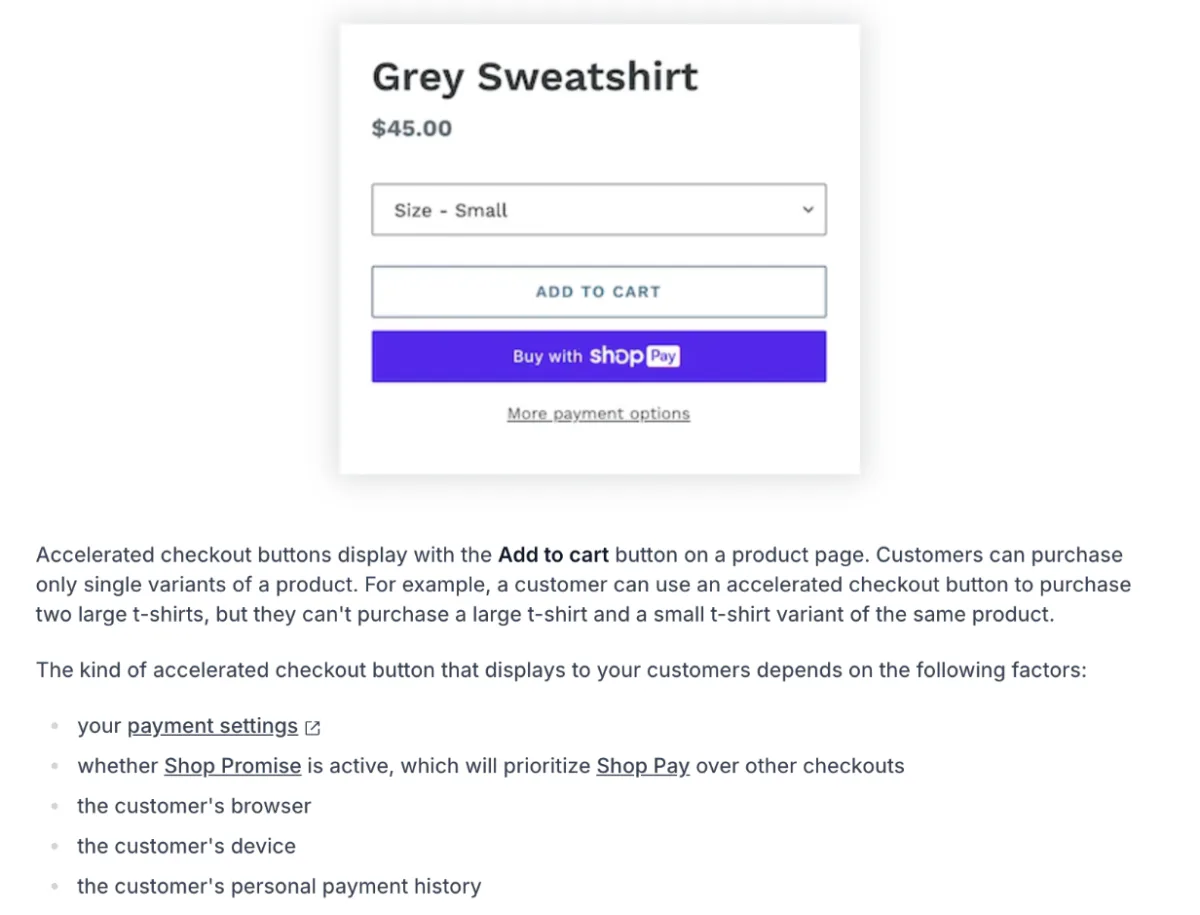
You can restyle the plain Buy it now button, but not branded buttons such as PayPal and Shop Pay. PayPal Wallet brings Venmo with it for US shoppers who have the Venmo app, and switching Venmo off takes a request to Shopify Support. Inside Shop Pay itself, PayPal never appears, in any region.
Should you offer both Shop Pay and PayPal?
Keep both on, then check your store against the cases below. You pay each one only on its own orders, and Shopify warns that hiding express checkouts might lower your conversion rate.
| If your store | Weigh this |
|---|---|
| Sells many orders under $20 | PayPal's 49¢ takes a bigger share of each one |
| Sells to shoppers paying in other currencies | PayPal's conversion fee is 3%, against 1.5% on Shopify Payments |
| Often refunds part of an order after a complaint | A disputed PayPal order can only be refunded in full |
| Ships orders of $750 or more | PayPal Seller Protection covers an item-not-received claim on them only with signature confirmation |
| Sells digital products or offers pickup | Shopify Protect covers neither, and PayPal covers digital goods only under its own rules |
| Has shoppers who pay with Venmo | Venmo comes with PayPal Wallet in the US |
From Shopify's Help Center, read November 11, 2026, and its US pricing page as archived November 9, 2026.
Paying over time is a separate product, covered in Shop Pay Installments.
FAQ
Questions, answered
-

14-day free trial
Explore Sledge on your store before you decide to commit.
-

No credit card required
Start improving your store with no upfront commitment.
-

Setup in minutes
Get Sledge running without a lengthy setup process.
-

Built to grow sales
Turn shopper behavior into actions that help you sell more.
Is Shop Pay cheaper than PayPal?
Per order, usually yes, at Shopify's US rates. On Basic, a standard card through Shop Pay costs 2.9% + 30¢ and PayPal starts at 3.49% + 49¢, so a $60 order costs $2.04 against at least $2.58. A business card or American Express through Shop Pay costs 3.5% + 30¢, which narrows the gap on that order to 18¢.
Does Shopify charge a fee on PayPal orders?
Not while Shopify Payments is your main provider: Shopify exempts PayPal from its third-party transaction fee. In the US, PayPal runs inside Shopify Payments, so that is the usual case. If another provider is your main one, you pay Shopify's third-party fee, set by your plan, on top of PayPal's own rate.
How do I add PayPal to my Shopify store?
In the US, it comes with Shopify Payments as PayPal Wallet, managed in the Shopify Payments section of your payment settings. Outside the US and France, Shopify opens a PayPal Express Checkout account with your email. To finish it, go to Settings, then Payments, click "Setup incomplete", the note next to PayPal under Additional payment methods, then "Complete setup".
Why does a PayPal order say payment pending?
On PayPal Express Checkout, it usually means the payment went to a PayPal account that wasn't verified when the order came in. Once you verify that account's email address with PayPal, the money can take up to two business days to arrive. Shopify advises checking that you've been paid before you mark the order as paid.
Is PayPal Seller Protection the same as Shopify Protect?
No. Shopify Protect is free for US stores on Shopify Payments and pays back fraudulent chargebacks on eligible Shop Pay orders. PayPal Seller Protection covers eligible PayPal orders against unauthorized payments and items not received. Both ask you to ship to the address on the order, with tracking or proof of delivery.
Can I refund part of a PayPal order?
Not once the shopper opens a dispute: Shopify's PayPal Wallet page says you can then refund only the full amount, and it sets no such limit before one. To close a valid complaint during the 20-day inquiry, a full refund is the route Shopify describes.
Picking how shoppers pay? Sledge works on what they buy.
Sledge doesn't process payments, add Shop Pay or PayPal, or change what either charges. It runs search, filters and pre-orders, and Shopify allows those pre-orders only on Shopify Payments or PayPal Express Checkout. Try it free for 14 days. Growth Intelligence turns on when you pick a paid plan, from $29.99 a month, and totals what its suggested fixes could add in one dollar figure, labeled Est. potential.