The 4 Ps of marketing are product, price, place and promotion, the four choices that make up a marketing mix. Product is what you sell, price is what shoppers pay, place is where they can buy it and promotion is how they hear about it. In a Shopify store, you set each one on an admin screen or two.
Say you sell stoneware mugs online for $20. Visits come in, sales don't, and you can't tell what's wrong: the mug, the price, where you sell it or how people hear about it. The 4 Ps split that one worry into four questions you can check.
What are the 4 Ps of marketing?
The 4 Ps are product, price, place and promotion, and each one answers a different question about what you sell.
| P | The question it answers | For the mug store | Where you set it in Shopify |
|---|---|---|---|
| Product | What do you sell, and why would someone pick it? | One stoneware mug in four glazes, gift-boxed | Products and Collections |
| Price | What do shoppers pay, and what do you keep? | $20 a mug, $15 for last season's glaze | A product's Price section, and Discounts |
| Place | Where can shoppers buy it? | The online store, Instagram, a weekend market | Settings, then Sales channels |
| Promotion | How do shoppers hear about it? | Posts, an email to subscribers, a launch code | Growth, and Discounts |
A 1960 marketing textbook is commonly credited with the list of four. The idea of a marketing "mix" is older, from a 1948 article.
What is the marketing mix?
The marketing mix is the set of choices you control to sell a product, and the 4 Ps are its most common version.
It's called a mix because the parts move together. Put last season's glaze on sale and the price falls, your margin shrinks and your promotion gets something new to say. Change one P without the others, and a sale can lose money or an ad can send shoppers to a channel that doesn't carry the product.
A $20 mug store and a subscription box won't share a mix. Once you know yours, an ecommerce marketing strategy puts it on a calendar.
Product: what do you sell, and why would someone pick it?
Product covers what you sell and why someone picks it: the item, its options, its packaging and how your range is grouped.
For the mug store, the product is one stoneware mug in four glazes, sold in a gift box. In Shopify, each glaze is an option on that one product.
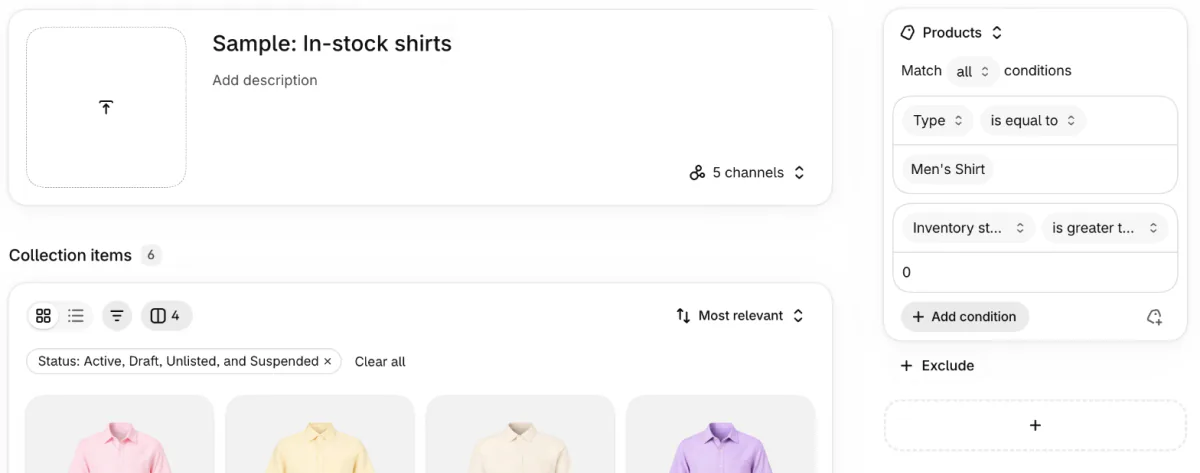
A collection groups your range, such as everything that makes a good gift. When you add a collection, "Add condition" sets a rule that picks the products for you, such as every product tagged "gift". The icon beside it, "Manually include products", lets you pick them by hand instead.
Why someone picks your mug over another is your value proposition. Say it on the product detail page. A mug and coasters sold as one set is a product bundle, another product decision.
Price: what will shoppers pay, and what do you keep?
Price is what shoppers pay and what you keep after costs, so check the margin before you set a sale.
Say each mug costs you $8 in clay, glaze, firing and the box, and you sell it for $20. On the product, click "Cost per item" and enter $8. The Price section then shows a profit of $12 and a margin of 60%. If your prices include tax, a taxed product doesn't show these two figures.
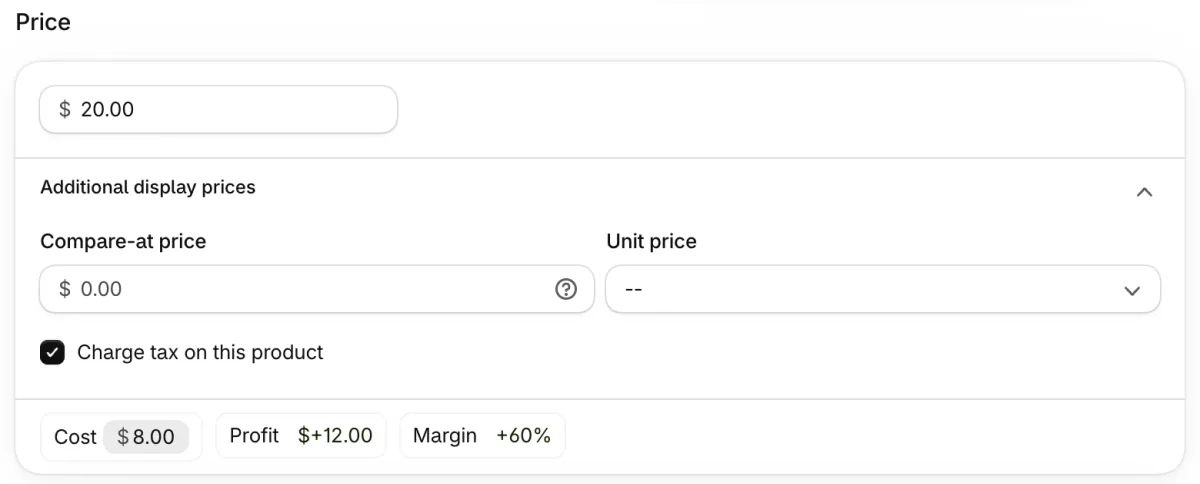
That 60% is margin, not markup, and markup vs margin explains the difference.
For a sale, put the original price in "Compare-at price" and the new one in Price. Both can show on product and collection pages, and checkout charges the sale price. Marked down from $20 to $15, last season's glaze is 25% off, and each sale still keeps $7, a margin of about 47%.
Shopify's own discounts cover an amount off, Buy X get Y and free shipping. For tiered discounts, where the price per mug drops again at each bigger quantity, Shopify's Help Center points you to apps. Sledge, a Shopify app, adds Volume Discounts, which show the tiers on the product page, such as 10% off at two mugs and 15% off at four.
Work out the margin at each tier before it goes live. At two mugs, each is $18 and keeps $10. At four, each is $17 and still keeps $9.
A heavy mug is expensive to ship, so build delivery into the price or into a free shipping threshold. Three ways to set a price have their own names: cost-plus pricing builds up from your costs, value-based pricing starts from what buyers think the mug is worth, and price skimming starts high and comes down later.
Place: where can shoppers buy it?
Place is every route from your shelf to the buyer: the channels you sell in, the countries you ship to and how orders arrive.
Say the mug store opens on its own website, adds an Instagram shop, then sells at a weekend market with Shopify POS. Each of those is a sales channel.
Every channel you add is listed in Settings, under "Sales channels". To add one, click that page's "Shopify App Store" button. The choices include social apps such as Facebook, Instagram and TikTok, plus Google, the Shop app and marketplaces such as Amazon and Temu. Your own website is the Online Store, and selling in person is Point of Sale.
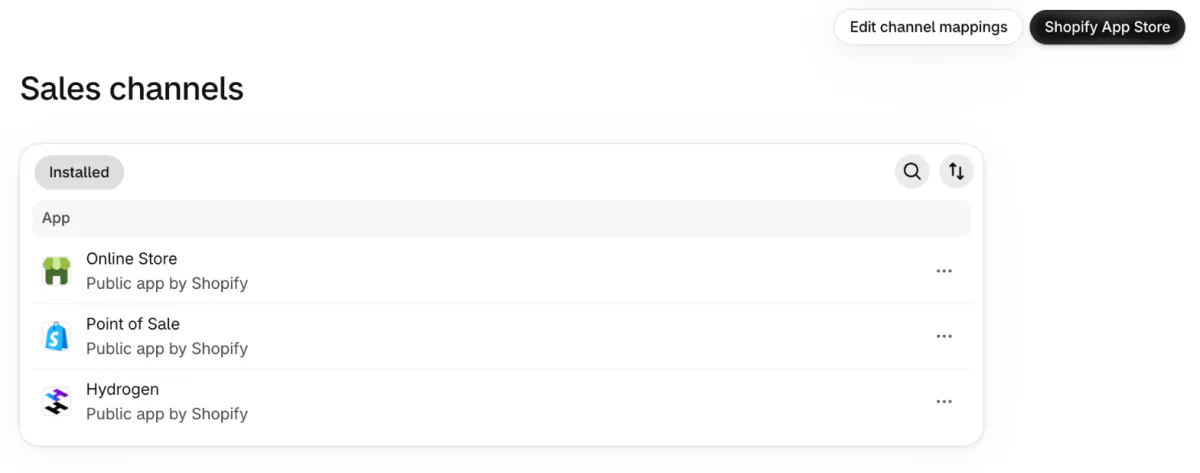
A new channel gets your whole catalog. To keep one product off a channel, switch that channel off in the product's "Publishing" section. Shopify Markets groups the countries you sell to into markets. Each market can have its own currency and language, and on some stores its own shipping.
Delivery is part of place too. Shopify shipping rates shows how to charge different shipping for heavy items like the mug.
One channel that sells beats three that don't. Add the next once the first brings in orders. Running several channels as one store is called omnichannel selling. For one channel at a time, see how to sell on Instagram, how to sell on TikTok Shop and Amazon vs Shopify.
Promotion: how do shoppers hear about it?
Promotion is how buyers learn the product exists and why to buy now: posts, email, ads, creators and sales.
Say the mug store plans a launch week: an email to subscribers, a few Instagram posts and a code for 15% off. A $20 mug then sells for $17.
In your Shopify admin, Growth is where you create campaigns, send email and SMS, and build sign-up forms. Shopify's marketing plan guide suggests you "develop a mix of channels".
For the code, open Discounts, choose "Amount off products" and set "Method" to "Discount code", the option for a code shoppers type at checkout. Then type LAUNCH15 as the code and pick 15% off.
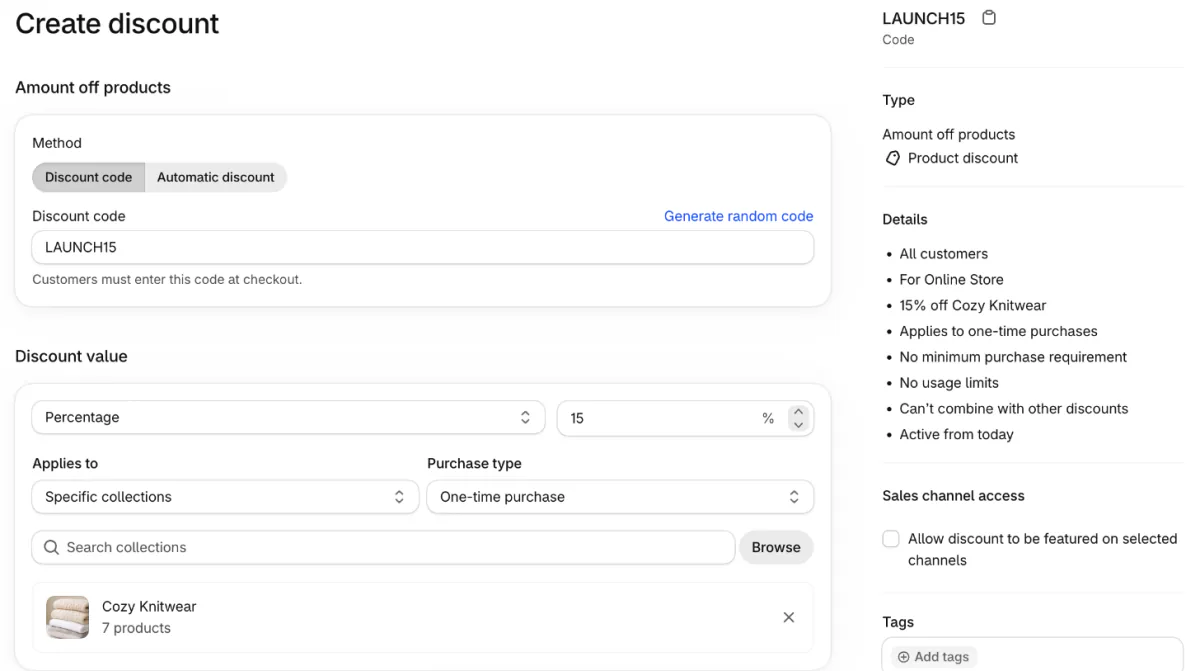
The 15% is a price decision. Telling people about it is promotion.
Your own pages can say when the offer ends. Sledge's Global Countdown puts one timer across the store, a Product Countdown sits on chosen product pages, and a Banner runs between the start and end dates you pick. All three are Sledge promotions. Keep the end date real: a timer that resets is what makes scarcity marketing fake.
For the email, Shopify email marketing covers setup and costs. How to create a discount code on Shopify walks through the other code types, and a content calendar spreads the posts across the weeks.
Which P should you fix when sales stall?
Change one P at a time, starting with the one your numbers point at, then measure again.
The 4 Ps matter because they turn one vague worry into four checks.
| What you see | Check this P first | Where to look in Shopify |
|---|---|---|
| Few visits from any channel | Promotion | Growth, then Attribution, and its "Top performing marketing channels" list |
| Visits, but almost no one adds to cart | Product, then price | The product's photos and options, and its price with shipping next to similar items |
| Orders arrive only with a code | Price | The "Sales by discount codes" report |
| One channel sells and the others don't | Place | A sales report by channel, under Analytics, then Reports |
| Carts and checkouts, but no orders | Price with shipping, then the checkout steps | Each step from cart to order, as in a sales funnel |
What are the 7 Ps and the 4 Cs of marketing?
The 7 Ps add people, process and physical evidence for services, and the 4 Cs restate the four from the shopper's side.
The three extra Ps came from a 1981 paper on services marketing. For an online store, people means whoever answers shopper questions. Process is checkout, delivery and returns. Physical evidence is your reviews, photos and packaging. Some guides stop at five Ps, adding people only.
The 4 Cs, from 1990, are the customer's wants and needs, cost, convenience and communication.
FAQ
Questions, answered
-

14-day free trial
Explore Sledge on your store before you decide to commit.
-

No credit card required
Start improving your store with no upfront commitment.
-

Setup in minutes
Get Sledge running without a lengthy setup process.
-

Built to grow sales
Turn shopper behavior into actions that help you sell more.
What is the marketing mix?
The marketing mix is the set of choices you control to sell a product. The common version has four parts, the 4 Ps: product, price, place and promotion. It's called a mix because the parts move together: a lower price changes your margin and gives your promotion something new to say.
What are the 4 Ps of marketing?
The 4 Ps of marketing are product, price, place and promotion. Product is what you sell and why someone picks it. Price is what shoppers pay and what you keep. Place is where they can buy it. Promotion is how they hear about it. In a Shopify store, you set each P on a screen or two in your admin.
What does place mean in the 4 Ps for an online store?
Place means where shoppers can buy your product and how it reaches them. For an online store, that's your sales channels, such as your own website, Instagram, a marketplace or a market stall, plus the countries you ship to and how orders get there. In Shopify, the Sales channels page in Settings lists where you sell.
When were the 4 Ps of marketing created?
The four-P list is commonly credited to a 1960 marketing textbook. The idea of a marketing mix is older: a 1948 article described marketers as mixers of ingredients. In 1981 a paper on services added three more Ps, and in 1990 the 4 Cs restated the list from the customer's side.
Is the marketing mix the same as marketing mix modeling?
No. The marketing mix is the set of choices you make about product, price, place and promotion. Marketing mix modeling is a statistical method that uses past sales and marketing spend to estimate how much each channel or tactic added to sales. It's often used to decide how to split an ad budget.
Which of the 4 Ps should a new store work on first?
Start with product and price, because promotion can't rescue a product nobody wants or a price that leaves you nothing. Add a cost per item in Shopify to see each product's margin. Then sell in one channel and promote it there, and open the next channel once the first one sells.
Shoppers found your store. What stops them buying?
Sledge doesn't set your prices, add sales channels or run your ads. Inside your Shopify store it runs search, filters and collection order, plus volume discounts, bundles, countdowns and banners. Try it free for 14 days. Growth Intelligence turns on when you pick a paid plan, and its suggested fixes add up to one dollar figure, labeled Est. potential.