What is conversion rate?
Conversion rate is the share of store visitors who complete a purchase, written as a percentage. Divide orders by sessions, then multiply by 100. If 1,000 people visit and 20 buy, the conversion rate is 2%. It is the single number that tells you how well your store turns traffic into sales, separate from how much traffic you have.
Example
Say your store gets 10,000 sessions a month and converts at 1.8%, so 180 orders. You can chase more traffic, which costs money, or lift the rate. Move it from 1.8% to 2.3% on the same 10,000 sessions, and 180 orders becomes 230. That is 50 extra orders from a better store experience. At a $45 average order, $2,250 a month from traffic you already paid for. If that traffic came from ads, your return on ad spend climbs with it.
That is why rate beats raw traffic for most stores: it compounds on every visitor you already have.
On Shopify stores
On a Shopify store, conversion rate shows in the analytics dashboard. It is one of eight ecommerce KPIs worth tracking, and one to check every week. Read it by stage, not as one number. The Shopify CRO guide walks each stage, from the first page a shopper lands on to checkout. A shopper converts from search, from a collection, from the cart. If carts are filling but checkouts are not, the leak is at checkout, not the product page. The friction hides in plain sight: search that returns nothing for a typo, a collection sorted worst-first, a sold-out bestseller. A Shopify store audit checks for all three in one afternoon. Fix the leak, not the average. When a setting won't close it, pick from the best Shopify apps to increase sales, sorted by leak. To prove a change raised your conversion rate, run an A/B test rather than comparing two weeks.
Conversion rate with Sledge
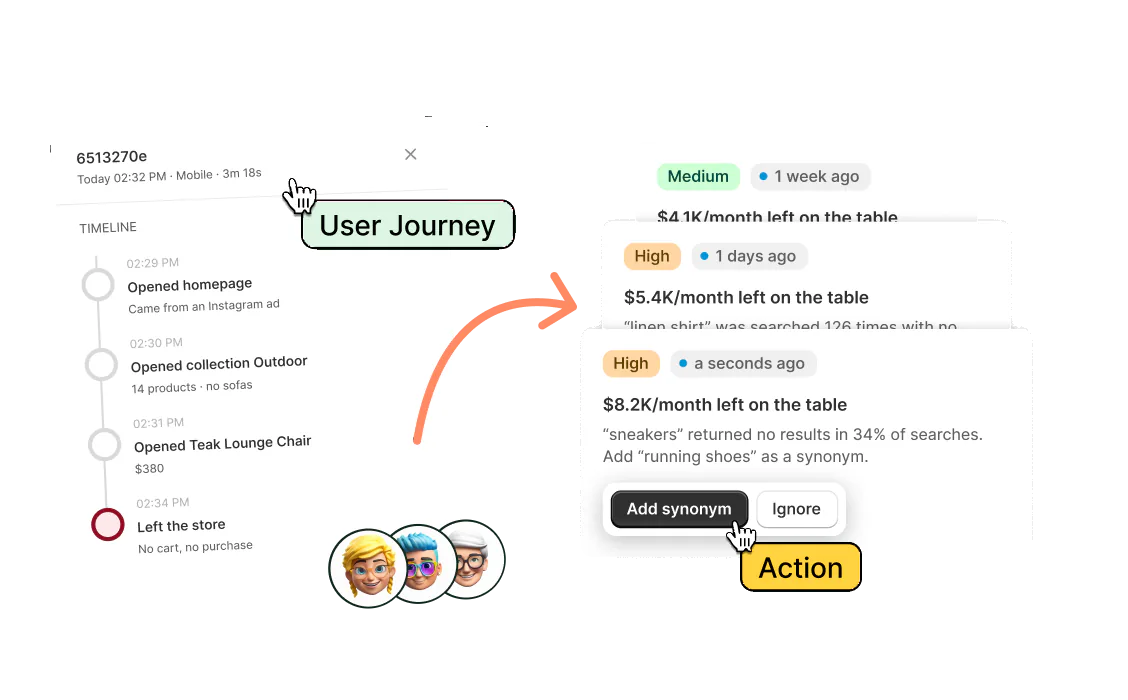
Sledge Analytics shows your store's conversion rate and what shoppers do on each kind of page, so you see where visits end without a sale instead of one blended number. On paid plans, Growth Intelligence goes past the chart: it names the leak, suggests the fix and shows one estimated dollar total for your fixes, then measures the result against real sales. Insights that tell you what to do. Not just what happened.