To start a jewelry business, pick one kind of jewelry and decide whether you make it or buy it wholesale. Price each piece from its metal, stones, findings, packaging and hours. Describe metals and stones the way the FTC's Jewelry Guides allow, register for sales tax where required, and list each piece with its sizes in your store.
Say your first 30 pieces are ready: sterling silver rings in six sizes, gold-plated studs and one $1,200 sapphire band. Three questions decide your first month. What may you call each piece? How does a shopper order a size you haven't made yet? And will the band arrive still insured?
What kind of jewelry business should you start?
Pick one kind of jewelry and one buyer, because the kind decides what you may call each piece and how you price it.
| Kind | What it's made of | Check first |
|---|---|---|
| Fine jewelry | Gold, platinum or sterling silver, with mined or laboratory-grown stones | The karat and stone wording, below |
| Plated and vermeil | A base metal or sterling silver under a layer of gold | That every listing says plated or vermeil |
| Fashion jewelry | Base metals, glass or resin | Any nickel-free claim your supplier can't back |
| Handmade or custom | Whatever you work in, often made after the order | How a shopper orders a size you haven't made |
Still weighing what to sell? Handmade goods are one of these 10 ecommerce business ideas.
Should you make your jewelry or buy it wholesale?
Make it if you have the skills, or buy it wholesale after you test samples.
Making it takes tools and a workspace with strong light, plus ventilation if you solder or polish, as GoDaddy's guide notes. Buying it means a wholesale marketplace or a manufacturer: order samples first, and repeat only the claims your supplier can back. A piece sold as nickel-free but made with nickel could become a customer relations and liability problem, Square's guide warns. A marketplace such as Etsy can run beside your store, and Etsy vs Shopify fees compares the two.
How much does it cost to start a jewelry business?
A home start runs about $300 to $600, by Craftybase's estimate, and soldering tools are a budget of their own.
| What you buy | Craftybase's estimate |
|---|---|
| Basic tools | $100 to $250 |
| Starter materials | $100 to $300 |
| Packaging for your first orders | $50 to $100 |
| Home start in all | $300 to $600 |
| Soldering tools, if you solder | $200 to $400 |
Figures from Craftybase, an inventory software company, read in November 2026.
A 2023 FitSmallBusiness guide gives a wider range, $600 to $29,000. The store itself is extra: Shopify's Basic plan is $39 a month, or $29 a month paid yearly, after 3 days free and 3 months at $1, as of November 2026. Shopify pricing lists every plan, and fixed vs variable costs shows which costs grow with sales.
How do you price jewelry so each piece makes money?
Add up the metal, stones, findings, packaging and your hours, then add your markup. GoDaddy's guide calls this cost-plus pricing.
Say a silver ring takes $9 of silver, stone and findings, $2.50 of box and pouch, and 30 minutes of your time at $20 an hour. That's $21.50. At $68, the ring leaves $46.50, a 68% margin before card fees and shipping. Markup vs margin shows why the same numbers give two percentages.
In Shopify, click "Cost per item" under the price, then type $21.50 in Cost, the field for what one ring costs you to make. The Price card then shows your profit and margin.
Buying finished pieces wholesale? Fine jewelry retailers may price at about three times wholesale cost, a rule called triple keystone pricing, per Shopify's own guide.
What can you call gold, silver or a diamond?
The FTC's Jewelry Guides set the words in your titles and descriptions, and they apply to a piece you resell as much as to one you make. The main ones, from the Guides' text:
- Gold. The word alone means 24 karat all the way through. An alloy puts the karat right before it, as in 14K gold or 14 karat gold.
- Plated. A piece with gold only on its surface must say so, with the plating's karat first, as in 14K gold plated.
- Sterling. "Sterling" or "sterling silver" means at least 925 parts silver in 1,000, the number behind a 925 stamp. A silver-coated piece says coated.
- Vermeil. Sterling silver coated with gold of at least 10 karat, at least 2.5 microns thick.
- Stones. A laboratory-grown or imitation stone carries a word that says so right before its name, as in laboratory-grown sapphire or simulated diamond. Disclose any treatment that isn't permanent, needs special care or changes the value a lot.
This summary is general information, not legal advice.
Do you need a license to sell jewelry?
There's no national jewelry license. Your state and city set the business rules, and sales tax has its own registration.
An LLC is optional at the start, though one keeps your personal and business liabilities apart, GoDaddy's guide notes.
To charge sales tax in a state, register with that state's tax agency first, per Shopify's Help Center. Then, in your Shopify admin, go to Settings, then Taxes and duties, open United States and add the state with its "Sales tax ID", the number the state issued you. Shopify doesn't file or pay the tax for you unless Shopify Tax is set to, as it is by default for some US stores opened after October 27, 2026.
Children's jewelry adds a federal rule. The CPSC caps lead at 100 parts per million in any part a child can reach, and the maker or importer certifies it with a Children's Product Certificate. Your state may add rules of its own.
How do you list rings, sizes and metals on Shopify?
Make one product per design, add a ring size option, and switch inventory tracking off when you make each ring after the order.
- In your Shopify admin, go to Products, then Add product. Type the title and price, and add your photos.
- In the Category field, type Rings and pick it from the list, so the field reads "Rings in Jewelry". Shopify then recommends options for rings, such as ring size and jewelry material. If you use Shopify Tax, the category also sets the product's tax rate.
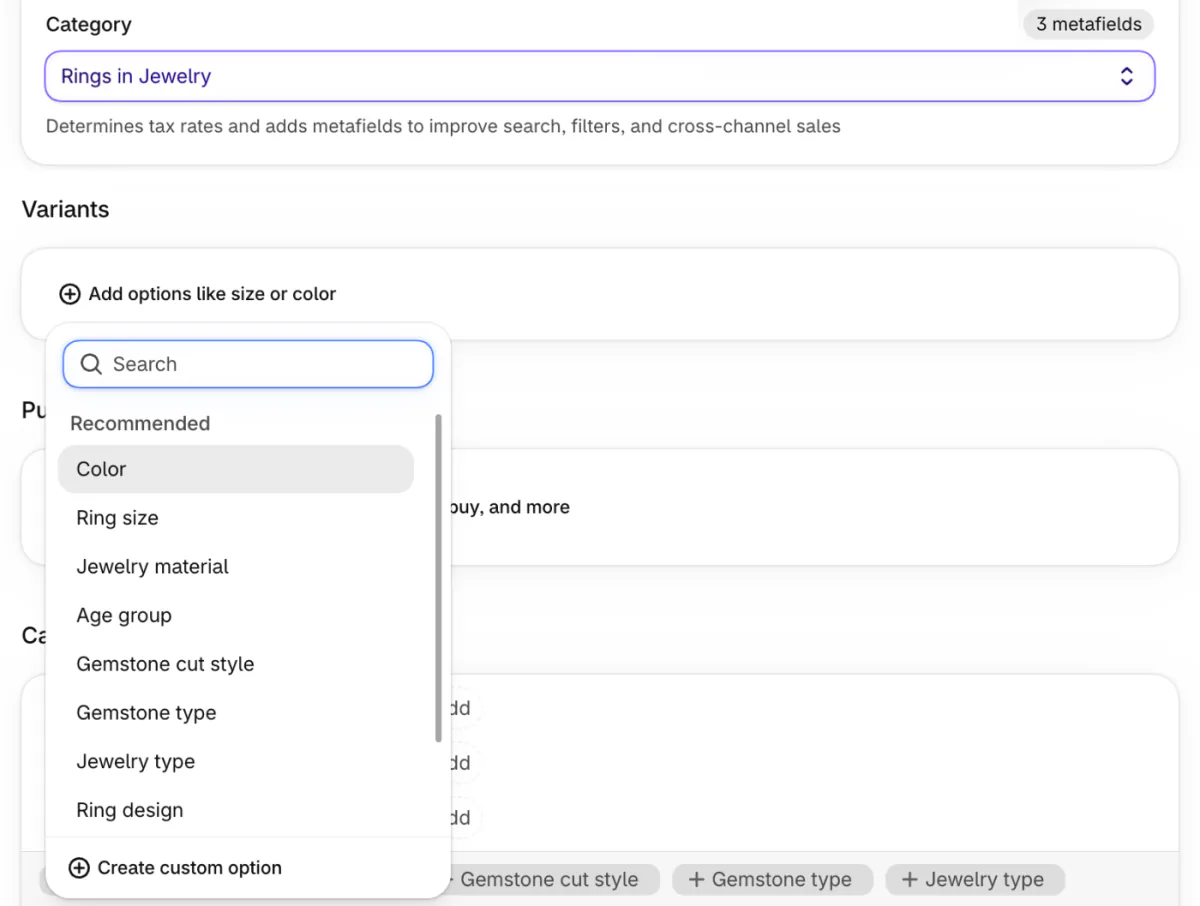
- Click "Add options like size or color", the button in the Variants card, and pick "Ring size" from the options Shopify recommends. Tick each size you make, such as 5 to 8, from its ready-made list of quarter sizes, and click Done. Shopify copies your price to every size.
- If one design comes in more than one metal, add "Jewelry material" as a second option, with one value per metal. A product takes up to three options and 2,048 combinations, per Shopify's Help Center.
- Making each ring after the order? In the Inventory card, switch off "Inventory tracked", the switch that keeps a stock count. It then reads "Inventory not tracked", so no size sells out. Shopify lists made-to-order products among those that may not need tracking. For rings already made, keep tracking on and type a count for each size.
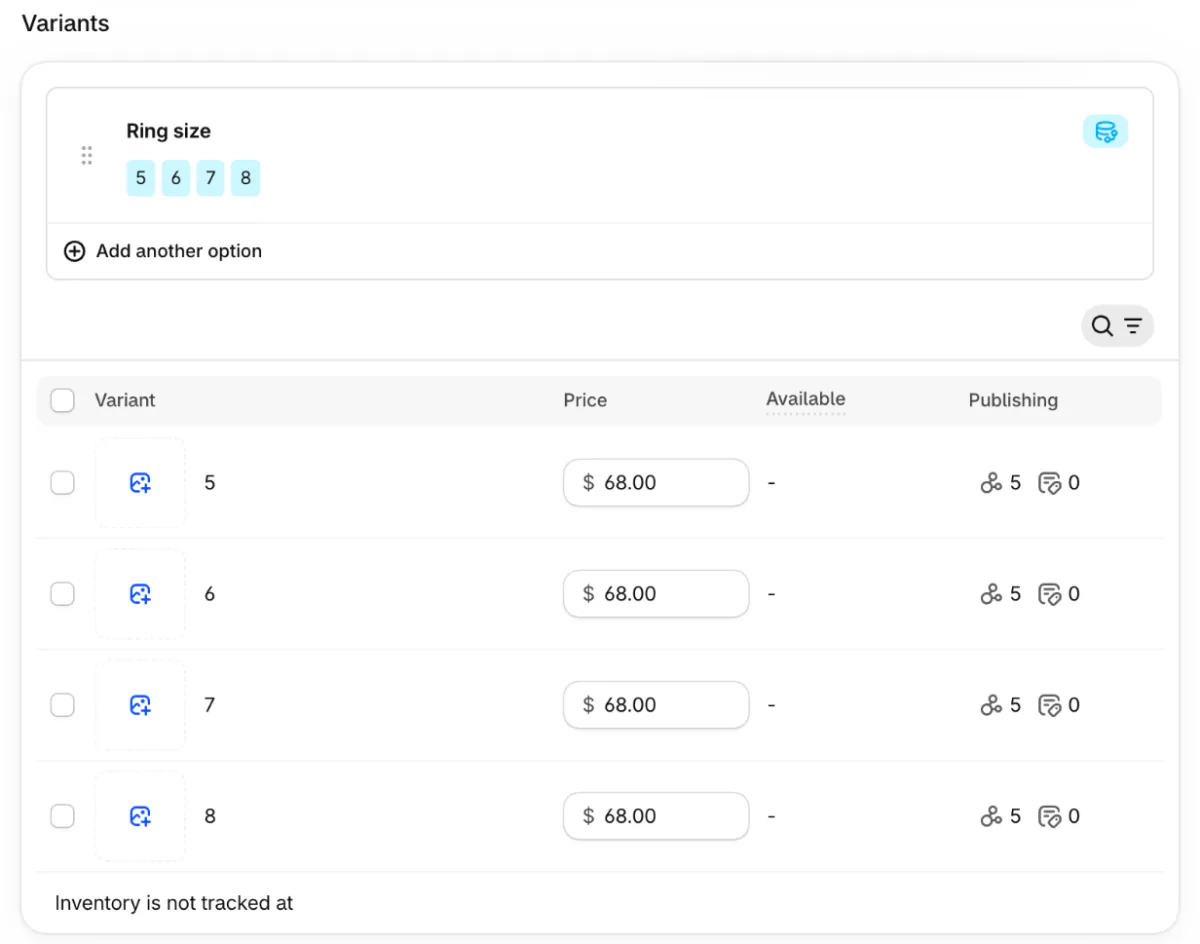
Give each metal its own photo. Each version of a product can show one of the product's photos, so a shopper who picks gold sees the gold ring. Shopify counts stock per size, so a one-of-a-kind ring offered in three sizes could sell three times. List a piece that exists once as one product with a stock of 1 and no size option. Shopify variants covers the limits.
How do you photograph jewelry for your store?
Small, shiny pieces need soft light, a plain background and a close-up. Plan four kinds of photo per piece: one on a plain background for the collection page, one worn for scale, one close-up of the clasp, stone or stamp, and one per metal, linked to that metal's version. Product photography covers the light setup and what a photographer costs.
How do you add jewelry filters for metal, stone and size?
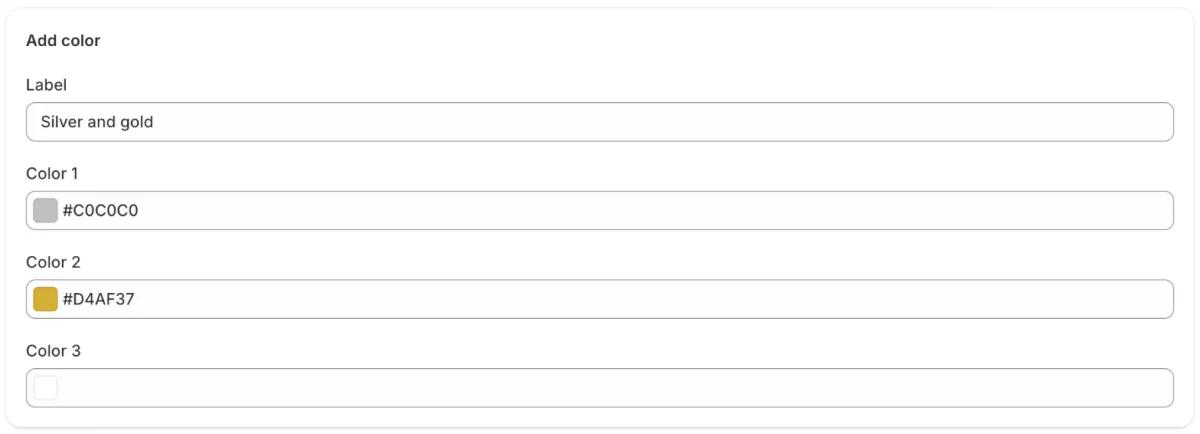
Let shoppers narrow your catalog by metal, stone and size. Shopify's free Search & Discovery app adds up to 25 filters to your store, including ones built from your product options and custom product details. It can show a swatch or a picture for each value when your theme supports it, per Shopify's Help Center.
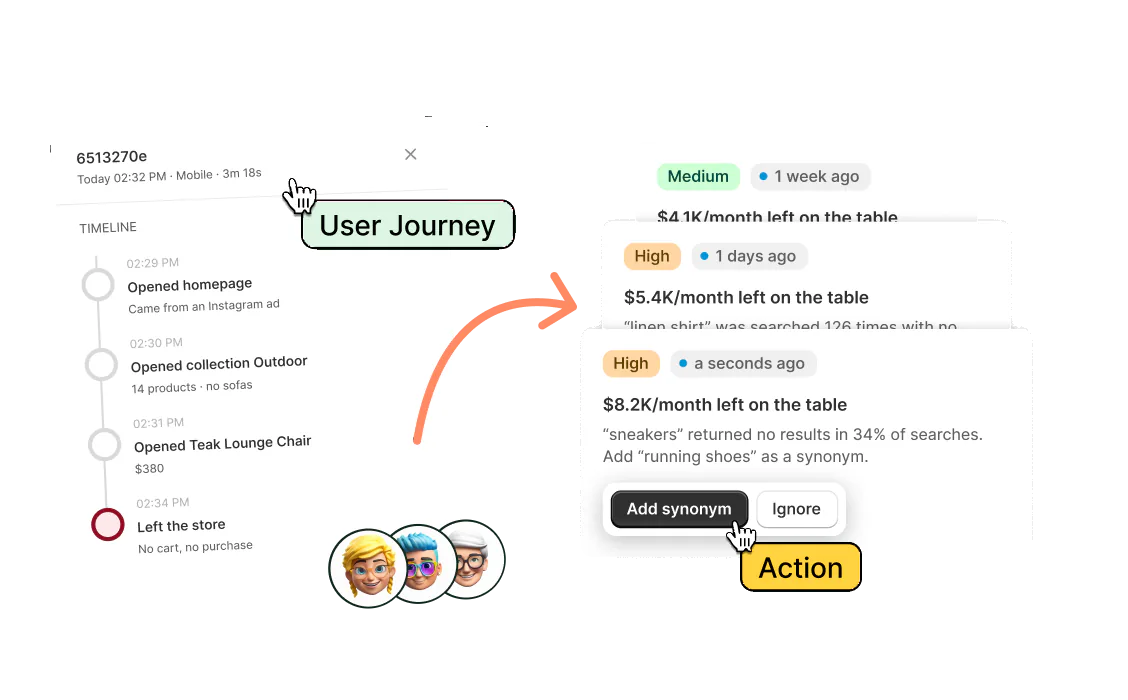
Sledge is a Shopify app for search, filters and merchandising. Its filters build from the same options and details, or from your collections and tags. Each metal or stone can show as a swatch: a dot of color, split in two for a two-tone piece, or a small photo of the stone. "Merge Value", the tool that folds similar values into one, turns "Sterling" and "Sterling silver" from two suppliers into a single choice. Its search can show your necklaces for "pendant" once you pair the two words under "Add manual synonym". Filters and search come with every paid plan, and you can try them free for 14 days.
Fill in the category's details, such as material, and Shopify's reports can split your sales by them, so you see which metal sells.
How do you ship jewelry safely?
Pack each piece in a small box inside a plain outer box, and insure what you can't replace.
- Keep your brand off the outside. Shopify's label insurance runs on Shipsurance's terms, which don't cover loss or theft when the outside names or hints at what's inside, branded boxes and branded tape included.
- Get a signature at $1,000 and up. Shipsurance's terms require signature confirmation on jewelry worth that much, inside the US and abroad.
- Insure labels you buy in Shopify. Cover goes up to $5,000, though Shipsurance caps it at $1,000 on economy services such as UPS Ground Saver. On Grow or a higher plan with Shopify Payments, each eligible label includes up to $200 of cover, and extra cover costs $0.89 per $100 within the US, per Shopify's Help Center.
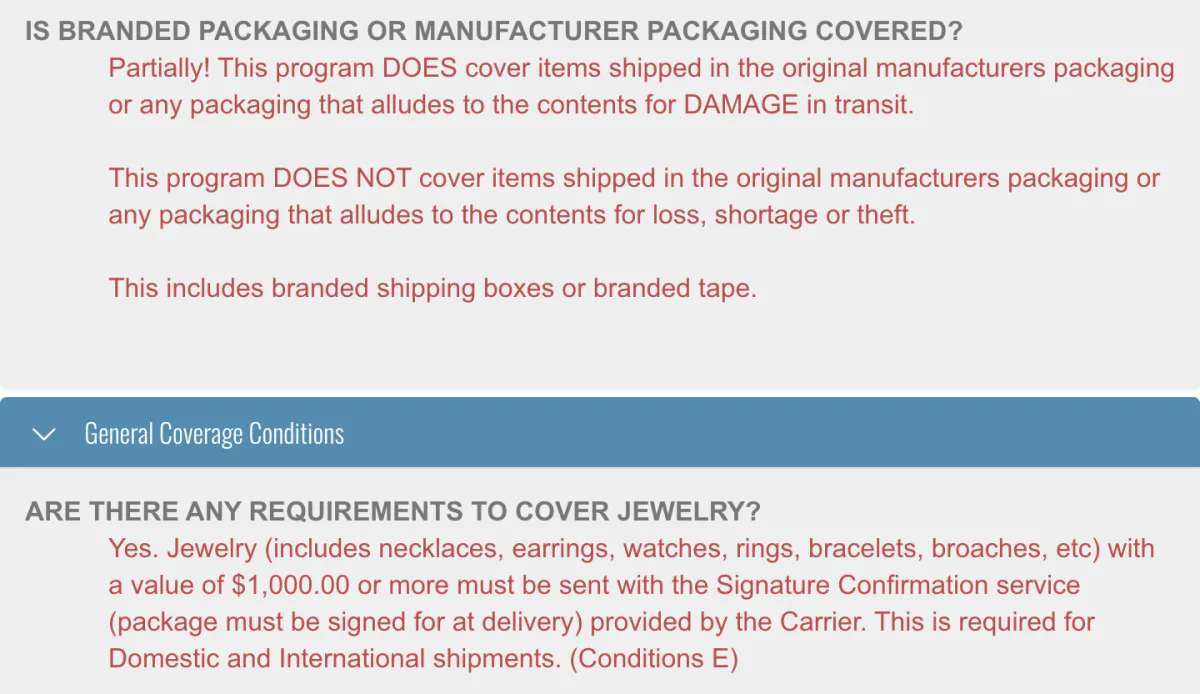
Back to the $1,200 sapphire band. Send it in a plain box with signature confirmation. Shopify's Basic plan includes no cover, so insuring it within the US costs about $10.68, twelve steps of $100 at $0.89 each. How to make a shipping label in Shopify covers the label itself, and a packing slip template covers what goes in the box.
How do you get your first jewelry sales?
Start where people already see your pieces, and keep every buyer's email.
- Post each piece worn, and tag it so a tap leads to the product, as how to sell on Instagram explains.
- Collect an email from the first sale, with Shopify's email tools.
- Send a launch email for each new collection, starting from these product launch email templates.
FAQ
Questions, answered
-

14-day free trial
Explore Sledge on your store before you decide to commit.
-

No credit card required
Start improving your store with no upfront commitment.
-

Setup in minutes
Get Sledge running without a lengthy setup process.
-

Built to grow sales
Turn shopper behavior into actions that help you sell more.
How much does it cost to start a jewelry business?
Craftybase puts a home start at $300 to $600 for basic tools, first materials and packaging, with soldering tools a separate $200 to $400. A 2023 FitSmallBusiness guide gives a wider range, $600 to $29,000. A Shopify Basic plan adds $39 a month, or $29 a month paid yearly.
Do you need a license to sell jewelry?
It depends on your state and city, so check both before your first sale. If you must charge sales tax in a state, register with its tax agency, then add your sales tax ID in Shopify under Settings, then Taxes and duties. An LLC is optional at the start. This is general information, not legal advice.
Is a jewelry business profitable?
It can be, if each price covers every cost. FitSmallBusiness puts the historical average gross profit margin for a jewelry business at 43% to 47%. Shopify's keystone pricing guide notes that fine jewelry retailers may price at about three times wholesale cost. Count your hours, packaging and card fees in each price.
Can you call gold-plated jewelry gold?
Not on its own. The FTC's Jewelry Guides treat the bare word gold as 24 karat, want the karat in front of gold on an alloy, as in 14K gold, and want a plated piece described as plated. Vermeil means sterling silver coated in gold of at least 10 karat, at least 2.5 microns thick.
How do you sell rings in different sizes on Shopify?
Add the ring as one product with a ring size option and one value per size. Shopify fills the same price into every size, and each size can keep its own stock. If you make each ring after it's ordered, switch inventory tracking off so no size sells out. A product takes up to three options.
How do you ship jewelry so it's insured?
Buy the label in Shopify and add insurance, up to $5,000, at $0.89 per $100 of cover on parcels shipped within the US. That insurance runs on Shipsurance's terms, which want signature confirmation on jewelry worth $1,000 or more and don't cover loss or theft when the outside of the parcel names or hints at what's inside.
Rings in three metals? Help shoppers find theirs.
Sledge doesn't make, appraise or ship your jewelry. It's a Shopify app whose filters can show each metal or stone as a swatch, a dot of color or a small photo, and whose search can show necklaces for "pendant" once you pair the two words. Try it free for 14 days. Growth Intelligence turns on when you pick a paid plan, and its suggested fixes add up to one dollar figure, labeled Est. potential.