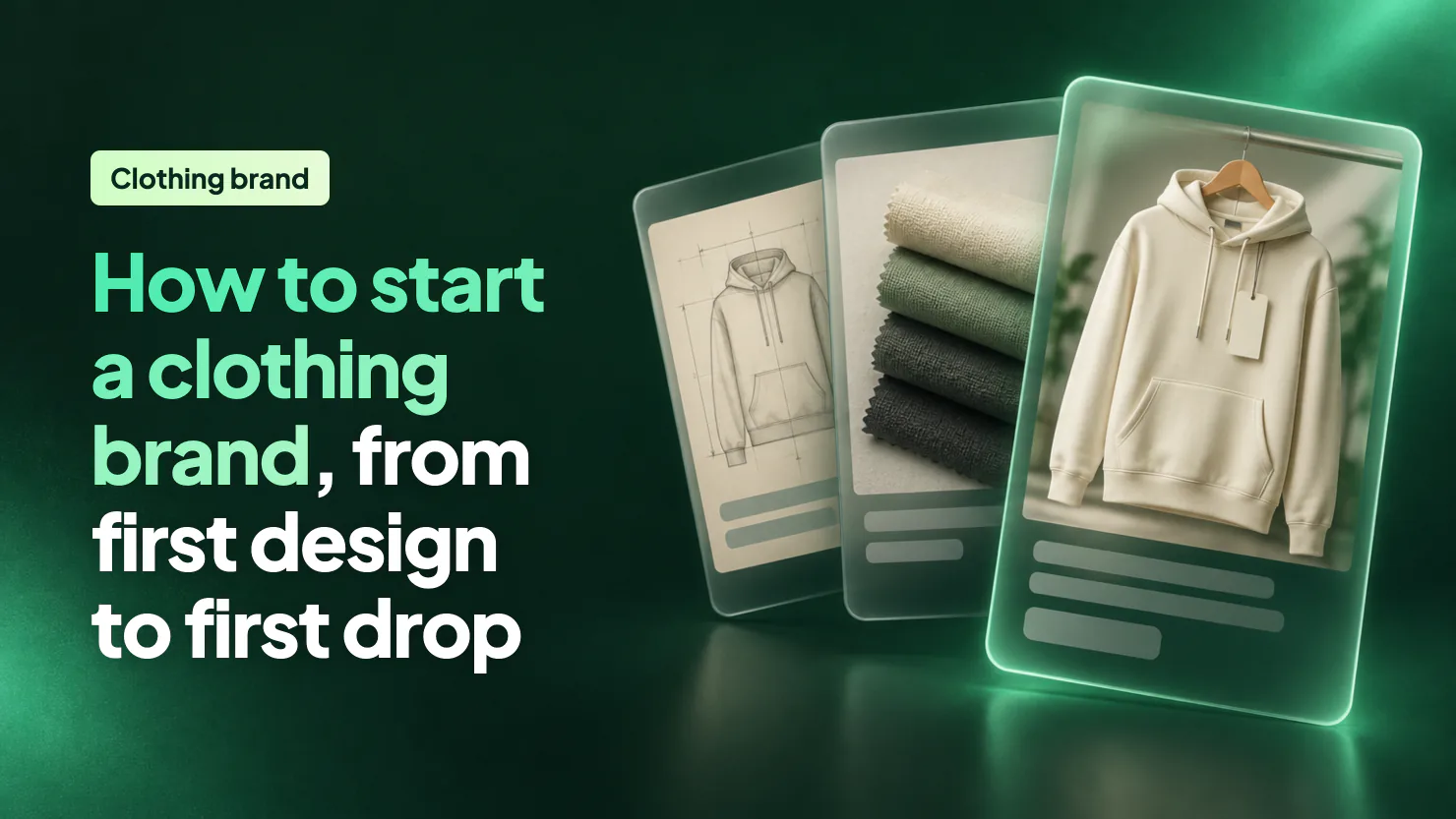
To start a clothing brand, pick who it's for and one first piece, then choose how it gets made. Write a tech pack, the spec sheet a factory sews from. Ask makers for their minimums and approve a sample before you pay for a run. Price each piece from its full cost, label it and pre-sell the first drop.
Say a factory quotes $22 a hoodie, with a minimum of 50 per color. Two colors is $2,200 before you've sold one, and the sample on your desk still pulls at the shoulder. The order of the next steps decides how much of that you risk.
1. Pick who it's for, a name and one first piece
Start with one group of people you can name and one piece they already buy. One hero piece in two colors keeps the first order small and still shows you which color sells. Check the name in the USPTO's trademark search before it goes on a label or a domain. If you're still deciding what to sell, weigh your own clothing line against nine other ecommerce business ideas.
2. Choose how your clothes get made
How your clothes get made decides what you pay before the first sale. Shopify's clothing brand guide names three models: hand production, a manufacturing partner and print on demand. Blanks you decorate sit between the last two.
| How it's made | What you pay before the first sale | The catch |
|---|---|---|
| You sew it yourself | Fabric, trims and your hours | Your sewing time caps how many you can sell |
| Print on demand | A sample or two, since each piece is printed after it sells | You pick from the supplier's garments, not your own pattern |
| Blanks you decorate | A box of blank tees or hoodies, plus the printing | The wholesaler's policies decide whether your label can replace theirs |
| A factory, cut and sew | Samples, then a full minimum run | The most cash out before a sale, for your own pattern under your private label |
Shopify's guide warns that a factory run means "high upfront costs to meet minimums". The steps below follow that route, since it's where most of the money goes before a sale.
3. Write a tech pack before you talk to a factory
A tech pack is the spec sheet a factory sews from. It usually holds drawings of the front and back, measurements for every size, the fabric, trims, stitching, colors and where each label goes. With one in hand, every factory quotes the same garment.
A vague tech pack gets you a wrong sample, and you pay for every new round. Maker's Row, a site that matches brands with US factories, puts each round at $50 to $300. You can fill one in yourself in a free spreadsheet, which Maker's Row counts as $0. A freelance designer can draw it instead, for a fee.
4. Find a manufacturer and ask five questions
Ask every factory the same five questions, in writing, so their quotes line up.
- What's your minimum per style, and does each color count on its own?
- How much is one piece at that minimum, and at double it?
- What does a sample cost, and does the fee come off the first run?
- How long is your lead time from an approved sample to a finished run?
- How much do you want up front, and when is the rest due?
Maker's Row puts small-batch minimums at 50 to 100 units, usually counted per style, so three styles at 50 each is 150 pieces. It also says factories tend to want 30% to 50% up front and the rest before the run ships.
To find a local factory, where you keep some oversight, Shopify's guide points to sourcing sites such as Maker's Row. Factories there bid on a project you post for free, and a paid plan lets you contact them directly, the site says. An overseas factory is completely hands off, in the guide's words. Once you choose, put the quantity, price and ship date on a purchase order before you pay.
5. Order samples and fix the fit
Approve a sample before you pay for a run. Measure it against the tech pack, wash it once and wear it for a day. Then have someone in each size try it on, since a fit that works in M can pull at the shoulder in XL. Maker's Row says most designs need 2 to 3 rounds. If you can sew, Shopify's guide suggests making the first samples yourself, because it helps you negotiate with factories.
6. Price it and split the first run by size
Price from what one finished piece costs you, then split the run by size. Say the hoodie costs $22 from the factory and $4 more for labels, freight to you and a bag, so $26 lands on your shelf. At $65, each sale leaves $39, a 60% profit margin before shipping, card fees and returns. That $39 is the piece's gross profit. Divided by the $26 cost instead of the $65 price, it's a 150% markup, and markup vs margin covers the difference.
In Shopify, enter $26 as the product's "Cost per item", the field for what one piece costs you, and Shopify shows the profit and margin beside the price. Each size takes its own cost, and how to sell clothes online shows that screen.
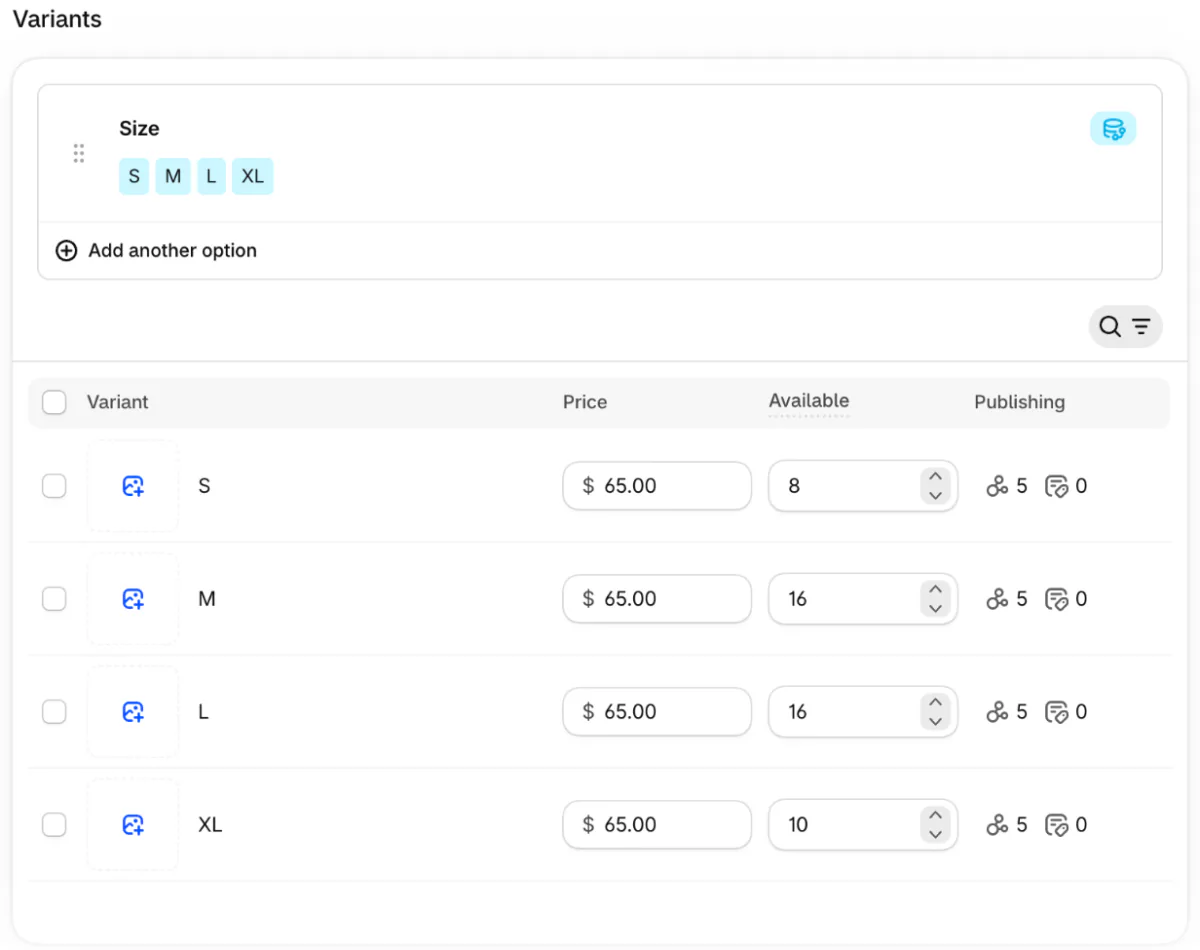
The factory usually counts its minimum per style, but Shopify counts stock per size. Say your 50 black hoodies come as 8 S, 16 M, 16 L and 10 XL. In the product's Variants card, add Size as an option and pick the four sizes from the list Shopify offers. Then type each count in the "Available" column, the stock you have to sell in that size, and give each size its own SKU. The size nobody buys turns into dead stock, so lean the run toward the middle sizes until your own sales show the real split.
7. Put your label on it, and the label the law asks for
In the US, the FTC wants a garment's labels to show fiber content, country of origin, your company name or an RN, and care instructions. An RN is a number the FTC issues, and its textile labeling guide says you don't need one to do business. Under the Care Labeling Rule, care instructions must stay attached and readable for the garment's useful life. Country of origin must also show in online ads, so put it in each product description.
On blanks, the FTC lets you replace a required label only with one that repeats its fiber content and country of origin and carries your own name or RN. A barcode isn't among these requirements, and what a UPC code is covers when you'd add one. To protect the name, the USPTO's base fee to apply for a trademark online is $350 per class, per its fee schedule. This is general information, not legal advice.
8. Pre-sell the first drop, then launch
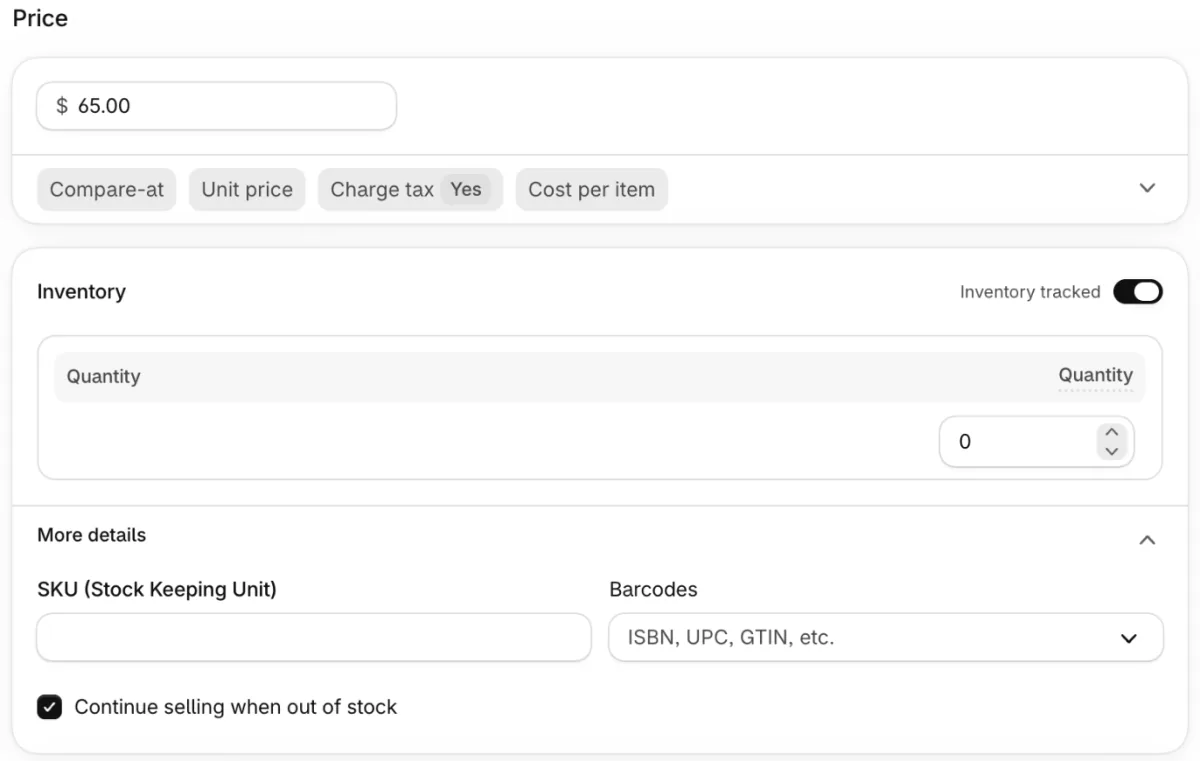
Orders taken before the run is made can pay for part of it and show you which sizes sell. Shopify's own route is "Continue selling when out of stock", the checkbox that keeps a product buyable after its stock hits zero. In the product's Inventory card, leave the "Inventory tracked" switch on so Shopify keeps counting stock. Then click "Sell when out of stock" and tick the one checkbox it opens. On a product with sizes, do this on each size. Shoppers see the usual buy button and pay in full, so write the ship date in the product description.
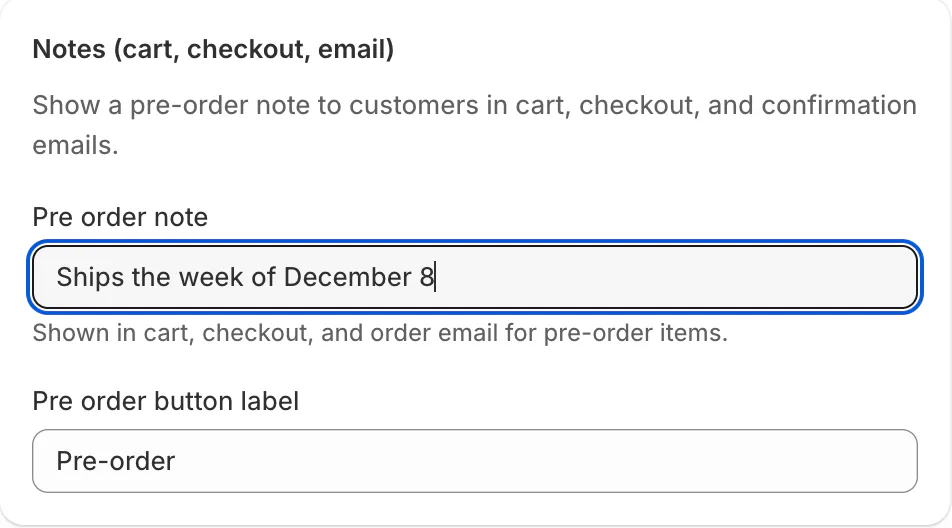
A pre-order with its own button and note needs an app. Pre-orders also work only for stores that take payments through Shopify Payments or PayPal Express, Shopify's Help Center says. A pre-order app such as Sledge keeps the products you pick on sale at zero stock, shows a "Pre-order" button and adds a note you write, such as the ship week, that shoppers see in the cart, at checkout and in the order email. Turning the pre-order off switches back only what it changed.
The FTC's Mail Order Rule asks you to ship within the time you state, or within 30 days if you state none. If you'll be late, ask buyers to accept the delay or cancel for a prompt refund. A pre-order is sold before the stock exists, unlike a backorder for an item you normally carry. The pre-order guide covers the setup in full.
The store itself, with sizes, a size chart, photos and returns, has its own guide: how to sell clothes online. Before the drop, run a giveaway to grow your list and find influencers who already wear your style. On launch day, send a product launch email.
What does it cost to start a clothing brand?
Shopify's guide expects a few thousand dollars upfront to make your own designs, and much less with print on demand. Say you make the two-color hoodie run from the top of this page:
| Cost | Example | Amount |
|---|---|---|
| Tech pack | You draw it yourself | $0 |
| Samples | 3 rounds at $150 | $450 |
| First run | 100 hoodies, 50 in each of two colors, at $22 | $2,200 |
| Trademark | Base fee for one class, filed online | $350 |
| Total | Tech pack, samples, first run and trademark | $3,000 |
Labels, photos, your Shopify plan and ads come on top. Maker's Row puts the bare minimum for samples and a first run at $850 to $5,400.
Can you start a clothing brand with no money?
You can plan one for nothing, but every sewn sample costs money, and four ways cut what you pay before the first sale.
- Print on demand. A supplier prints each piece after it sells, so you buy no stock. Starting a print on demand business covers the setup, and Printful vs Printify compares two suppliers on one tee.
- Pre-sell the first run. Maker's Row lists pre-orders among the ways to fund a first run, set up as in step 8.
- Crowdfund it. Shopify's guide suggests crowdfunding product runs, and on Kickstarter no one is charged for a pledge unless the project reaches its goal.
- Sew the first samples yourself. You skip the factory's sample fee while you test the fit and the look.
FAQ
Questions, answered
-

14-day free trial
Explore Sledge on your store before you decide to commit.
-

No credit card required
Start improving your store with no upfront commitment.
-

Setup in minutes
Get Sledge running without a lengthy setup process.
-

Built to grow sales
Turn shopper behavior into actions that help you sell more.
How do I start a clothing brand online?
Make or source the first pieces, then sell them from your own online store. On Shopify, add each style once with Size and Color as options, put a size chart next to the size picker and set your return rules before launch. How to sell clothes online walks through the store setup step by step.
Do I need a license to start a clothing brand?
It depends on where you sell. Shopify's guide says common needs include a permit to sell and collect tax, and in the US, garment labels must follow the FTC's rules on fiber content, country of origin and care. Check with your state and city before your first sale. This is general information, not legal advice.
What is a tech pack?
A tech pack is the spec sheet a factory sews from. It usually holds flat drawings of the front and back, measurements for every size, the fabric, trims, stitching, colors and where each label goes. With one, every factory quotes the same garment and sews a sample that matches it. You can draw and fill one in yourself.
What is a minimum order quantity for clothing?
It is the fewest pieces a factory will make in one order, usually counted per style, so ask whether each color counts separately. Maker's Row, a site that matches brands with US factories, puts small-batch minimums at 50 to 100 units. At $22 a piece, 50 hoodies in each of two colors is a $2,200 order.
How long does it take to start a clothing line?
Plan on months, not weeks. Maker's Row puts the path from idea to a garment ready for production at 4 to 6 months, most of it tech pack work and sample rounds, with the production run after that. Shopify's guide suggests having a collection ready at least six to eight months before the season it's for.
Can I put my own label on blank clothing?
Yes, if the supplier's policies allow it, Shopify's guide says. In the US, the FTC says a seller can't remove the required labels without replacing them, and the new label must repeat the fiber content and country of origin and carry your own company name or RN. Your brand can go on its own label.
Your first run isn't made yet. Can shoppers order it now?
Sledge doesn't design, source or sew your clothes. Its pre-order keeps the pieces you pick taking orders where your payment provider allows, with a "Pre-order" button and a note shoppers see in the cart, at checkout and in the order email. Try it free for 14 days. Growth Intelligence turns on when you pick a paid plan, and its suggested fixes add up to one dollar figure, labeled Est. potential.