
A Squarespace to Shopify migration moves your products and customers by spreadsheet. Main product pictures, reviews, pages, blog posts and your design stay behind, and old links need redirects. Export from Squarespace, fix a few columns, import into Shopify, rebuild the rest by hand, and connect your domain last.
Say you are switching from Squarespace to Shopify with 300 products, 80 blog posts and 120 reviews. You export the products and import them. The main pictures are missing, the reviews stayed behind and the blog never arrived. The steps follow Shopify's Help Center and Squarespace's help articles as they read on November 23, 2026.
What moves from Squarespace to Shopify, and what doesn't?
Products and customers move by spreadsheet. Main pictures, reviews, pages, blog posts and your design don't.
| What you have in Squarespace | Comes across? | What to do |
|---|---|---|
| Products with prices, stock, sizes, colors and tags | Yes, after column fixes | Export, fix, import. Squarespace exports up to 10,000 physical and service products. |
| Main product pictures, variant pictures and picture descriptions | No | Add them in Shopify after the import. |
| The other product pictures | As links, where the file lists them | Put one link on each row, and import before you cancel Squarespace. Shopify copies each picture during the import. |
| Customer names, emails and marketing choice | Yes | Fix the headings, add a country code column that Squarespace's file lacks, then import. |
| Customer notes and saved addresses | Notes no, one address at most | Squarespace exports only the address from each customer's latest physical order. |
| Order history | Not through Shopify's own import | Use a migration app, or keep Squarespace's orders file for your records. |
| Reviews | No | Squarespace can't export them in any format. Collect new ones. |
| Pages and blog posts | No | Squarespace's only file for them is made for WordPress, and Shopify can't import it. Copy them by hand. |
| Design and styles | No | Pick a Shopify theme. |
| Old page addresses | No | Add redirects before the domain moves. |
| Domain | Yes | Connect it or transfer it, last. |
Squarespace's product export names physical and service products only. Neither it nor Shopify's guide says what happens to downloads, gift cards or subscriptions, so look for each one in Shopify after the import. Whether to move at all is a different question, and Shopify vs Squarespace covers it.
From Shopify's guide to migrating from Squarespace and Squarespace's help articles on exporting products, site content, contacts and orders, and on reviews, read November 23, 2026.
In what order do you switch from Squarespace to Shopify?
Export everything while Squarespace is still live, build and check the new store while it is private, and connect your domain last.
- Keep Squarespace running. Squarespace says an expired site's content may already be deleted, so export before you cancel.
- Export from Squarespace. Products: open Products & Services, the panel that lists your shop, click Products, then Export all. Orders: click Orders in the same panel, then Export data. Customers: open Contacts, its three-dot menu, then Export all contacts. Keep every file as a backup.
- Fix the product spreadsheet. The seven fixes are in the next section.
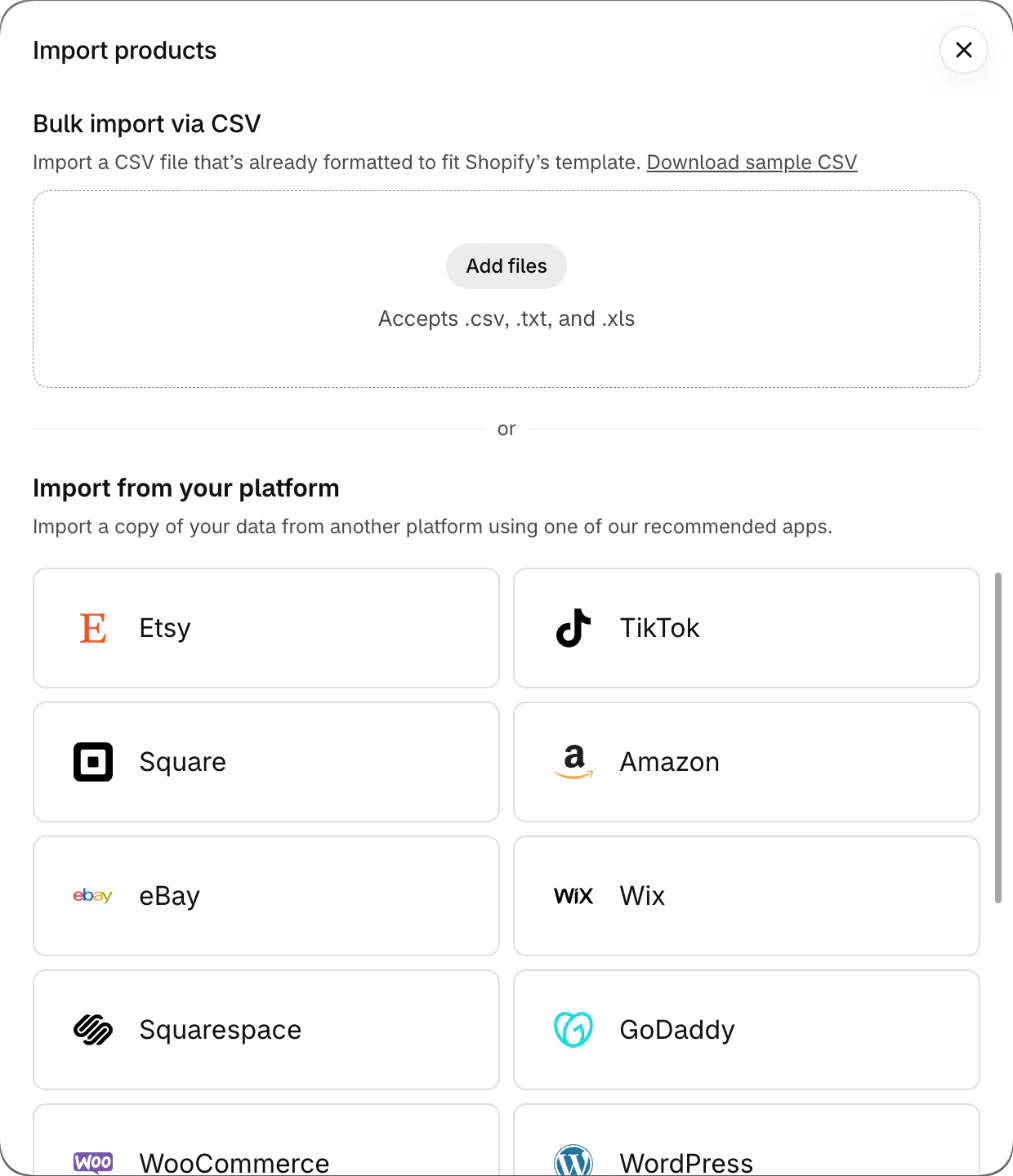
- Import products, then customers, then orders. Click Products, then Import, then "Add files", the button that picks your spreadsheet. Shopify's guide has you clear the "Publish new products to all sales channels" box, which starts ticked. Then import customers under Customers, then Import. Orders come last, so products and customers can connect to them. Staff who get new-order emails should switch them off first, because each imported order sends one. File limits are in how to import products to Shopify and how to import customers.
- Check what came in. Hidden products arrive unpublished, and a product missing a size or color isn't imported, so add it by hand. Add each product's main picture in the Media box on its page, as how to add products to Shopify shows.
- Rebuild by hand. Collections, pages, blog posts and a theme come next, as the section on rebuilding explains.
- Set up and test. Set up shipping, taxes and payments, then place test orders. Shopify keeps a new store private by default, hidden from visitors and search engines, so you can check it before launch. The Shopify password page covers that switch.
- Add redirects, then connect the domain. Both are in the section on old links and domains.
How do you export Squarespace products to Shopify?
Seven fixes turn the Squarespace file into Shopify's, and the sale price swaps two cells.
Open the file in Google Sheets or Excel. Squarespace says its export uses the same layout as its import file. Shopify's guide has you match the headings of its sample product spreadsheet and delete any column its own table doesn't mention, so keep that table open beside the file.
| Squarespace column | Shopify column | The fix |
|---|---|---|
| Product URL | URL handle, the end of the product's web address | Squarespace fills it on a product's first row only. Copy it onto every size and color row, so they import as one product. |
| Categories | Type | Squarespace writes each category as a path, such as clothing, then blouses. Keep the last word, Blouses, as the Type. To group products as categories did, add a Collection column with one name per product, and Shopify creates any collection that doesn't exist yet. |
| Weight | Weight value (grams) | Pounds times 453.6, kilograms times 1,000, with no decimals. 2 lb becomes 907. |
| Price, Sale Price and On Sale | Price and Compare-at price, the old price shown beside the new one | Where On Sale is Yes, move Price to Compare-at price, then move Sale Price to Price. A $50 item on a $40 sale becomes Compare-at 50 and Price 40. Delete the two sale columns. |
| Stock | Inventory quantity | Numbers only, for a store with one location. A cell that reads unlimited has no number to keep, so decide that count first. |
| Visible | Published on online store | Yes becomes true, and No becomes false. |
| Hosted Image URLs, Squarespace's column of picture links | Product image URL | One picture link per row. Each extra picture takes its own row that repeats the URL handle, so a product with three pictures takes three rows. |
Column names are from Shopify's guide to migrating from Squarespace. The $50, $40 and 2 lb examples are ours.
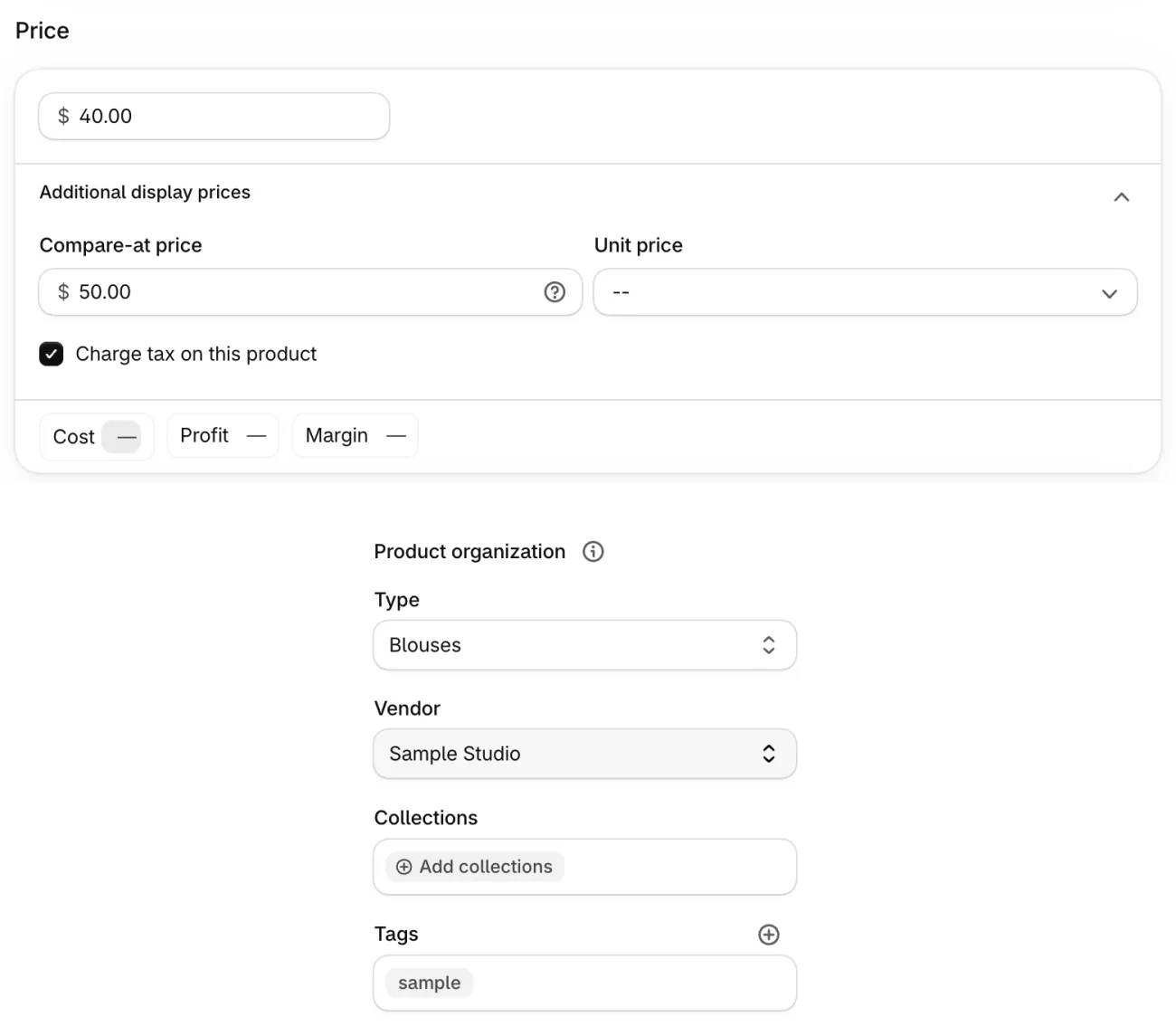
A new product form doesn't show Compare-at price at first. Click the "Compare-at" chip in the Price card to open the "Additional display prices" row, where Compare-at price sits. Type is in the Product organization card, and the separate Category box, which can fill itself in from the title, is a different field.
Two more sets of columns only need new headings. Default Vendor Name becomes Vendor, and Option Name 1 and Option Value 1 become Option1 name and Option1 value, with the same change for options 2 and 3. Title, Description, Tags and SKU need nothing.
Two of the columns the table leaves out are worth a note. Product Type isn't Shopify's Type, so delete it. If you use barcodes, move GTIN, a barcode number, into the barcode column instead of deleting it.
The upload itself is in how to import products to Shopify. Hiring a Shopify Partner is another route, and how to hire a Shopify expert covers when it pays. The Squarespace tile in the Import window opens "Import from another platform", a list of six recommended migration apps, each with an Install button. Shopify's guide recommends the spreadsheet where one is available. Shopify's free Store Migration app doesn't name Squarespace in its App Store listing, and the app isn't one of those six.
What do you rebuild by hand after the import?
Main pictures, reviews, pages, blog posts and your design are built again by hand.
- Pictures. The export leaves out featured images, variant images and picture descriptions. Upload each main picture in the product's Media box and write the descriptions again, and alt text examples shows what to write. Keep your original photo files, and if you don't have them, save the pictures from your Squarespace site before you cancel.
- Reviews. Squarespace says you can't export reviews in any format or move them to another site. Shopify's guide says to collect new ones with a review app, and some review apps import a spreadsheet you build yourself. Sledge's Product Review tool collects and moderates new reviews. It can't import old ones. How to get more reviews covers asking, and Klaviyo Reviews vs Judge.me compares two review apps.
- Pages and blog posts. Squarespace's file for them is made for WordPress and leaves out drafts, product blocks and every blog after the first. Copy short pages such as shipping and refund policies by hand, and ask a migration app whether it moves blog posts.
- Design and collections. Squarespace's style settings and any custom code you added don't export. Add a free theme from the Themes page or buy a paid one, and best Shopify themes helps you choose. If you didn't add a Collection column, build the collections that grouped your categories, as Shopify collections explains.
- Orders. Shopify's own import takes none. Its guide names EZ Importer as an example of an app that imports orders from a spreadsheet.
How do you keep your old links and domain working?
Shopify's page addresses likely differ from Squarespace's, so add redirects before the domain moves. Connecting the domain keeps it registered at Squarespace, and a transfer can take up to 15 days.
Shopify says old links to specific pages likely won't load, and its guide suggests setting up redirects in advance. Redirects sit under Content, then Menus, behind a "URL redirects" button that sends an old address to its new page. Before you cancel Squarespace, note the old addresses of pages that shoppers bookmarked or other sites link to. The steps and the spreadsheet import are in Shopify URL redirects.
If your domain is registered at Squarespace, you can connect it to Shopify or transfer it. To connect it, make the changes Shopify's connection guide lists at Squarespace, then open Settings, then Domains in Shopify and click "Connect existing". Shopify says connecting, unlike transferring, keeps the domain registered with Squarespace. You might need to disconnect the domain at Squarespace first, or you may see security-certificate errors.
Transferring has two limits. Squarespace can lock a domain for 60 days after you register it or change its contact details, and a locked domain can't be transferred. A transfer can take up to 15 days, Squarespace says, and your site stays on Squarespace until you cancel your Squarespace subscription separately. Change your Shopify store name or domain covers the Shopify side.
Which Squarespace details can your product filters use?
Sledge doesn't import anything from Squarespace, but the cells you fixed are what its filters read.
Sledge is a Shopify app for search, filters, reviews and Growth Intelligence. It has no history of your Squarespace site. Once your products are in Shopify, "Add filter item" in Sledge's filters opens a form with a "Source" list, the product details a filter can read.
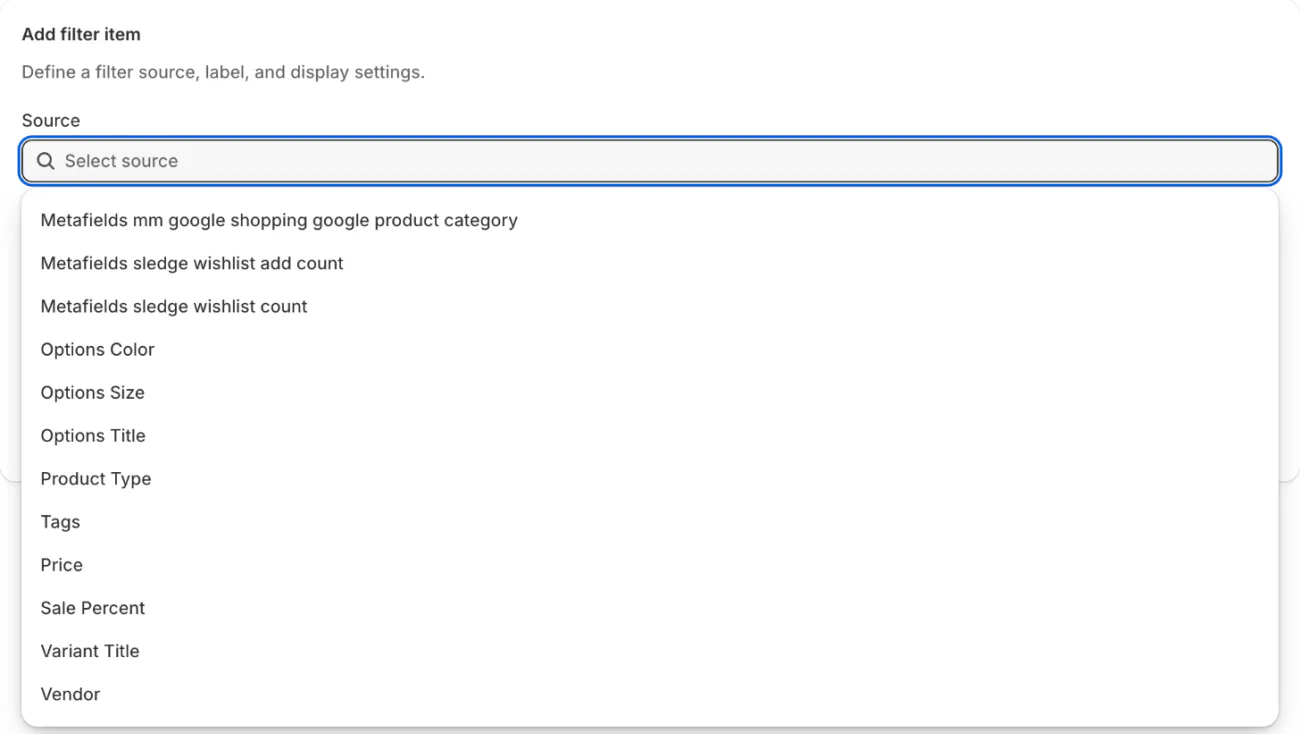
- Your Categories, fixed into Type, show as Product Type.
- Tags stay Tags, and Vendor reads your Vendor cell if you fill it in.
- Options named Size and Color show as Options Size and Options Color.
- Sale Percent is worked out from the old price in Compare-at price and the sale price in Price.
A product with no Compare-at price shows no sale, so a sale filter finds nothing on it. How to migrate to Shopify sets up search and filters from scratch on a new store.
FAQ
Questions, answered
-

14-day free trial
Explore Sledge on your store before you decide to commit.
-

No credit card required
Start improving your store with no upfront commitment.
-

Setup in minutes
Get Sledge running without a lengthy setup process.
-

Built to grow sales
Turn shopper behavior into actions that help you sell more.
What are the ways to do a Squarespace to Shopify migration?
Shopify's guide lists four ways, from least to most technical: copy and paste by hand, a spreadsheet import, a third-party migration app, or a Shopify Partner you hire. It recommends the spreadsheet where one exists. Apps and Partners set their own prices, and the guide points to an app for order history.
Can you move your Squarespace blog and pages to Shopify?
Not with a file. Squarespace exports pages and one blog only as a file made for WordPress, and Shopify can't import it. Copy pages and posts across by hand, or ask a migration app whether it moves blog posts. The export also leaves out drafts, product blocks and every blog after the first.
Do Squarespace reviews move to Shopify?
No. Squarespace says you can't export reviews in any format or move them to another site. Shopify's guide says to collect new reviews with a review app, and some review apps import a spreadsheet of reviews you type up yourself. Old star ratings don't carry over, so product pages start without them.
Why are product pictures missing after you import from Squarespace?
Squarespace's export leaves out featured images, variant images and picture descriptions, so each product's main picture has to be added in Shopify. The pictures it does list sit in a Hosted Image URLs column, and Shopify wants one link per row. Shopify copies each linked picture during the import, so import before you cancel Squarespace.
Does Shopify's Store Migration app work with Squarespace?
Shopify's free Store Migration app doesn't name Squarespace. Its App Store listing, read November 23, 2026, lists Square, WooCommerce, Etsy, Wix, Amazon, eBay, Clover and Lightspeed. The Squarespace tile under Products, then Import, opens six other apps. Shopify's Squarespace guide uses a spreadsheet. Orders need a third-party migration app or a developer, because Shopify's product and customer imports skip them.
How long does a Squarespace domain transfer take?
Squarespace says a transfer can take up to 15 days. Shopify says a domain must be at least 60 days past its registration, last transfer or a change to its registrar details, and each transfer includes a one-year renewal. To keep the domain at Squarespace, connect it to Shopify instead of transferring it.
Moved over? Let shoppers filter by what you fixed.
Sledge has no importer for Squarespace and no history from your old site. Once your products are in Shopify, you can build its filters from the types, tags, vendors and sale prices you just fixed, and its Product Review tool collects new reviews. Try it free for 14 days. Growth Intelligence turns on when you pick a paid plan, reads your new store's orders, searches, filters and carts, and its suggested fixes add up to one dollar figure, labeled Est. potential.