A shopper asks your store at 11pm whether the medium runs small, hears nothing, and buys the same hoodie from a store that answered. Conversational commerce means selling through conversations like that one, in chat on your store, in WhatsApp or a text, or through an AI assistant. On Shopify, the place to start is the free Shopify Inbox app.
You don't need every channel, and you may not need a paid one. Eight Shopify tools at their October 2026 prices, plus one sum, show when a paid chat earns its fee.
What is conversational commerce?
Conversational commerce is selling through a two-way conversation instead of a page the shopper reads alone. The shopper asks a question and gets back an answer, a product suggestion or a filled cart. Shopify's own definition names chatbots, messaging apps and voice assistants.
On a Shopify store it comes in four kinds.
- Chat on your store: live chat that you or your staff answer, and AI chat that answers on its own.
- Messaging apps and texts: WhatsApp, Instagram, Messenger and SMS.
- AI assistants off your store: ChatGPT, Microsoft Copilot, Gemini and the Shop app's AI agent, which can recommend your products.
- Conversational search: your search bar reads a whole sentence, one branch of AI search.
If a shopper can ask and get an answer before leaving, that is conversational commerce, whatever the app.
What do shoppers actually use it for?
To decide. Shopify said in 2023 that 70% of Inbox conversations are shoppers ready to buy.
They ask whether a size runs small, when a parcel will arrive, whether the black one is back, and which of two products to pick. "Where's my order?" comes after the sale.
Most answers come from pages you already have: Shopify's Inbox agent reads your catalog, policies, published pages and the facts you add.
A chat tool answers only as well as your product pages and policies are written.
Which conversational commerce platforms work with Shopify?
Start with Shopify's own three.
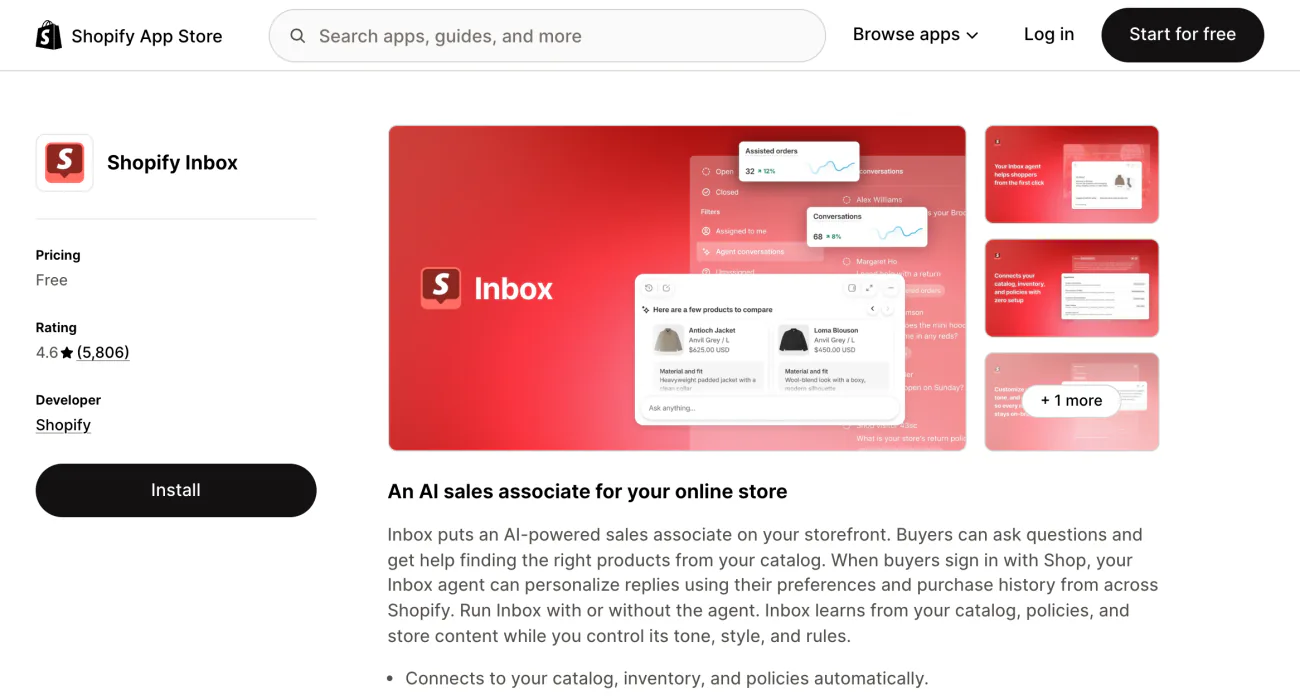
- Shopify Inbox is free chat on your store. Its optional Inbox agent answers questions, recommends products, adds them to the cart and replies in the shopper's language. Inbox needs the Basic plan or higher.
- Shopify Messaging, formerly Shopify Email, sends email, SMS and WhatsApp campaigns, and you pay per message.
- Agentic storefronts show your products inside ChatGPT, Microsoft Copilot, Meta, and Google's AI Mode and Gemini. They are on by default for eligible stores.
Sidekick is something else. It is Shopify's assistant for you, inside your admin, and Shopify's help page describes no chat with shoppers.
The apps below run by kind and cost, from what a small store tries first, not by rank.
| Tool | Best for | What it does | Price, Oct 2026 | Where it stops |
|---|---|---|---|---|
| Shopify Inbox | Every store on Basic or higher, as a first step | Chat on your store, with an optional Inbox agent that answers from your catalog and policies, recommends and adds to the cart | Free | A chat that starts before sign-in may leave you no way to reply; the agent needs new customer accounts and works only in your store's chat |
| Tidio | Trying AI chat on a small budget | Live chat plus the Lyro AI chatbot, with one inbox for email, Instagram, WhatsApp and Messenger | Free plan; Customer Service $29 a month for 100 conversations; Flows $29; Lyro AI $39 for up to 200 Lyro conversations | Chat, flows and AI are priced apart, so the plans stack |
| Gorgias | A support team with real ticket volume | A helpdesk with one inbox for email, live chat, SMS, social and voice, plus an AI Agent add-on | Starter $10 a month for 50 tickets, then $0.40 each; Basic $60 for 300; AI Agent charged per conversation it handles; 7-day trial | The bill rises with tickets and with every AI-handled chat |
| Rep AI | Steady traffic and a catalog that needs advice | An AI agent with live chat that opens a conversation when a shopper hesitates | Free for 100 visitors a month on up to 100 products, then $12 per extra 1,000 visitors; Starter $104 a month for up to 10,000 visitors | Priced by visitors, so a traffic spike costs more |
| Manifest AI | Stores ready to talk to a sales team | AI chat, a quiz, product recommendations and cart recovery | Free to install, a minimum 30-day free trial, then a month-to-month or longer agreement | No price listed |
| Shopify Messaging | Texts and WhatsApp on Shopify's own bill | Email, SMS and WhatsApp campaigns from your admin | First 10,000 emails a month free, then from $1 per 1,000; SMS $0.012 a message to the US plus $2.15 a month for the number; WhatsApp $0.106 a message to the UK | Campaigns, not a chat: customers can't text back to its toll-free number, and WhatsApp marketing can't go to US customers |
| Zoko | Customers who already shop on WhatsApp | Your Shopify catalog inside WhatsApp, where customers browse and buy | Starter $49.99 a month plus Meta's message rates and $0.015 a conversation; AI bots from $24.99 a month each; 7-day trial | Three cost layers, and AI bots cost extra |
| Postscript | US stores with an SMS list | Two-way texts; its Shopper feature answers questions, recommends products and sends 1:1 messages | Starter: a $49 monthly minimum spend, then $0.009 an SMS plus carrier fees; Growth $100 | The minimum spend runs even in a quiet month |
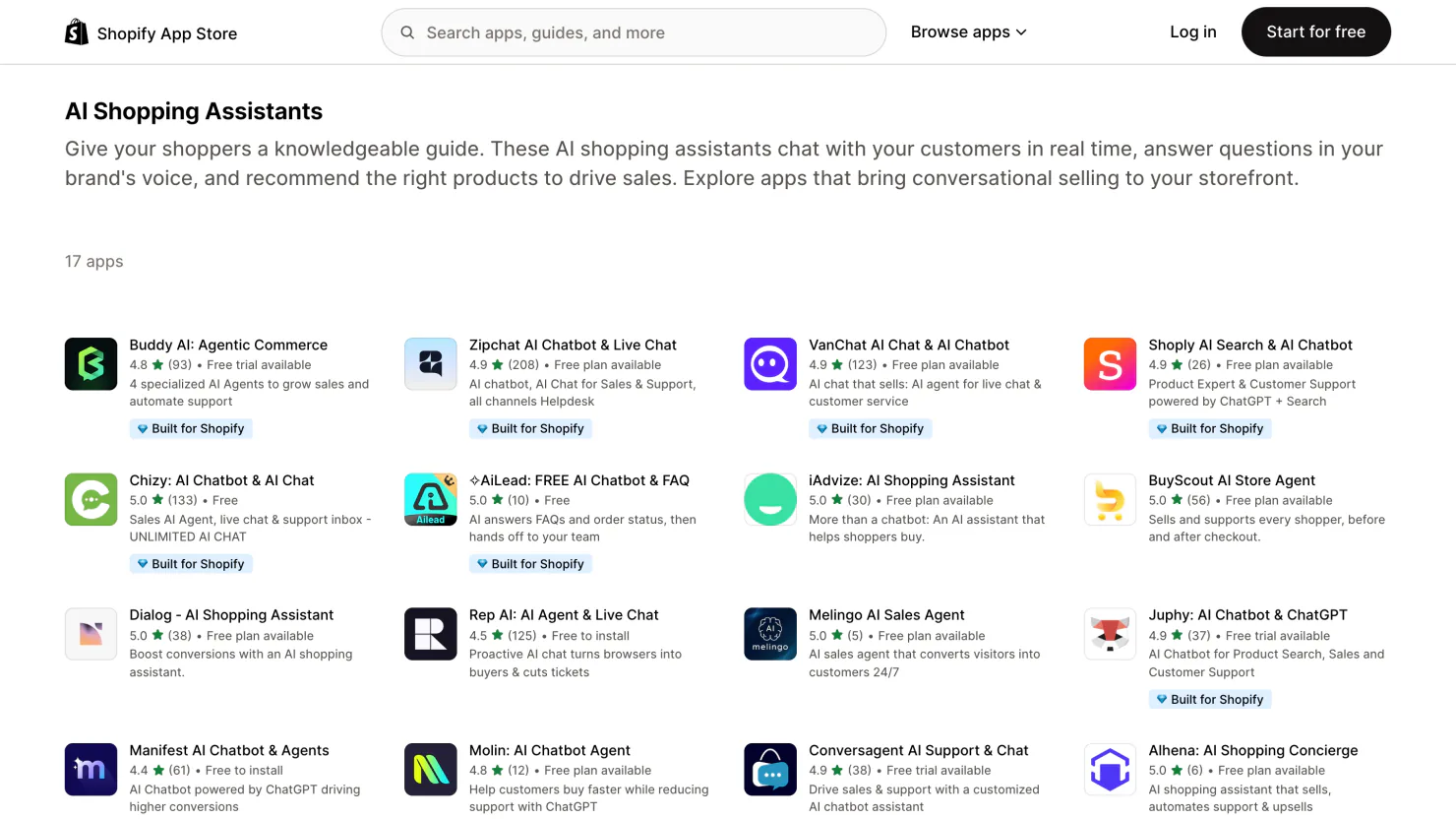
Prices as listed on the Shopify App Store and in Shopify's Help Center, October 2026. To compare more, Shopify's App Store keeps a shelf of 17 AI shopping assistants.
How much does conversational commerce cost, and when does it pay?
It can cost $0, since Shopify Inbox is free. The paid tools differ mostly in what they count.
- Per ticket: Gorgias, $0.40 each past the 50 on Starter.
- Per AI conversation: Tidio, $39 a month for up to 200.
- Per visitor: Rep AI, $12 per 1,000 past the free 100.
- Per message: Shopify Messaging, $0.012 a text to the US. WhatsApp replies inside 24 hours are free up to 1,000 a month, and since October 1, 2026, the rest are billed.
- Per contract: Manifest AI, with terms set after the trial.
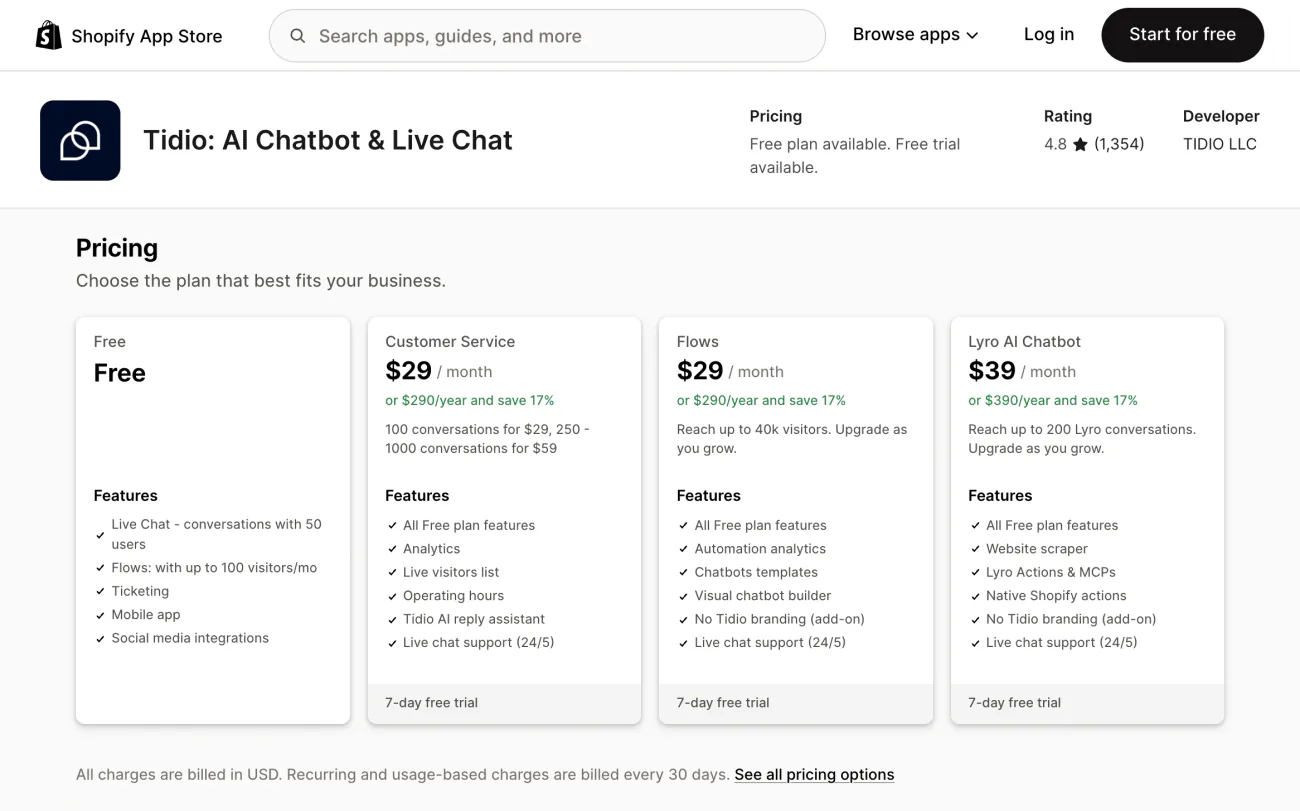
Run the sum with your own numbers. Say 3,000 visits a month, a $60 average order, and $24 of it kept after costs. Inbox costs nothing, so every sale it saves is profit. A $39 AI chat plan pays for itself at two extra orders a month, and a $104 plan needs five.
The bills that hurt grow with use. You open a helpdesk invoice for $1,000 and count fewer than 50 questions behind it. Or you buy a $59 chat plan and need an upgrade within a day, because chats, flows and support are priced apart.
A small store needs free chat and clear product pages first, and a paid AI chat only once it saves more orders than it costs.
How do you start with conversational commerce?
Five steps, all inside Shopify.
- Write the 10 answers you give most, on sizing, shipping, returns and stock, into your product pages and policies. The Inbox agent and AI channels read them.
- Install Shopify Inbox and add instant answers, the questions a shopper taps to see your ready-made reply. Up to 100 show in the chat. On a phone, check that the chat bubble doesn't cover your add-to-cart button.
- Decide who answers at night. Set the Inbox agent to "Only when your staff is unavailable", so it replies outside your availability hours. If you had Inbox before the agent arrived, the setting starts at Never, so the agent stays off until you change it.
- Make sure the chat collects an email before it reaches you, so you can write back after the shopper leaves.
- Read your chats every week and fix the page behind each question that keeps coming back. Do the same with searches that find nothing, which are the same questions, typed.
Step 4 is the costly one. A shopper asks about a jacket, the chat never asks for her email, and all you see is "Shop visitor", with no email or phone to write back to.
Shopify's help page calls the fix "Require sign-in to chat with staff", on by default with new customer accounts. A "Collect customer details" setting that can require a name and email is rolling out, Shopify says. Sign-in has a cost too: some shoppers leave at the six-digit code. If you keep chats open, ask for an email in your first reply.
Before you add any AI, make sure every chat leaves you a way to write back.
Add a second channel once the first one runs: texts in the US and Canada, WhatsApp elsewhere. Shopify Messaging texts are one-way, so for two-way texts you need an app such as Postscript.
What is the future of conversational commerce?
More shopping starts inside AI assistants. Adobe counted a 693.4% jump in traffic from generative AI tools to US retail sites over the 2025 holiday season, and adds that the group of shoppers using them is still modest.
Shopify's agentic storefronts already share your eligible products with those assistants, and each order shows in your admin with its channel. ChatGPT sends the buyer to your own checkout, with no fee beyond standard payment processing. In Copilot, Gemini and Meta, shoppers can pay inside the chat when direct checkout is on.
Support is moving too. In Gorgias's survey of 400 ecommerce decision-makers, AI already handles an average of 31% of customer interactions.
AI channels match a request typed in everyday words to your product descriptions, and more images help. Write product descriptions that answer the questions shoppers ask.
If you sell precise parts and fear an assistant will send shoppers to the wrong one, you can opt out. In Sales channels, then Agentic, turn off "Allow Shopify to manage for me", then "Shopify Catalog access". Sharing can take up to 7 days to stop, and your products can still be found through web crawling and in the Shop app. To hide one product from every AI channel, set its status to Unlisted, which also hides it from search engines.
Is conversational search the same as a chatbot?
No. A chatbot talks back. Conversational search reads the sentence a shopper types into your search bar and shows the products that fit.
Shopify's built-in search already matches by meaning, with nothing to switch on. Its own example finds red pumps for "christmas party shoes".
Sledge is a Shopify app for search, filters and offers, and its AI-Conversational Search takes the next step. "Black tee under $30" shows tees filtered to black and $30 or less. It picks only colors, sizes, brands and other filter values your catalog already has, plus the price the shopper typed. If those filters find nothing, the search runs again on the shopper's words.
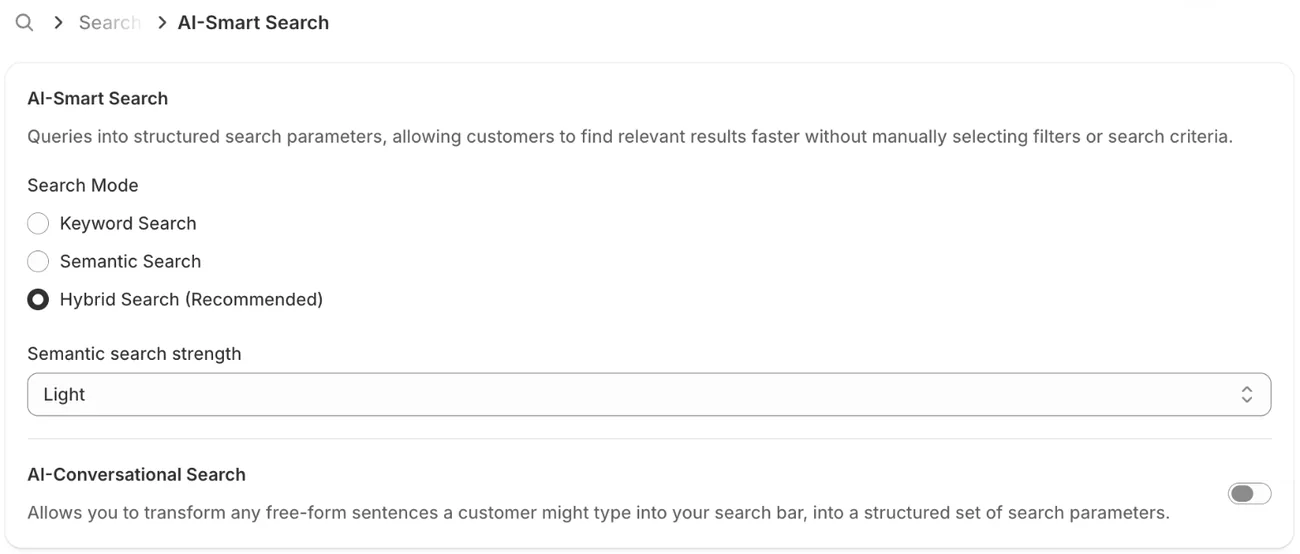
AI-Conversational Search stays off until you switch it on, under Search, then AI-Smart Search. Pro, at $29.99 a month, includes 2,000 of these searches a month, and past that, search keeps working on the words as typed. The 14-day free trial and development stores leave it off. Sledge reads a typed sentence into filters, and it doesn't chat with shoppers.
FAQ
Questions, answered
-

14-day free trial
Explore Sledge on your store before you decide to commit.
-

No credit card required
Start improving your store with no upfront commitment.
-

Setup in minutes
Get Sledge running without a lengthy setup process.
-

Built to grow sales
Turn shopper behavior into actions that help you sell more.
What is conversational commerce?
Conversational commerce is selling through a conversation instead of a static page. A shopper asks a question in chat on your store, in WhatsApp or a text, or in an AI assistant such as ChatGPT, and gets an answer, a product suggestion or a filled cart. On Shopify, the free Shopify Inbox app is the simplest place to start.
What is the difference between conversational commerce and social commerce?
Social commerce sells through social media: a post, a shop tab, a live stream. Conversational commerce sells through a two-way chat, which can happen inside a social app, such as an Instagram message, or on your own store and in text messages. Shopify draws the same line: messaging apps for one, social media for the other.
How much does conversational commerce cost for a small store?
It can start at $0, because Shopify Inbox is free on the Basic plan and up. Tidio's Lyro plan lists $39 a month for up to 200 AI conversations, and Rep AI's Starter lists $104 a month for up to 10,000 visitors. Campaign texts through Shopify Messaging cost $0.012 each in the US, plus $2.15 a month for the number.
Can an AI chat assistant give shoppers wrong answers?
Yes. It answers from your catalog, your policies and the facts you add, so a gap there turns into a vague or wrong reply. Shopify says you are responsible for what its Inbox agent tells customers. Fill in sizing, shipping and returns first, read real chats every week, and hand the hard questions to a person.
Can shoppers buy my products inside ChatGPT?
They can find them there. Shopify's agentic storefronts share eligible products with ChatGPT, Microsoft Copilot, Gemini and others, switched on by default. ChatGPT sends the shopper to your own checkout, needs a store that sells to US customers, and charges no fee beyond payment processing. With direct checkout on, Copilot and Gemini can finish the sale inside the chat.
Let your search bar read the whole sentence.
AI-Conversational Search comes with every paid plan, from 2,000 searches a month on Pro at $29.99. On those plans, Growth Intelligence can suggest switching it on when many searches that find nothing are typed as sentences.