Shopify Black Friday checklist 2026: what to fix
Part 1 of 10 in the Black Friday series
Summarize with AI
Black Friday 2026 falls on Friday 27 November and Cyber Monday on Monday 30 November. Count back from those two dates in weekly blocks, because the jobs have an order. Your product data has to be right before filters can read it, and the filters have to exist before anyone can narrow a sale.
Somewhere in your notes is a list of everything Black Friday needs. The sale collection, the offers, the search terms, the timers. No order to it, and no way to tell which line is safe to leave until November.
When does Black Friday prep actually have to start?
Eight weeks out, which for 2026 is the last week of September. Twelve weeks is better. That is arithmetic rather than advice. The storefront jobs depend on each other, so they cannot all happen at once in the final fortnight.
Two dates are fixed and you already know them. Three others matter more, and none of them is on a calendar yet: the day your catalog stops changing, the day your offers stop changing, and the evening you rehearse.
Shopify's own BFCM 2025 press release, published 2 December 2025, reported $14.6 billion in sales, up 27% year on year, with more than 94,900 stores recording their highest-selling day ever.
What order do the jobs go in?
In one chain, and it runs one way. Product data feeds search and filters. Search and filters feed the collection a shopper lands on. The collection carries the offers. The offers get rehearsed. Then the whole thing gets measured.
Every job in a Black Friday plan sits somewhere on that chain, and a job done out of order gets done twice. Build a filter before the fields behind it are filled and you rebuild it in November. Schedule an offer before the discount math is settled and you edit it live, at the worst hour of the year to be editing anything.
What goes in each week?
The same chain, cut into weeks: eight blocks counted back from 27 November. Each row carries one test rather than a task list, because a task list can be half finished and still look complete.
| Weeks out | Dates | What must be true by the end of it |
|---|---|---|
| 8 to 10 | Late Sept to early Oct | Every product in the sale set has a value in every field your filters and search will read |
| 7 | Mid Oct | The sale list is chosen and priced, and the margin at that price is written down |
| 6 | Mid to late Oct | Catalog values are frozen: one spelling, one casing, no blanks |
| 5 | Late Oct | Search answers the words shoppers type for a sale, not only the words on your products |
| 4 | Early Nov | The sale collection exists, and a shopper can narrow it to one product on a phone |
| 3 | Early to mid Nov | Offers are built and scheduled, and still sitting as drafts |
| 2 | Mid Nov | Gift entry points are live and reachable from navigation and from the search bar |
| 1 | 20 to 26 Nov | The rehearsal has passed on a real phone, and nothing new is being built |
Which decisions have to be frozen, and when?
Two of them, and both earlier than feels comfortable.
The catalog freeze stops your product data changing. Filters, swatches, and merchandising rules all read fields on your products, so a tidy-up in the third week of November silently changes what every one of them returns. Six weeks out is early enough that anything it breaks still has time to surface.
The offer freeze stops the discount math moving. A threshold you move after the offer is built is one nobody has tested at that number. Three weeks out, then build, schedule, and leave the offers as drafts until their start dates take over.
Late changes are what break launch night, and they break it quietly. Nothing errors. A rule starts returning a different set of products than the one you previewed.
Will your app plan cover a month like this?
Worth checking in September rather than on 28 November, because November is the month you are most likely to outgrow the plan you picked in March.
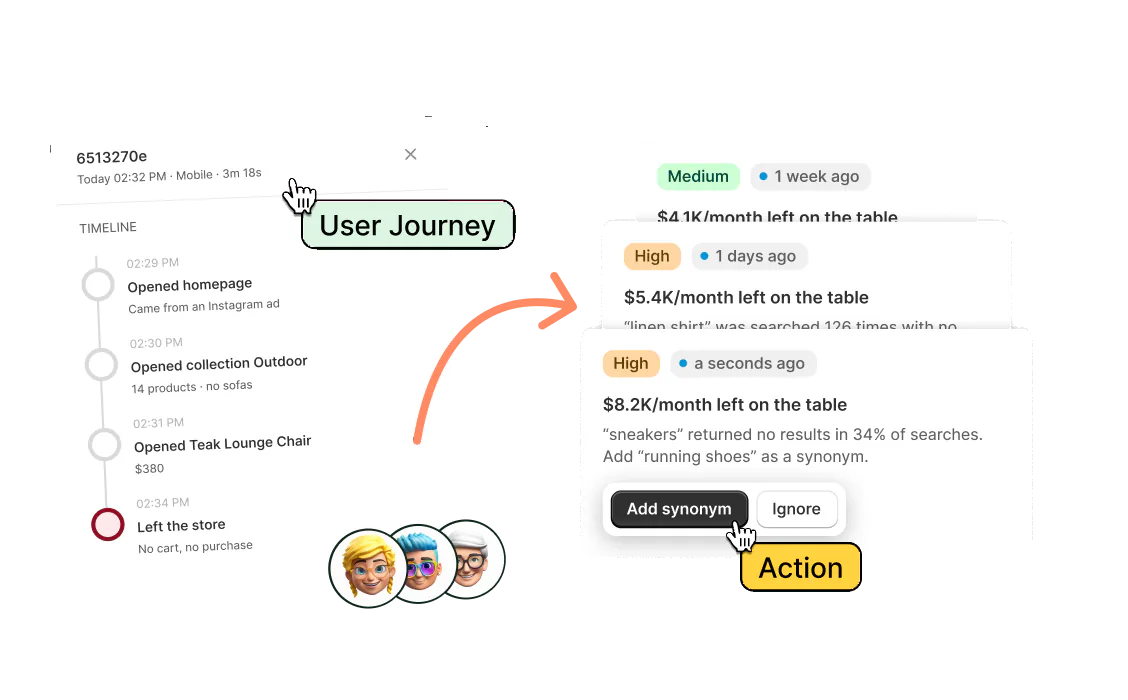
Sledge plans are flat and never take a percentage of your sales. Each one covers a Monthly Revenue Boost, the revenue Sledge is credited with adding in a month: $8,000 on Pro, $30,000 on Scale, $75,000 on Accelerate, $300,000 on Ultimate. Growth Intelligence is the advisor behind that number: it reads your orders and shopper behavior, then names a move with a dollar estimate attached. Past your cap, new suggestions wait for the next month while every storefront tool keeps running.
If you already run Sledge, pick your plan against the revenue it was credited with last November, not an average one.
What does the plan look like when it is working?
A quiet week, by the end. The week of 20 November holds a rehearsal and some watching. It does not hold building.
If you are still building that week, the plan slipped, and the table above shows exactly where. That is most of what a plan is for. It does not make the work smaller. It tells you early enough to move the offer build up a week, or drop the gift entry points instead of rushing them.
Growth Intelligence reads on a schedule, weekly on Pro, twice a week on Scale, daily on Accelerate and Ultimate. Start eight weeks out on a weekly read and it gets roughly eight passes at your store before the traffic arrives. Start two weeks out and it gets two.
Do this in one sitting, before any of it feels urgent
- Put both dates in the calendar. Friday 27 November and Monday 30 November, then mark the eight Mondays before them.
- Name one owner per week. Even if the name is yours eight times, an unowned week is the one that slips.
- Set the catalog freeze date, six weeks out, and tell anyone who edits products what it means.
- Set the offer freeze date, three weeks out.
- Check your app's revenue cap against your busiest month, or last November if you already run Sledge.
- Book the rehearsal for a weekday evening, not the night before.
- Decide now which two things you will change mid-sale, and which you will not touch while orders are flowing.
- Write the January date when you'll read this whole plan back against what actually happened.
FAQ
Questions, answered
-

14-day free trial
Explore Sledge on your store before you decide to commit.
-

No credit card required
Start improving your store with no upfront commitment.
-

Setup in minutes
Get Sledge running without a lengthy setup process.
-

Built to grow sales
Turn shopper behavior into actions that help you sell more.
When should I start preparing my Shopify store for Black Friday?
Eight to twelve weeks out, which for 2026 means the last week of September. The reason is arithmetic rather than advice: the storefront jobs depend on each other, so they cannot all happen at once in the final fortnight. Product data has to be right before filters can read it, and the filters have to exist before anyone can narrow a sale.
What date is Black Friday 2026?
Friday 27 November 2026. Thanksgiving is the fourth Thursday of November, which falls on 26 November, so Black Friday is the day after and Cyber Monday is Monday 30 November.
What should I fix first before Black Friday?
The product fields your sale will read. Filters, swatches, and merchandising rules all draw on values stored on your products, so a blank or a mis-spelled value quietly removes that product from the sale. Everything built later inherits whatever state those fields are in.
When should I stop making changes to my store before Black Friday?
Two freezes, both earlier than feels comfortable. Freeze catalog values six weeks out so filters and search stop moving underneath you. Freeze thresholds and discount math three weeks out, then build and schedule the offers as drafts. A threshold moved after the offer is built is one nobody has tested at that number.
Will my Shopify app plan cover a big sales month?
Check before the sale rather than during it. Sledge plans are flat and never take a percentage of your sales, but each covers a Monthly Revenue Boost: $8,000 on Pro, $30,000 on Scale, $75,000 on Accelerate, $300,000 on Ultimate. Past that ceiling, new Growth Intelligence suggestions wait for the next month while every storefront tool keeps running.
Is it too late to prepare for BFCM in November?
No, but the order of work changes. In November you stop building and start removing risk: rehearse what is already scheduled, check every start and end date against your store's timezone, and make sure the sale collection can be narrowed on a phone. Anything that needs a read before it earns, like an A/B test, has run out of runway.
Does this series cover email and ad prep too?
No. Every part covers what happens on your own store: catalog and product prep, search and merchandising, offers, rehearsal, live monitoring, and the read-back after. Email sequences and ad spend are separate work, worth planning on their own calendar alongside this one.
Your calendar has eight Mondays left.
Install free. By tomorrow, built-in Growth Intelligence reads your orders, searches, and shopper behavior, then names the moves worth making before 27 November with a dollar estimate on each.