Custom packaging is any box, mailer, tape, tissue or insert made or printed for your brand. To start, measure what you ship, add a printed label or card to plain boxes, then order a small run of printed boxes or mailers. Recycled cardboard and paper are common eco friendly picks, and a heavier box can raise a weight-based shipping rate.
Say you ship 100 orders a month in plain boxes at $0.40 each. Printed ones at $1.50 add $110 a month, and a heavier box can move an order into the next shipping bracket. Pick the type, the material and the size before you order.
What counts as custom packaging?
Custom packaging is anything that holds or wraps your order and carries your brand, from a printed sticker to a box built to your product's size. You can customize the print, the size or both. Only a supplier's quote gives you a real price.
| Type | What it is | Where it fits |
|---|---|---|
| Sticker or label | Your logo or name on a plain box | The cheapest start, with no minimum order |
| Printed tape | Branded tape that seals regular boxes and mailers | Any parcel that already ships in plain stock |
| Tissue or wrap | Printed or colored paper around the product | A gift look for a small cost |
| Insert | A thank-you card, flyer or care note | Any order; $0.05 to $0.50 each in one guide |
| Printed mailer or bag | A paper or plastic mailer with your print | Soft goods such as clothing |
| Printed box | A corrugated box printed to your design | Products that need protection; $0.10 to $10.00 each in the same guide |
| Rigid or paperboard box | A stiff, gift-style box | Gifts and high-priced products |
The two price ranges come from one fulfillment company's guide, published September 8, 2026. Match the type to what you sell: a mailer suits a shirt, and a rigid box suits a gift.
Print-on-demand apps pack for you, which our print on demand guide covers. A third-party logistics company packs for you too.
Which eco friendly packaging materials are worth using?
Recycled cardboard and paper are the usual picks, and every compostable or plant-based option has a catch. The table draws on a shipping guide contributed by a shipping company and the fulfillment guide above.
| Material | What it is | The catch |
|---|---|---|
| Recycled corrugated cardboard | Boxes made from up to 100% recycled material | It only counts where your buyer can recycle it |
| Paper fill, kraft paper and tissue | Replaces bubble wrap and plastic peanuts | It may protect heavy or sharp items less |
| Paper mailers | Light, and a favorite for apparel | Weigh and test one before you switch |
| Recycled or bio-based plastic mailers | Poly mailers made from those materials | The eco claim holds only for those materials, not standard plastic |
| Compostable mailers | Corn starch, compostable plastics such as PLA and PBAT, or recycled paper | Some compost only in a commercial facility, others at home |
| Molded pulp or starch fill | Pressed paper forms, and starch peanuts that dissolve in water | Starch and plant-based plastics cost land and water to grow |
Clothing is the common case. Shopify's Help Center puts most T-shirts and blouses at 8 to 16 oz, weights that ship in a poly mailer, a bubble mailer or a small box. Test a paper or recycled mailer as the swap, and weigh it first.
You can start with ready-made stock in an eco material and add print later. Use the smallest box that fits, because Shopify's Help Center says most carriers charge by size and weight. Fill the gaps with paper, and send one insert instead of three.
What can you say about eco friendly packaging without overclaiming?
Say what it is made of, not that it is "eco friendly". The FTC's Green Guides say a seller should not make an unqualified general claim such as "eco friendly" or "green".
A "recyclable" claim needs an established recycling program that reaches enough buyers, and without access for at least 60 percent of them it needs a qualifier. A "compostable" claim needs evidence that the package breaks down safely in a composting facility or a home pile.
"Made from 100% recycled cardboard" is a claim you can write, if your supplier states it in writing. This is general information, not legal advice.
How much does custom packaging cost?
One fulfillment company's guide puts custom boxes at $0.10 to $10.00 each, inserts at $0.05 to $0.50 and samples at $10 to $30. Material, size, design, ink coverage and add-ons all move the box price, and it falls as the run grows. The same guide says some suppliers accept orders as small as 10 boxes.
Say a $40 candle ships in a $1.50 printed box with a $0.20 insert and a $0.10 sticker. Packing it costs $1.80, which is 4.5% of the price. The figures are made up.
That is a cost on every order, so it belongs in your cost line beside shipping and card fees. Our pages on contribution margin and fixed and variable costs show where it goes. The guide's author sells fulfillment, so read its range as a map and get two quotes.
How do you start custom packaging on a small budget?
Start with a label or an insert on a plain box, and order printed boxes only once the price per box makes sense. Six steps get you there.
- Open Orders and note the three order sizes you ship most.
- Add a printed sticker, label or insert to a plain box, the cheapest step, with no minimum order.
- Order samples, which the same guide puts at $10 to $30, and allow two to three weeks for printed ones.
- Measure the finished box on the outside, because carriers price from the outside size, and weigh it empty on a scale.
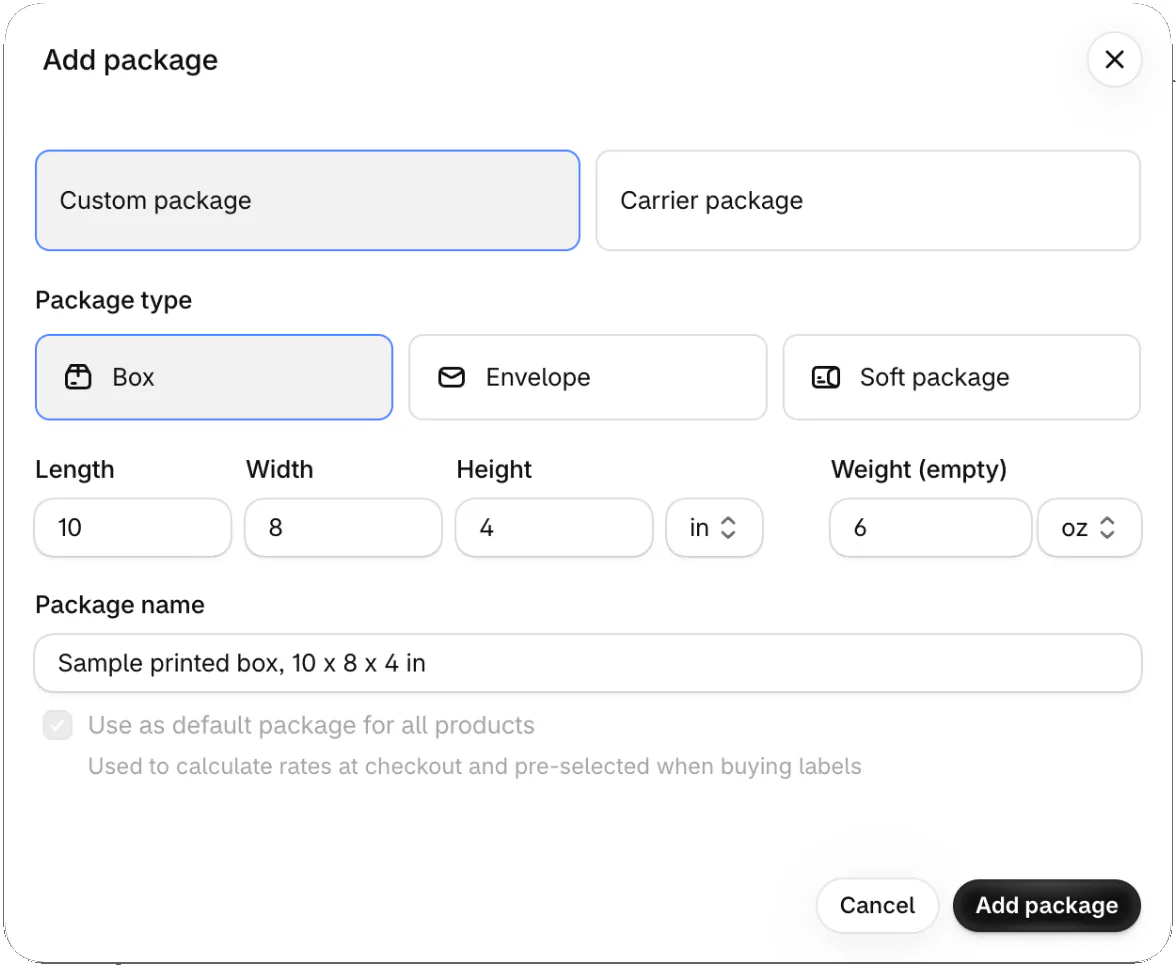
- Save it in Shopify: Settings, then Shipping and delivery, then Packages, the list of boxes Shopify prices shipping from. Click Add package, choose Custom package, then Box for a printed box, and fill in Length, Width, Height, Weight (empty) and Package name.
- Compare two suppliers on minimum order, sample quality and reorder time, and order the smallest run that brings the price per box down.
Many carriers give away packaging for use with their own rates, and USPS, UPS, DHL Express and FedEx do, though you may need a free carrier account. A custom box of the same size does not get a carrier's flat rate price, which our page on flat rate shipping explains.
How does custom packaging change your Shopify shipping rate?
With weight-based rates, Shopify adds your store default box's weight to your products' weight, so a heavier box can raise the rate a shopper pays at checkout. A flat rate does not change with weight. For carrier-calculated rates, the default package's size and weight are part of what Shopify sends to the carrier.
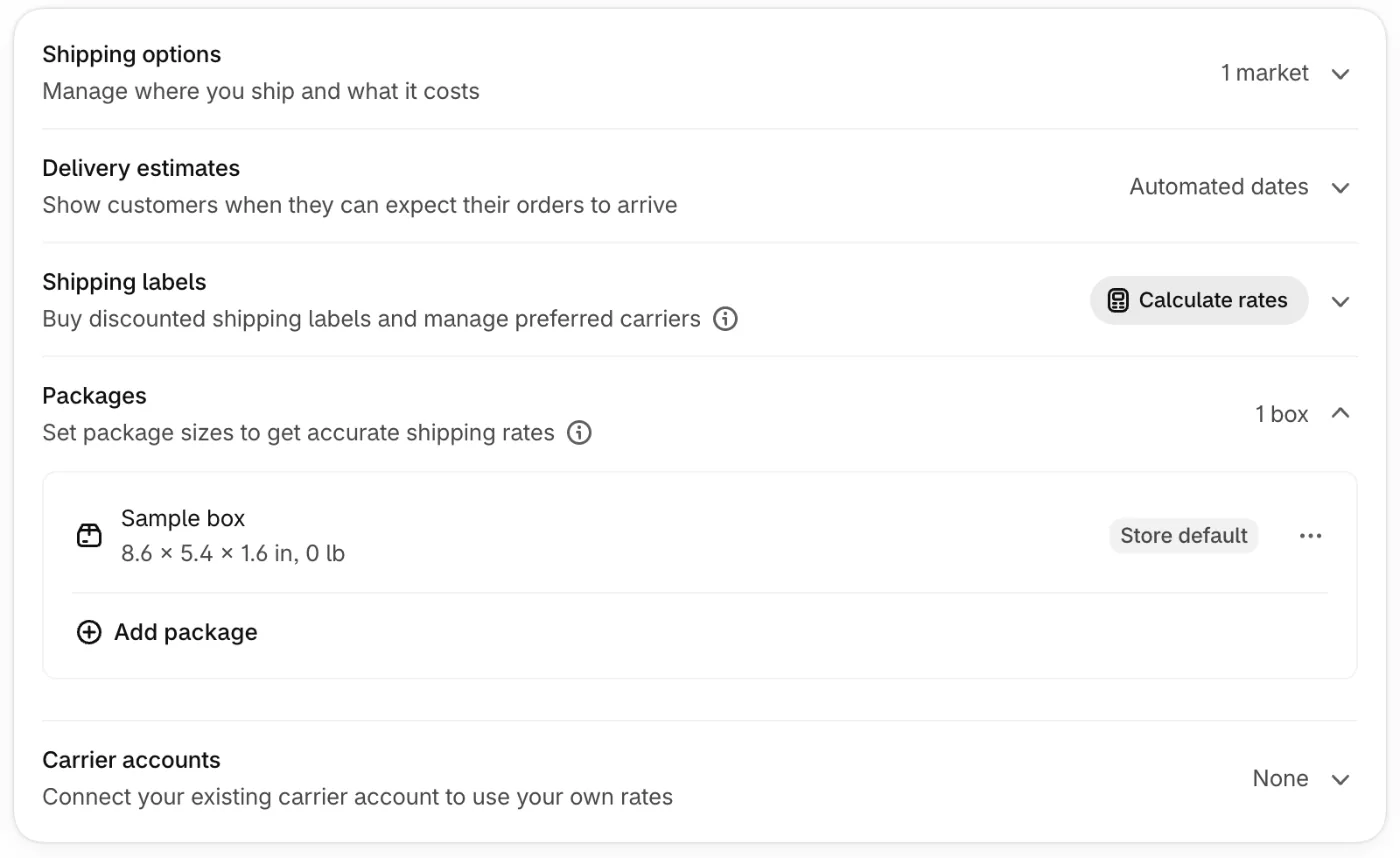
Enter each product's Weight in the Shipping card of its page, for the product alone. Put the box's weight in the saved package's Weight (empty) field. The box tagged Store default under Packages is the one Shopify uses to calculate rates at checkout. If you also add the box to every product's weight, Shopify counts it twice.
Say your rates are $4.00 up to 1 lb and $6.50 over 1 lb up to 2 lb, and your candle weighs 14 oz. A 1 oz paper mailer makes 15 oz, so the shopper pays $4.00. A 3 oz box makes 17 oz, so the shopper pays $6.50. Shopify's own example uses kilograms, but the mechanism is the same. Our shipping rates guide sets the rates themselves, and the shipping labels guide covers buying labels.
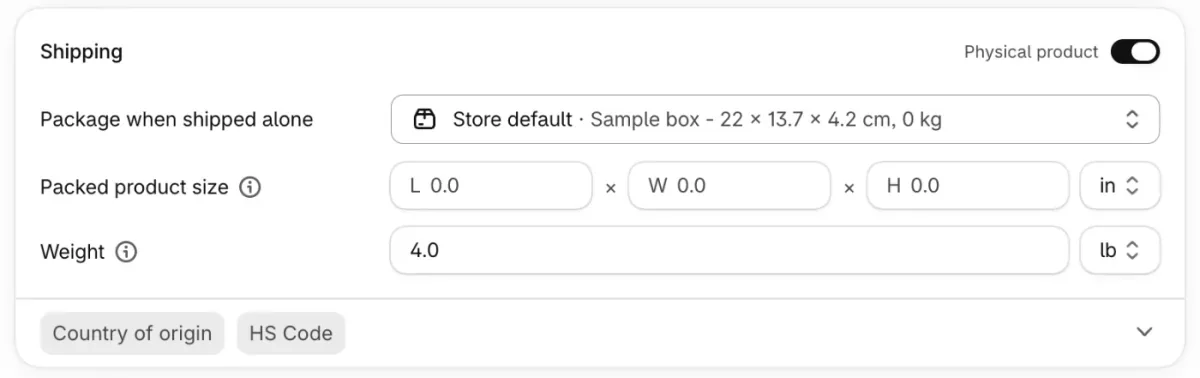
A few rules decide which box Shopify uses:
- Package when shipped alone sets a package for one item, and it overrides the store default only for single-item orders.
- Packed product size is the outer length, width and height of a packed item. With it, Shopify picks the smallest saved box that fits, and only packages of the Box type count.
- A package over 1 cubic foot can be charged for the space it takes up, if that is more than its real weight.
- A soft package thicker than 3/4 inch loses USPS First Class Mail rates.
Shopify's package setup page walks through each of these.
How do you add gift wrap or a thank-you card without a custom box?
A card or a gift wrap product gives the unboxing moment without a print run. A thank-you card is an insert at $0.05 to $0.50, and you can print a discount code on it to bring the buyer back for a second order.
Create gift wrap as its own product. Sledge's Add-ons offer, extra products shoppers tick on the product page, can show a gift wrap product you create, with a discount you set above zero. The upsell page covers where it shows.
A packing slip travels in the box, and Shopify's has no price field. Our packing slip template covers a gift note and a hidden price. For what happens once the box is packed, see pick and pack.
FAQ
Questions, answered
-

14-day free trial
Explore Sledge on your store before you decide to commit.
-

No credit card required
Start improving your store with no upfront commitment.
-

Setup in minutes
Get Sledge running without a lengthy setup process.
-

Built to grow sales
Turn shopper behavior into actions that help you sell more.
What is custom packaging?
Custom packaging is packaging made or printed for your brand, such as boxes, mailers, tape, tissue paper, stickers and inserts. It ranges from a printed label on a plain box to a box built to your product's size. A common start is the label or insert, with printed boxes ordered later.
How much does custom packaging cost?
One fulfillment company's guide, published September 8, 2026, puts custom boxes at $0.10 to $10.00 each, depending on material, size, design and ink, with the price per box falling as the order grows. Inserts run $0.05 to $0.50, and samples $10 to $30. Ask each supplier for its own quote and minimum.
What is the cheapest way to start with custom packaging?
The cheapest start is a printed sticker or label on a plain box, because it needs no minimum order or print run. Branded tape or tissue paper comes next, then custom mailers or printed boxes once volume justifies them. A thank-you card is another low-cost step, at about $0.05 to $0.50 each in the same guide.
What is eco friendly packaging made of?
Recycled cardboard and paper are the usual choices: corrugated boxes, kraft paper fill, paper mailers and molded pulp. Compostable mailers and plant-based fill also exist, and recycled or bio-based plastic mailers are a middle step. Compostable can mean commercial or home composting, so check which one the maker means.
Can you call your packaging eco friendly or recyclable?
Be specific. The FTC's Green Guides say sellers should not make unqualified general claims such as eco friendly, and that recyclable or compostable claims need qualifying when most buyers lack recycling or composting access. Say what it is made of, such as 100% recycled cardboard. This is general information, not legal advice.
Does heavier packaging raise your Shopify shipping rate?
Yes, with weight-based rates. Shopify adds your store default package's weight to the products' weight at checkout, so a heavy box can push an order into the next rate. Carrier-calculated rates use the package's size and weight too, and carriers may charge for the space a parcel takes up once it passes 1 cubic foot.
Packaging goes in after the sale. What grows the order before it?
Sledge doesn't make, print or order packaging. Before checkout, its Add-ons offer can show a gift wrap product you create as a tick box on the product page, and its bundles and cart drawer help shoppers fill the order that goes in the box. Try it free for 14 days. Growth Intelligence turns on when you pick a paid plan, and its suggested fixes add up to one dollar figure, labeled Est. potential.