Word of mouth marketing is getting customers to recommend your store to people they know. The talk is organic when it starts on its own and encouraged when you give it a reason, such as a review request or a link to share. It shows up as reviews, shared links and first orders with no ad behind them.
Say a regular buys a candle and mentions it to a coworker at lunch. Three days later a stranger places an order with no coupon, no ad click and no hint of where she heard your name. That order is word of mouth, and your reports can only guess at it.
What is word of mouth marketing?
Word of mouth is customers talking about you, and the marketing is giving them something worth saying and an easy way to say it.
Sources draw the line in different places. Some keep it to unpaid talk, and others count every nudge you give. Shopify's 2026 strategy guide keeps it to talk with no paid incentive. It calls a program that rewards each recommendation referral marketing, and a partner who earns a commission an affiliate. Shopify's older guide lists referral programs as a word of mouth tactic, so even its own pages differ.
Here, the moment you pay for each recommendation, it is a referral or affiliate program. Anything short of that is word of mouth, organic or encouraged.
| Kind | What you do | Do you pay? |
|---|---|---|
| Organic | Nothing. A buyer tells a friend on their own. | No |
| Encouraged | You ask, or you make sharing easy, with a review request or a share link. | No |
| Referral | You reward each friend who buys. | Yes |
| Affiliate or creator | A code or link earns a commission or a gift. | Yes |
Kinds as this page uses them, November 2026. Shopify's guide read November 18, 2026.
The referral rule, with a sample reward, sits in 8 loyalty program types and what each costs.
Why does word of mouth work for an online store?
A shopper can't pick up your product, so another buyer's words do the picking up.
In Nielsen's 2021 Trust in Advertising study, recommendations from people they know were the most trusted channel in the US, at 89%. Shopify's 2025 survey of 500 stores on its platform found that 53% of the established ones relied on word of mouth as their most common year-one growth strategy. Shopify notes that the sample may not represent every store.
The talk cuts both ways. A late parcel travels as far as a good one. A reward that is too big can make a recommendation sound bought.
No one can say what share of your sales it brings. Reviews are the version you can show on a page, and they are one form of social proof.
What are examples of word of mouth marketing?
Seven everyday ones, each a scene from a store like yours. The scenes are made up. Each links to the page on how to get it.
| Scene | Kind | Read more |
|---|---|---|
| A buyer writes that the lamp's shade is paler than the photo. | Organic, or asked for | Customer review examples |
| A shopper posts the mug on her desk and tags your store. | Organic | User-generated content examples |
| A shopper saves five lamps and sends the list to her sister. | Encouraged, with a share link | Sledge's wishlist |
| A friend gets 15% off a first order, and the buyer who sent her gets a thank-you credit. | Referral, with a reward for each friend | Loyalty program examples |
| A creator shows the headphones and shares her own code. | Affiliate or creator, with a gift or commission | How to find influencers and Shopify Collabs |
| Entrants tag a friend to win a candle set. | Encouraged, with a giveaway | Giveaway ideas |
| A handwritten note in the box makes a buyer film the unboxing. | Encouraged, with a note in the box | Custom packaging |
Two of the seven cross from word of mouth into referral and affiliate marketing. A brand ambassador is someone you pick and keep, for months rather than one post.
How do you get customers to talk about your store?
Earn the mention first, then ask, then make the words and the sharing easy to find.
- Earn it. People mention a late parcel as readily as a good surprise, so give them one thing worth saying, such as a note in the box or a small extra. Custom packaging covers the options.
- Ask after delivery. Send the review request from Shopify Messaging or another email tool, as 6 review request email templates shows. If you sell on Shop, Shopify's Help Center says Shopify asks Shop buyers itself. You pick the day, from 1 to 180 days after delivery, under Sales channels, then Shop, then Settings.
- Show the words where the next shopper decides. Sledge's Product Review tool, part of its reviews, collects a star rating, a short review and up to five photos on your own product pages. The "Publishing" card decides what goes live without you. "Enable auto publish" starts switched on and "Minimum rating" reads "4 stars & up". Reviews of 4 and 5 stars post by themselves, and lower ones wait for you, as how to respond to negative reviews explains.
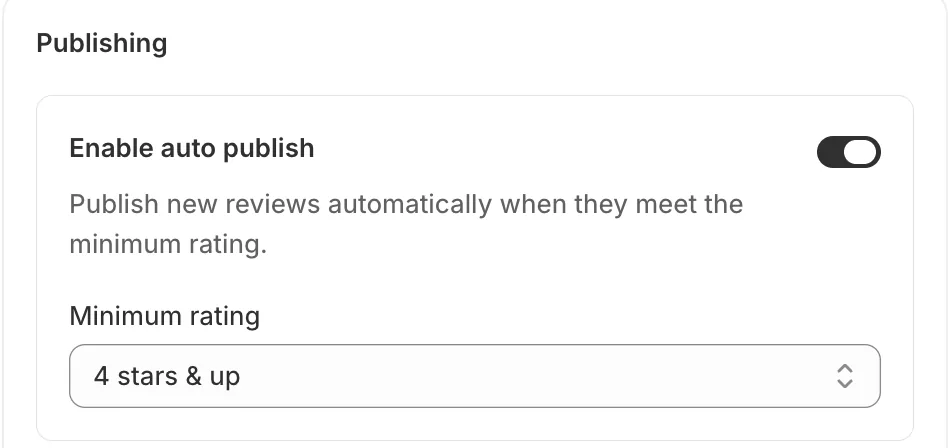
Sledge's Publishing card for reviews on the Sledge Demo Store, a test store. - Make sharing one tap. Sledge's wishlist page has a share button that makes a link to the shopper's whole list. Whoever opens the link sees the saved products and can add all of them to their own wishlist. The shopper chooses who gets it, and nothing is sent for them.
- Say thanks, and be open about a reward. The FTC's guide for marketers says not to tie a reward to a positive review, and that the review should disclose it. Its influencer guide says to disclose anything of value given to someone who mentions your product. Some review sites ban rewarded reviews. This isn't legal advice.
How do you measure word of mouth on Shopify?
No report counts it exactly, so watch three signals.
- Direct visits. Go to Analytics, then Reports, and open "Sessions by referrer", listed under "Acquisition". It is a chart of visits sorted by where each one came from, and the bar labelled "Direct" is the one to watch. In the terms of its sales report, Shopify's Help Center says "Direct" means the shopper typed your address. It also lists a link clicked in an email, an app, an instant message or a bookmark among the cases where a Direct visit's source can't be traced. A friend's tip sent in a message can land there, or under search, so a rise after you ask for reviews or add a note to the box is a hint, not proof. Open your own store with the "View store" button so your visits don't count. Compare only ranges that start after September 23, 2026, when Shopify changed how it counts sessions.
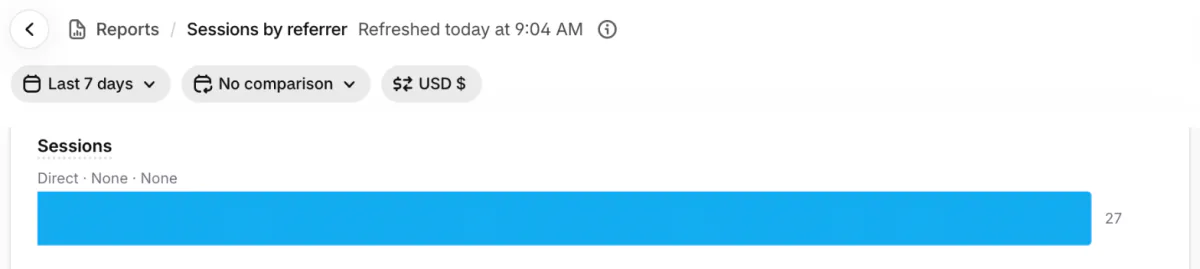
The top of Shopify's Sessions by referrer report on a test store, showing a bar for Direct visits. - A code you hand out. Give a regular a code to pass on, then read its row in "Sales by discount codes", the report that groups sales by code. One code per person shows whose friends ordered. Growth hacking for ecommerce has the code test.
- A question. Add "How did you hear about us?" to your first reply to a buyer, and read the answers once a month. The order confirmation email template covers the email a buyer gets right after ordering. Shopify's guide says a true customer referral rate needs a dedicated referral program or app.
Sledge tracks none of this for you. It has no referral program, no review-request emails and no text messages to shoppers.
FAQ
Questions, answered
-

14-day free trial
Explore Sledge on your store before you decide to commit.
-

No credit card required
Start improving your store with no upfront commitment.
-

Setup in minutes
Get Sledge running without a lengthy setup process.
-

Built to grow sales
Turn shopper behavior into actions that help you sell more.
What is word of mouth marketing?
Word of mouth marketing is getting customers to recommend your store to people they know. The talk is organic when buyers start it on their own, and encouraged when you give them a reason, such as a review request or a link to share. Paying for each recommendation makes it a referral or affiliate program.
What is the difference between word of mouth and referral marketing?
Word of mouth is customers talking about you with no payment involved. Referral marketing is a program that rewards each recommendation, such as a discount for a friend and credit for the buyer who sent them. Affiliate marketing pays partners a commission. Shopify's 2026 guide draws the same lines.
Is word of mouth marketing effective?
In Nielsen's 2021 Trust in Advertising study, recommendations from people they know were the most trusted channel in the US, at 89%. Shopify's 2025 survey of 500 stores on its platform found 53% of the established ones relied on word of mouth as their most common year-one growth strategy. Neither says how much of your sales it brings.
How do you measure word of mouth marketing on Shopify?
No report counts it exactly. Open Analytics, then Reports, then Sessions by referrer, and watch the Direct bar after you ask for reviews or add a note to the box. Hand a regular a code to pass on and read its row in Sales by discount codes. Then ask new buyers how they heard of you.
Can you pay customers for word of mouth?
In the US, yes, if you are open about it. The FTC says anyone you give something of value to mention your product should say so, and that a reward for a review must not depend on the review being positive. Some review sites ban rewarded reviews, so check where yours will show. This isn't legal advice.
Can Sledge run a referral program or send review requests?
No. Sledge collects and shows reviews on your product pages and lets shoppers share their wishlist by link. It has no referral rewards and sends no review-request emails, so send those from Shopify Messaging or another email tool and point the button at the product page.
A friend's tip brings the visit. Does the product page back it up?
Sledge doesn't run a referral program or send review-request emails. It collects reviews on your own product pages, with reviews of 4 and 5 stars published by default, and lets shoppers share their wishlist by link. Try it free for 14 days. Growth Intelligence turns on when you pick a paid plan, weekly on Pro, and can flag when too few of your products have reviews. Its suggested fixes add up to one dollar figure, labeled Est. potential.