These customer loyalty program examples cover eight types: points, tiers, cash back, paid membership, referrals, punch cards, subscribe and save, and milestone perks. Each has a sample rule below, what it costs you on a $50 order, and whether Shopify can run it without a loyalty app.
A shopper places her third order, and nothing on your store says thank you. You'd like to, but points, tiers and cash back sound like another app to pay for.
What are 8 customer loyalty program examples?
A loyalty program is a rule that rewards a repeat order, and these eight are the rules a small store can copy. The samples are made up. Say your average order is $50 and you keep $30 of it after product cost and card fees. Each cost below is set against that $30, a simple version of your contribution margin on an order.
| Type | Sample rule | What it costs you | In Shopify without a loyalty app |
|---|---|---|---|
| Points | 1 point per $1, 100 points for $5 off | $2.50 | No |
| Tiers | Free shipping at 3 orders, 10% off at $400 spent | $5 to $10 | Partly |
| Cash back | 3% back as store credit | $1.50 | Yes, by hand |
| Paid membership | $39 a year for free shipping | $5 of shipping | Partly |
| Referral | $10 off for a friend, $10 credit for you | $20 once | Partly |
| Punch card | Buy nine, get the tenth free | $5 | Partly |
| Subscribe and save | 10% off a repeat delivery | $5 | Yes |
| Milestone perks | 10% off on a birthday | $5 once a year | Yes |
Sample rules written for this page, November 2026. Shopify settings and the programs below checked November 6, 2026.
Yes means Shopify's own tools can run the rule, Partly means they cover one piece of it, and No means you need a loyalty app. Shopify's own guide names most of these types and points you to a loyalty app to start one.
How does a points program work?
Shoppers earn points on every order and spend them as money off a later one. Sample rule: earn 1 point for every $1, and spend 100 points for $5 off. That gives back 5 cents on the dollar. A $50 order earns 50 points, worth $2.50, which is 8% of the $30 you keep. Points nobody spends cost nothing.
Shopify has no points feature you can run for your own store, so points mean a loyalty app. The free plans stop at different order counts.
What do tiered loyalty program examples look like?
A tiered program gives better rewards as a shopper spends more, so your best buyers get something new buyers don't. This ladder is a sample.
| Tier | How a shopper gets in | Reward | What it costs you |
|---|---|---|---|
| Regular | Any order | None | $0 |
| Insider | 3 orders | Free shipping | $5, the shipping you'd charge |
| VIP | $400 spent | Free shipping, 10% off, first look at new items | $10, a third of the $30 you keep |
Price the top tier first, because its perks stack.
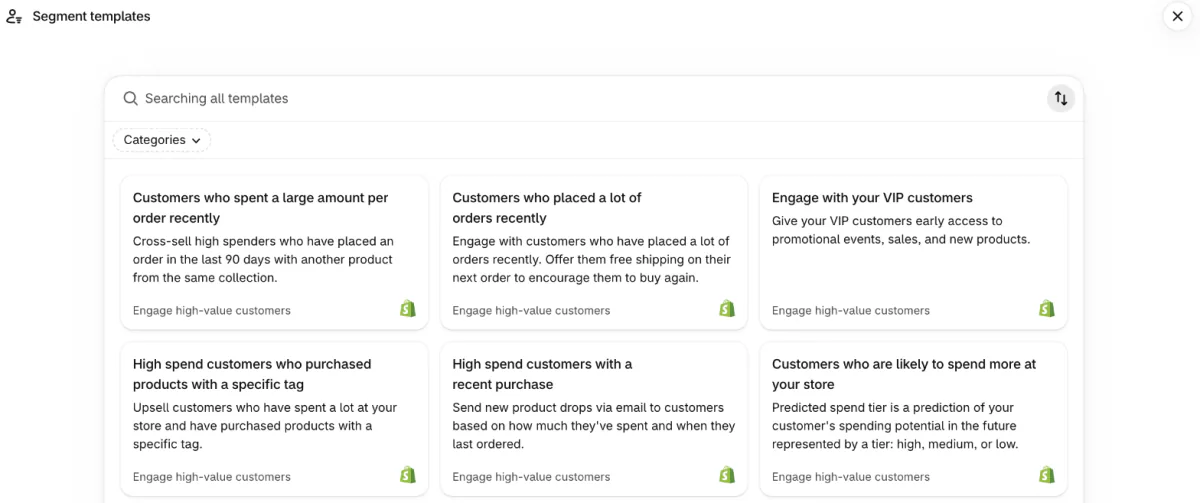
Without an app, build one segment per tier. A segment is a customer list that adds and removes people by itself, from filters such as amount spent and number of orders, much like the groups in RFM analysis. The "Segment templates" panel, opened from "Create segment", lists ready-made segments to start from.
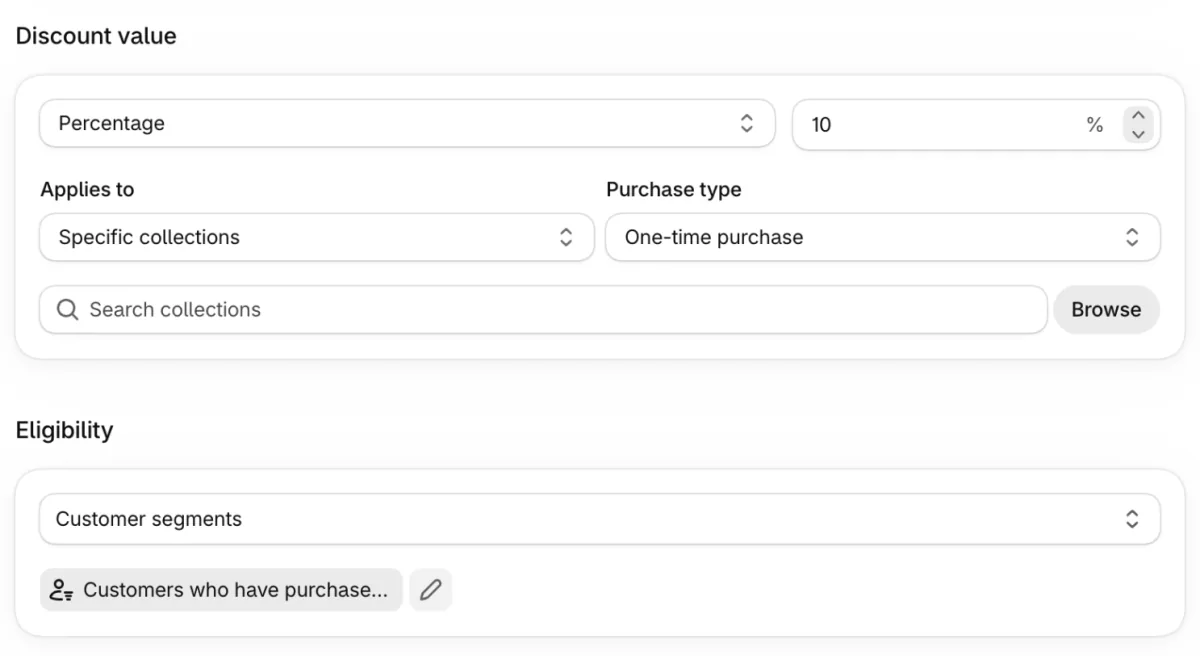
Then create a discount for each tier. Under "Eligibility", the part of a discount that picks who can use it, choose "Customer segments" and pick one of the segments Shopify already lists, or one you built. A segment discount reaches existing customers only, because a first-time buyer joins a segment after the first order is complete.
A segment is a list for you, not a status page for the shopper. Showing a shopper their tier and the distance to the next one is a loyalty app's job.
How does cash back work as a loyalty program?
Cash back returns a share of each order as store credit that shoppers spend on the next one. Sample rule: 3% of each order comes back as store credit, valid for 90 days. That costs $1.50 on a $50 order, or 5% of the $30 you keep.
Store credit is built into Shopify, and you issue it from each customer's page. Open a customer, find "Store credit" and click the pencil. In the "Adjust store credit" window, enter an "Amount", pick a date under "Set expiration date", leave "Notify customer" switched on to email them, and click "Issue credit".
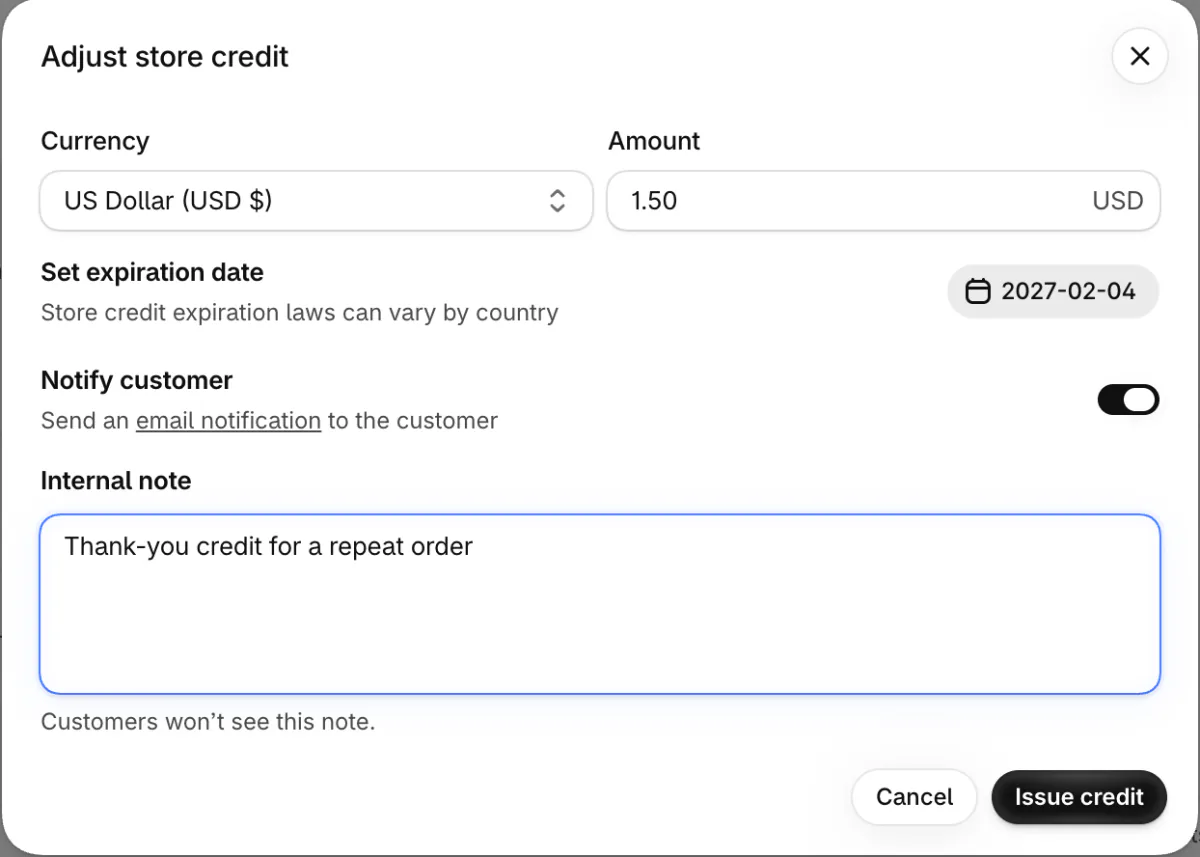
Three limits matter. Shoppers can use credit only when signed in to a customer account or paying with Shop Pay. They can't pick part of their balance. On stores created on or after May 12, 2025, Shopify charges its transaction fee on the part of an order paid with credit. Store credit expiration laws can vary by country, so check yours before you set a date. Some loyalty apps pay rewards as store credit for you.
Can a paid membership work as a loyalty program?
A paid membership sells shoppers the perks up front, so the fee pays for them. Sample rule: $39 a year buys free shipping on every order. A member who orders four times uses $20 of shipping you'd have charged at your shipping rates, so you keep $19 of the fee. The fee covers about eight orders of shipping, and each order past that costs you $5.
Shopify's free Subscriptions app can bill a yearly fee. Recognizing members at checkout, for free shipping, is the part to check before you promise it. To go further, compare subscription apps by what each one does.
How do referral programs work?
A referral program pays a customer for bringing in a new one. Sample rule: a friend gets $10 off a first order of $40 or more, and the customer who sent them gets $10 in store credit once that order ships. On a $50 first order the friend pays $40, you keep $20, and the credit leaves you $10. Pay after the first order, not at sign-up, so a friend who never buys costs you nothing.
Shopify's Help Center lists store credit as a reward for a loyalty or referral program, and you can send a one-use discount code by hand. Tracking who sent whom is what referral apps do.
What is a punch card program?
A punch card counts orders and rewards the tenth. Sample rule: buy nine, get the tenth free, up to $50. The free order gives away $50 in every ten, which is $5 an order, or 17% of the $30 you keep. It suits things people use up, such as coffee or skin care.
Shopify's POS guide points to an app for digital punch cards. Online, a segment of customers with nine orders, plus a one-use code you email them, gets close.
Is subscribe and save a loyalty program?
Subscribe and save rewards a shopper for ordering on a schedule instead of choosing again each time. Sample rule: subscribe and save 10% on a delivery every 30 days. That is $5 off each $50 delivery, or 17% of the $30 you keep, and the reward is the repeat order itself.
Shopify's free Subscriptions app bills on a schedule and can apply a percentage discount to subscription products. Your store needs a supported payment gateway first.
Which milestone perks can you give without points?
A milestone perk rewards a moment, such as a birthday or a third order, with no balance to track. Sample rules: 10% off on a customer's birthday, a free sample in the third parcel, and a first look at new items for VIPs. The birthday code costs $5 once a year, and the first look costs nothing.
Shopify Messaging, Shopify's own app for marketing emails and texts, has two of these ready. Click "Create automation" and look under "Customer appreciation". "Celebrate customer birthday" sends a discount code on the day, and Shopify says its Forms app can collect birthdays. "Welcome VIP customers" sends a marketing message when someone joins the VIP customers segment, which by default means a third order and at least $1,000 USD spent, or a VIP tag.
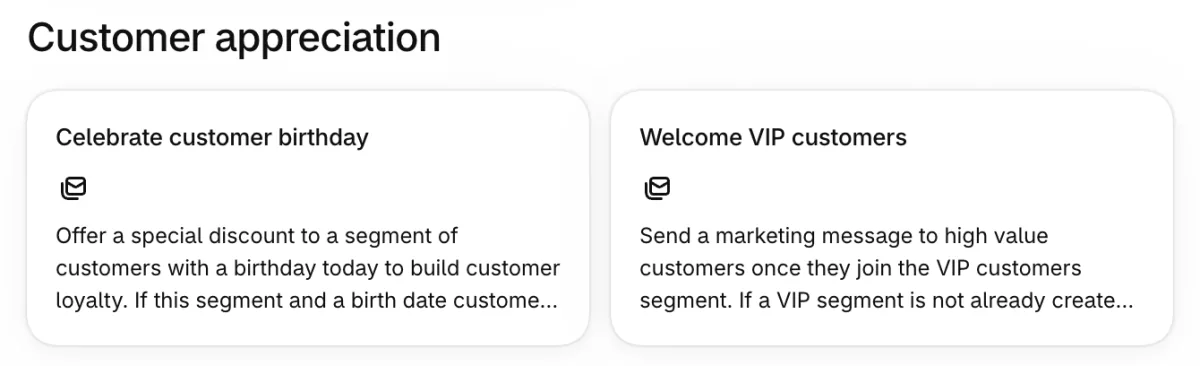
For the rest of what Shopify's email tools do, see Shopify email marketing.
Which loyalty program fits your store?
Pick the rule that fits how your shoppers already buy. In Attentive's January 2026 survey of 600 US adults, the perks they wanted were free or faster shipping (65%), rewards points (59%), free gifts (52%), exclusive deals (41%) and VIP status or tiers (34%).
- Your product gets used up and reordered: subscribe and save, or a punch card.
- Shoppers buy a few times a year: tiers or milestone perks.
- New shoppers mostly come from friends: a referral program.
- You want one simple rule: cash back as store credit.
These matches are judgment, not measured results. Whatever you pick, write down what happens to a reward when an order comes back, and say it in your refund policy. To check it works, see whether this month's first buyers come back sooner than last month's, as the cohort report in the repeat customers guide shows. When a rule needs a points balance or a tier page, compare loyalty apps by job.
How do big brands run their loyalty programs?
Two public programs, read on their own pages on November 6, 2026. Chipotle Rewards gives 10 points for each $1 spent, and its page says points last while a member makes at least one qualifying purchase a year. Nike Membership is free, and its page lists free shipping on orders of $50 or more and a 60-day Wear Test, with no points or tiers named.
FAQ
Questions, answered
-

14-day free trial
Explore Sledge on your store before you decide to commit.
-

No credit card required
Start improving your store with no upfront commitment.
-

Setup in minutes
Get Sledge running without a lengthy setup process.
-

Built to grow sales
Turn shopper behavior into actions that help you sell more.
What is a customer loyalty program?
It is a rule that rewards shoppers for ordering again, such as points, a tier, cash back, a free item or a member price. The rule is the program, and an app is one way to run it. Start with one rule you can price against what you keep on an order, as the examples above do.
Which loyalty program is best for a small store?
It depends on the job. Stores that sell things people use up suit subscribe and save or a punch card. Stores whose shoppers order a few times a year suit tiers or milestone perks. Referrals suit stores that grow through friends, and cash back suits one simple rule. Price the rule against what you keep on an order first.
Can you run a loyalty program on Shopify without an app?
For some types, yes. Store credit lets you pay cash back by hand, Shopify Messaging sends birthday and VIP emails, a segment limits a discount to your best buyers, and Shopify's free Subscriptions app handles subscribe and save. Points, a tier page shoppers can see and referral tracking need a loyalty app.
How much does a loyalty program cost?
Two things cost money: the rewards and the app. In the samples above, rewards run from $1.50 to $10 on a $50 order, and a referral costs $20 once per new customer. Many loyalty apps price by monthly orders, and our loyalty comparison lists the free plans.
What is the difference between a points program and a tiered one?
Points reward every order with a balance the shopper spends. Tiers reward total spend or orders with a status that brings perks. Tiers put the reward behind a threshold, so they cost little on small spenders and more on your best buyers. Many programs combine both.
Rewards come after the first sale. Is your store winning it?
Sledge doesn't run points, tiers or referrals. It works on the sale before them with search, filters, bundles and a cart drawer, and you can try it free for 14 days. Growth Intelligence turns on when you pick a paid plan. It studies what shoppers search for and buy, then lists fixes for the sales your store misses, with one dollar total for all of them, labeled "Est. potential".