Shopify vs WooCommerce comes to about the same bill in a small store's month. On a made-up month of 100 orders at $50, Shopify Basic comes to $204 and WooCommerce to $200 to $207, because both charge 2.9% + 30¢ per standard US card. The difference is the upkeep: Shopify runs the hosting and updates, and on WooCommerce they are yours.
A plugin update goes out on a Friday night, and by Saturday your checkout page is blank. Or a $29 plan has grown into four app bills. On November 9, 2026, we read Shopify's and WooCommerce's own pricing, fee and update pages and worked out one month on each.
Which one fits your store?
Pick by who keeps the store running, because the standard card rate on a US sale is the same on both.
Shopify is a hosted store you rent by the month. WooCommerce is free software that turns a WordPress site into a store, on a host you pick.
| If you | Look at | Why |
|---|---|---|
| Have no one to manage hosting, updates and backups | Shopify | Every plan includes hosting and the security certificate a checkout needs, and Basic has 24/7 live chat support |
| Already run a WordPress site with a blog that brings visitors | WooCommerce, or Shopify's WordPress plugin | WooCommerce adds the store to that site, and Shopify's plugin puts Shopify products on its pages |
| Sell products with more than three options, such as size, color, material and fit | WooCommerce | A Shopify product has up to three options and 2,048 variants, and WooCommerce's pricing page lists no variant limit |
| Want a payment provider other than the platform's own | WooCommerce | WooCommerce adds no fee for any provider, and Shopify Basic adds 2% to each sale through another one |
| Take many American Express or business cards | Check both rates | Shopify Basic charges 3.5% + 30¢ on those cards, and WooPayments' US table prints one card rate of 2.9% + 30¢ |
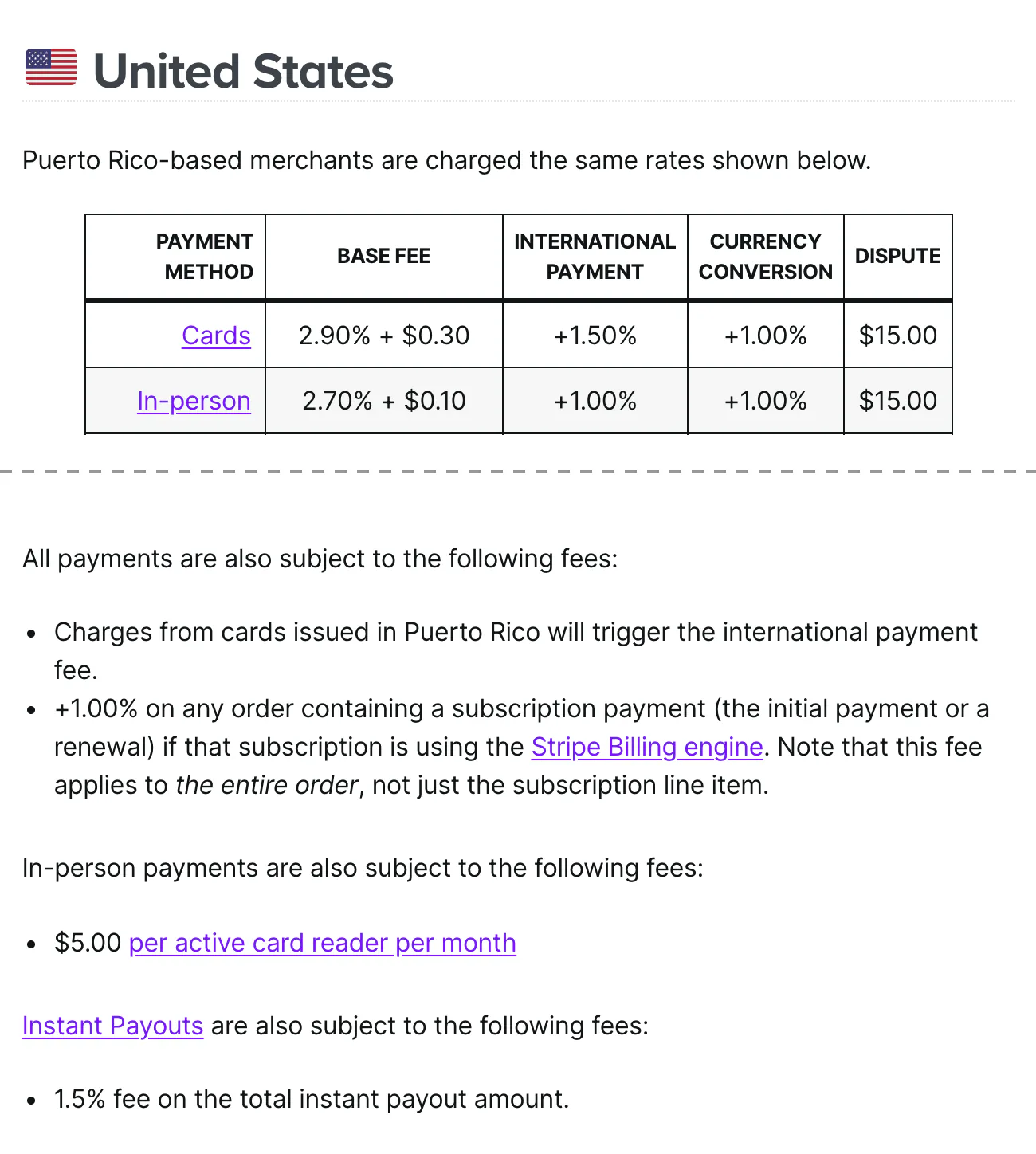
| Sell at markets or a counter too | Either | Shopify Basic takes in-person cards at 2.6% + 10¢, and WooPayments at 2.7% + 10¢ plus $5 a month for each active card reader |
From Shopify's and WooCommerce's own pages, read November 9, 2026.
The three-option limit comes from Shopify's Help Center. Choosing among more platforms? Shopify vs Magento vs BigCommerce and Shopify vs Wix set those platforms against Shopify.
Shopify vs WooCommerce: what does each one charge for?
Shopify charges one plan price with hosting inside it, and WooCommerce charges nothing for the plugin and leaves hosting, extensions and payments to you.
| Cost | Shopify Basic | WooCommerce |
|---|---|---|
| Platform | $29 a month paid yearly, $39 paid monthly | Free plugin, no share of sales |
| Hosting | Included | $25 to $350 a month for most stores, by WooCommerce's estimate |
| Add-ons | Set by each app; Shopify's own Bundles and Subscriptions apps are free | $29 to $299 a year for each paid extension |
| US card, own payments | 2.9% + 30¢ | 2.9% + 30¢ with WooPayments |
| Another payment provider | 2% on top of its rate | No added fee |
Shopify's US pricing page as archived November 9, 2026; WooCommerce's pricing and WooPayments fee pages, read November 9, 2026.
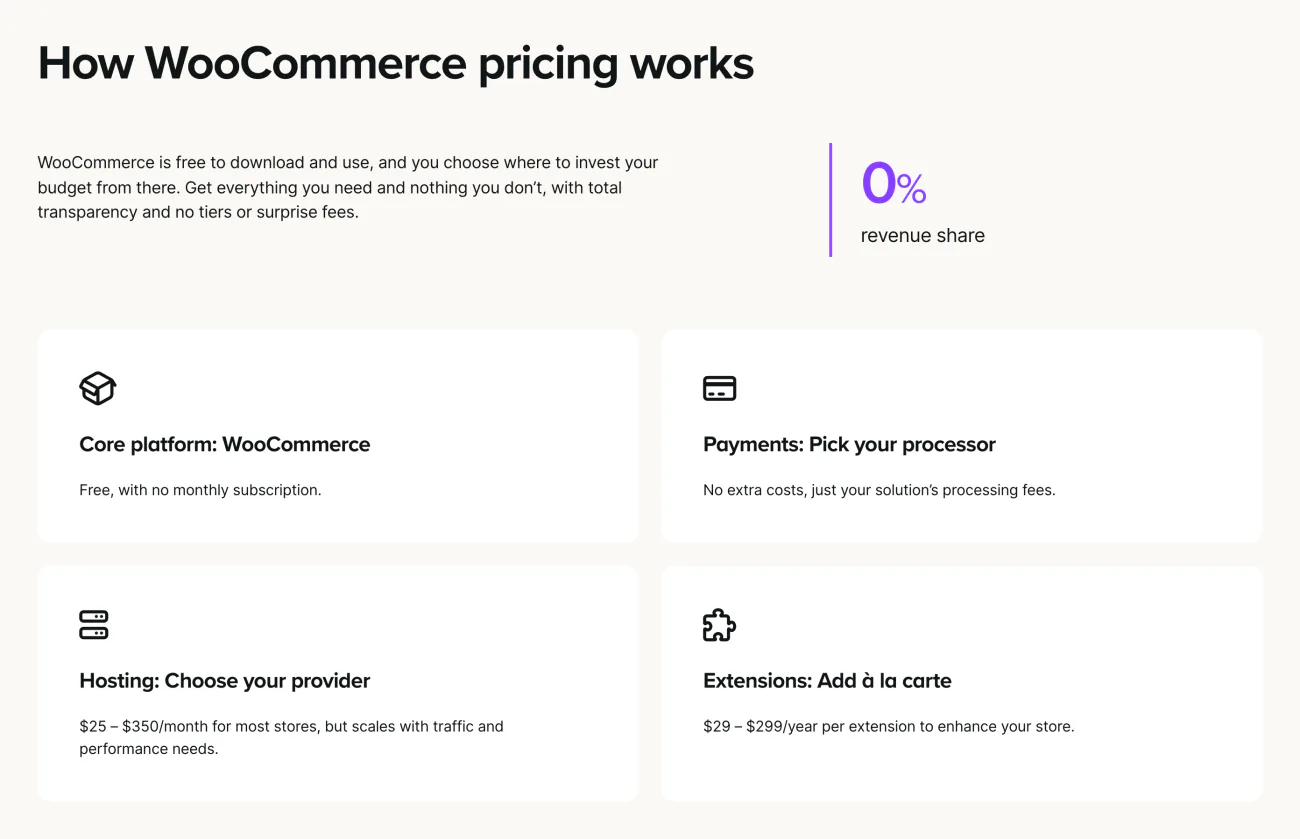
The WooCommerce figures come from WooCommerce's pricing page, and Shopify's from its own pricing page.
One host WooCommerce recommends is WordPress.com, whose Commerce plan costs $45 a month paid yearly, or $70 month to month. It includes automatic WordPress updates, real-time backups and some paid store extensions, and WordPress.com takes 0% of WooCommerce sales on it. Shopify's bigger plans, Grow, Advanced and Plus, are in our Shopify pricing guide.
What does one month cost on each?
On 100 orders of $50, card fees are $175 on both, so the month comes to $204 on Shopify Basic and $200 to $207 on WooCommerce.
| A made-up month | Shopify Basic, paid yearly | WooCommerce, $25 host | WooCommerce, $25 host, with bundles |
|---|---|---|---|
| Plan or hosting | $29.00 | $25.00 | $25.00 |
| Card fees, 100 orders at 2.9% + 30¢ | $175.00 | $175.00 | $175.00 |
| Bundles add-on | $0, Shopify's Bundles app | None | $6.58, Product Bundles at $79 a year |
| The month | $204.00 | $200.00 | $206.58 |
A made-up store with 100 online orders of $50, every shopper on a standard US card, worked out from both pricing pages, read November 9, 2026. $25 is the low end of WooCommerce's own hosting estimate. It leaves out shipping, tax, the domain and a paid theme.
The extras differ. WooPayments' fee page adds 1.5% for a card from abroad, and Shopify Basic adds 1%. Both take $15 for a US dispute and return it if you win, per Shopify's Help Center for Shopify Payments.
If 20 of those shoppers pay with American Express or a business card, Shopify's premium rate adds $6.00, and the month comes to $210.00. A refund returns no card fee on either platform. Paid monthly, Shopify Basic adds $10. On WordPress.com's Commerce plan, the hosting line is $45 and the month $220 before any extension.
The table leaves out your own time. On WooCommerce, that time goes to updates and backups. On Shopify, it goes to choosing apps.
Who keeps the store running?
Shopify runs the servers and the software, while a WooCommerce store asks you to back up and test each update yourself.
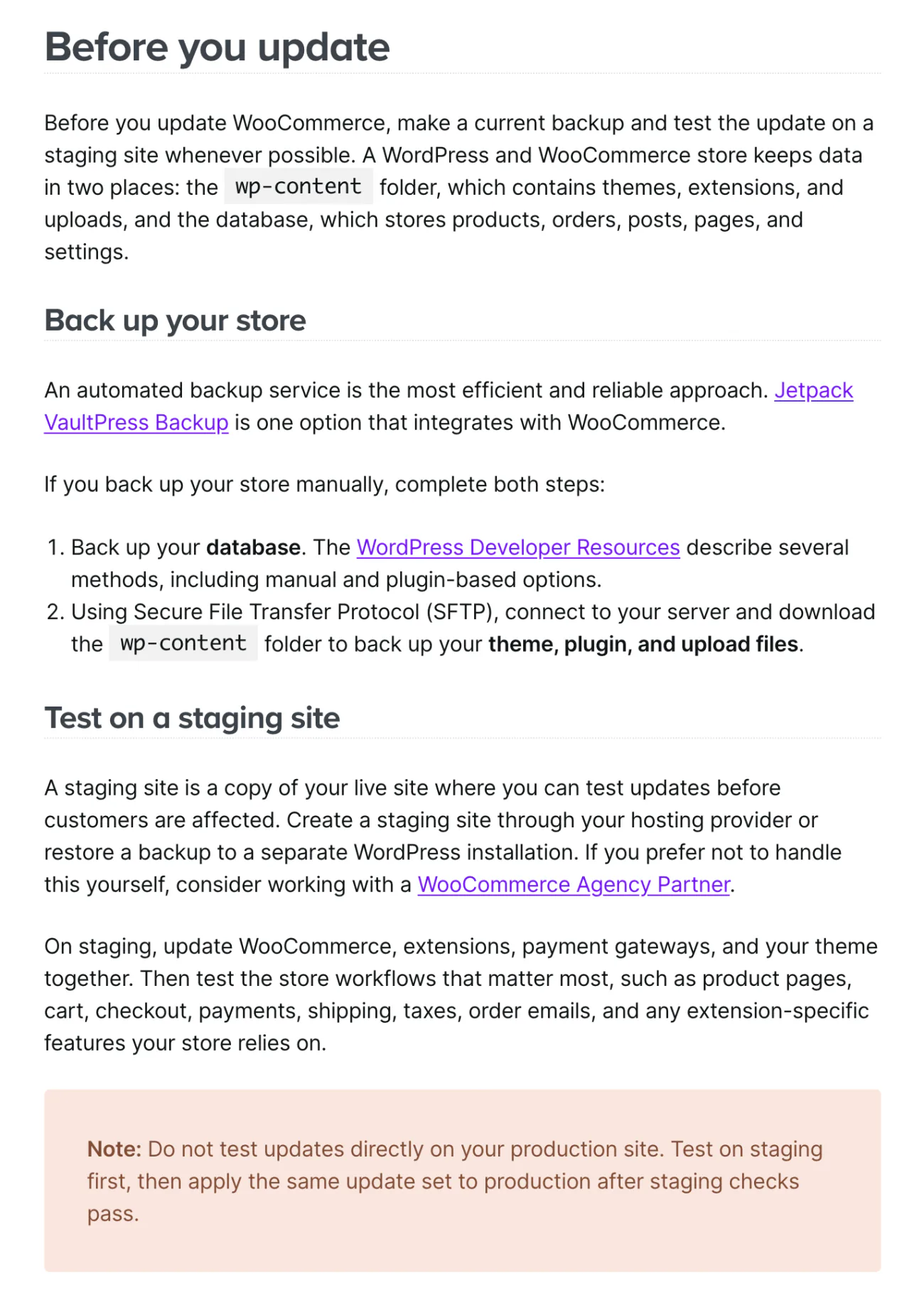
WooCommerce's own update guide asks for a current backup before every update and a test on a staging site, a private copy of your store, whenever possible. It says to update WooCommerce, its extensions, the payment gateways and the theme together, then test product pages, cart, checkout and payments. On a basic host, that work is yours or a developer's. WordPress.com's Commerce plan runs WordPress updates and backups for you.
Shopify Basic includes 24/7 live chat. Help for the free WooCommerce plugin comes from its community forums on WordPress.org, and each paid extension includes updates and support for as long as you renew it.
Traffic is the host's job on WooCommerce. A sale day that doubles your visitors runs on the plan you picked, and WooCommerce says hosting costs scale with traffic. Shopify includes unlimited hosting on every plan.
Apps or extensions: how do add-ons compare?
Shopify apps are priced by each maker, while WooCommerce's own extensions are priced by the year.
Shopify says its App Store held more than 21,000 apps at the end of 2025. WordPress.org lists over 78,000 free plugins, for every kind of WordPress site. WooCommerce's own extensions show their price on a one-year plan: Product Bundles and Product Add-Ons cost $79 a year, and WooCommerce Bookings $249.
Subscriptions show the difference. Shopify's own Subscriptions app is free. On WooCommerce, the Subscriptions extension costs $279 a year, and WooPayments adds 1% to any US order holding a subscription billed through its Stripe Billing option. WooCommerce's pricing page lists no such fee with the Subscriptions extension.
Add up the apps you would need before you compare.
Can you move from one to the other later?
Yes, both ways, but your product addresses usually change, so each changed address needs a redirect to its new one.
Every Shopify product address contains the word products, and every collection address the word collections. WooCommerce lets you choose the word in "Settings > Permalinks", WordPress's page for address formats. If you move from WooCommerce, Store Migration, Shopify's free app, brings over your customers, and your products as drafts. Order history and blog posts need another app, per Shopify's Help Center. Migrating to Shopify walks through the move and the redirects.
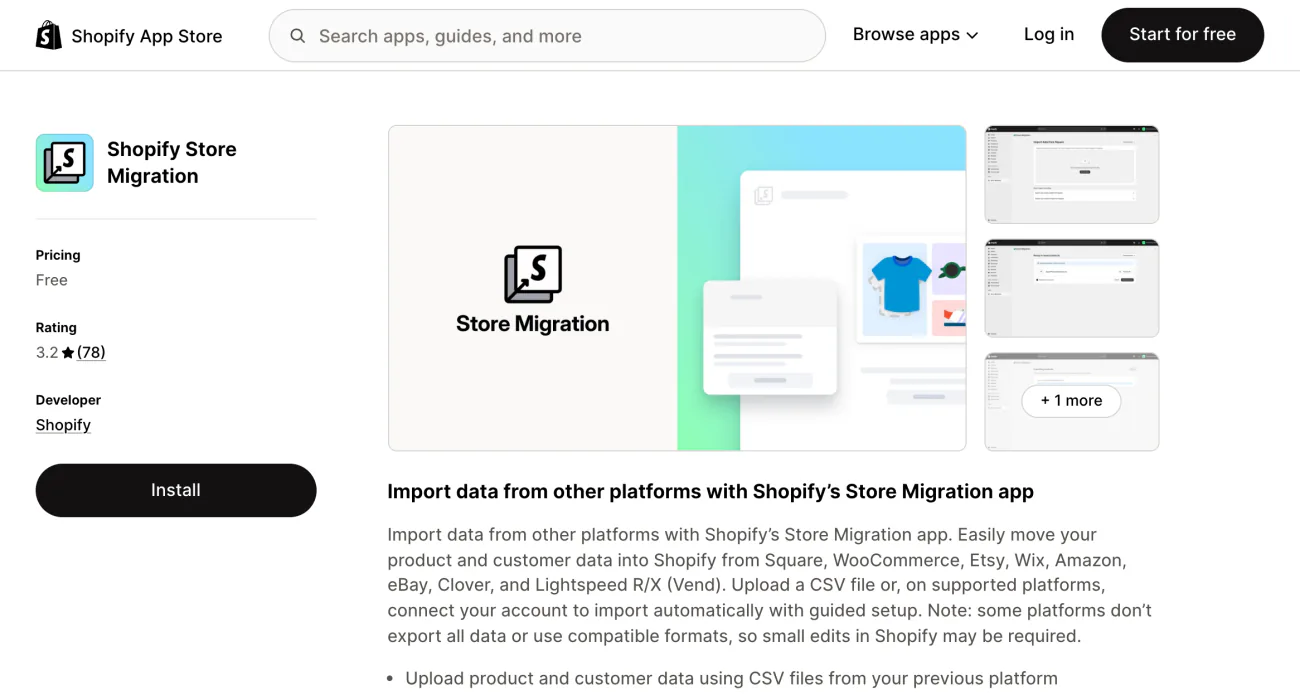
To move the other way, WooCommerce's marketplace sells importers. Its maker says Shopify Data Migrator, at $69 a year, moves products, customers, orders and reviews.
FAQ
Questions, answered
-

14-day free trial
Explore Sledge on your store before you decide to commit.
-

No credit card required
Start improving your store with no upfront commitment.
-

Setup in minutes
Get Sledge running without a lengthy setup process.
-

Built to grow sales
Turn shopper behavior into actions that help you sell more.
Is WooCommerce cheaper than Shopify?
Only by a few dollars either way in a small store's month. Both charge 2.9% + 30¢ per standard US card through their own payments, so the gap is the plan against the host. On 100 orders at $50, Shopify Basic comes to $204 and WooCommerce to $200 on a $25 host, or $206.58 with one paid extension at $79 a year.
Which is better, Shopify or WooCommerce?
It depends on who will run the store. Shopify fits a store with no one to manage hosting, updates and backups, since the plan covers them. WooCommerce fits a WordPress site you already run, products with more than three options, or a payment provider of your own choosing with no added fee.
Is WooCommerce really free?
The plugin is free and takes no share of your sales. The store around it is not. By WooCommerce's own estimate, most stores spend $25 to $350 a month on hosting, each paid extension costs $29 to $299 a year, and WooPayments takes 2.9% + 30¢ per US card.
Is Shopify or WooCommerce better for SEO?
Both let you write each product's search title and description: Shopify in its search engine listing box, WordPress through an SEO plugin such as Yoast SEO. The bigger difference is the addresses. Every Shopify product address contains the word products and every collection address the word collections, while WooCommerce lets you pick the word. Switch later and each changed address needs a redirect.
Can I use Shopify on my WordPress site?
Yes. Shopify's free plugin for WordPress adds your Shopify products and collections to WordPress pages and blog posts from the WordPress editor, and the checkout runs on Shopify. It works with any Shopify plan, so you keep the site and pay a Shopify plan instead of running WooCommerce.
Can I move from WooCommerce to Shopify later?
Yes. Store Migration, Shopify's free app, brings over the customers and products you export from WooCommerce, the products as drafts. Order history and WordPress posts and pages need another app or a copy by hand. Products with four or more attributes arrive without variants. Our migration guide covers the redirects.
On Shopify already? Find the sales your store lets slip.
Sledge doesn't run on WooCommerce, and it doesn't change what either platform charges. On Shopify, it adds search, filters and offers to your store. Try it free for 14 days, then plans start at $29.99 a month with no cut of your sales. Growth Intelligence turns on when you pick a paid plan, lists fixes and adds them up as one dollar figure, "Est. potential".