Shopify vs BigCommerce: both start at $29 a month in the US, paid yearly. Shopify Basic includes wholesale tools and lists no sales limit. BigCommerce adds storefronts to one account from $30 a month each, skips its own fee on 21 named payment providers, and moves you up a plan once counted sales pass $30,000 a year.
You sell to shoppers, and now a few schools want to pay by purchase order. Or a second brand is coming. On November 9, 2026, we read Shopify's and BigCommerce's own pricing, help and limits pages and compared them on the jobs that split them.
Which one fits your store?
Choose by how you sell: wholesale on a small plan, several brands from one account, or products with many options.
| If your store | Look at | Why |
|---|---|---|
| Sells to shops or schools as well as shoppers, on a small budget | Shopify | Basic includes company accounts, payment terms, PO numbers and up to 3 wholesale catalogs. BigCommerce's customer groups start on Growth, and its price lists on Performance |
| Needs quotes from your sales team and a buyer portal | BigCommerce B2B Edition or Shopify Plus | B2B Edition lists quotes and a buyer portal, by request with no published price. Plus adds a catalog per company, deposits and partial payments, from $2,300 a month |
| Runs two or more brands from one dashboard | BigCommerce | Its Core plan adds a storefront from $30 a month. Below Plus, Shopify opens each store separately on its own plan, and Plus includes up to 9 expansion stores |
| Sells one brand in several countries and languages | Shopify | One store sells by market in up to 20 languages. BigCommerce allows 5 languages per storefront |
| Lists products with many sizes and colors | Either, check the shape | Shopify allows 2,048 variants and three options. BigCommerce allows 600 variants and 250 values per option |
| Expects to grow past $30,000 in sales a year | Shopify | Basic lists no sales limit. BigCommerce moves Core up to Growth, $79 a month paid yearly, once the sales it counts pass $30,000 |
| Already takes cards through Stripe, PayPal or Adyen | BigCommerce | It charges no fee of its own on its 21 listed providers. Shopify Basic adds 2% on a provider other than Shopify Payments |
From each company's own pages, read November 9, 2026.
What does each cost to start, and per sale?
Shopify Basic and BigCommerce Core both cost $29 a month paid yearly and $39 paid monthly.
| Plan | Paid yearly | Paid monthly | Before you pay | Fee outside its own list |
|---|---|---|---|---|
| Shopify Basic | $29 a month | $39 a month | 3 days free, then $1 a month for 3 months | 2% on a provider other than Shopify Payments |
| BigCommerce Core | $29 a month | $39 a month | 15 days free, no card needed | 2% on a provider outside its 21 named ones |
US prices from both companies' pricing pages, read November 9, 2026, with Shopify's archived the same day.
On each online card sale, Shopify Basic charges 2.9% + 30¢, and BigCommerce's card rates begin at 2.89% + 29¢. BigCommerce renamed its plans from June 1, 2026: Standard, Plus and Pro became Core, Growth and Scale. A review that still prints the old names also prints the old sales limits.
Shopify vs Magento vs BigCommerce works through one store's bill as its sales grow. Every Shopify plan is laid out in Shopify pricing.
Which one handles wholesale on a small plan?
Shopify puts its B2B tools on Basic, while BigCommerce spreads them across Growth, Performance and its B2B Edition.
A school wants 40 hoodies, its purchase order number on the invoice, and 30 days to pay. That is wholesale, also called B2B.
| For wholesale | Shopify | BigCommerce |
|---|---|---|
| Company accounts | Basic, Grow, Advanced and Plus | B2B Edition, by request |
| Prices for a group of buyers | Up to 3 wholesale catalogs on Basic to Advanced, unlimited on Plus | Customer groups from Growth, price lists by product on Performance |
| Payment terms | Net terms on every B2B plan | Payment terms per company in B2B Edition |
| PO numbers | On every B2B plan | Purchase orders per company in B2B Edition |
| Quotes | An order you build and send as an invoice, on every B2B plan | Quotes from sales staff in B2B Edition |
From Shopify's Help Center and BigCommerce's pricing and help pages, read November 9, 2026.
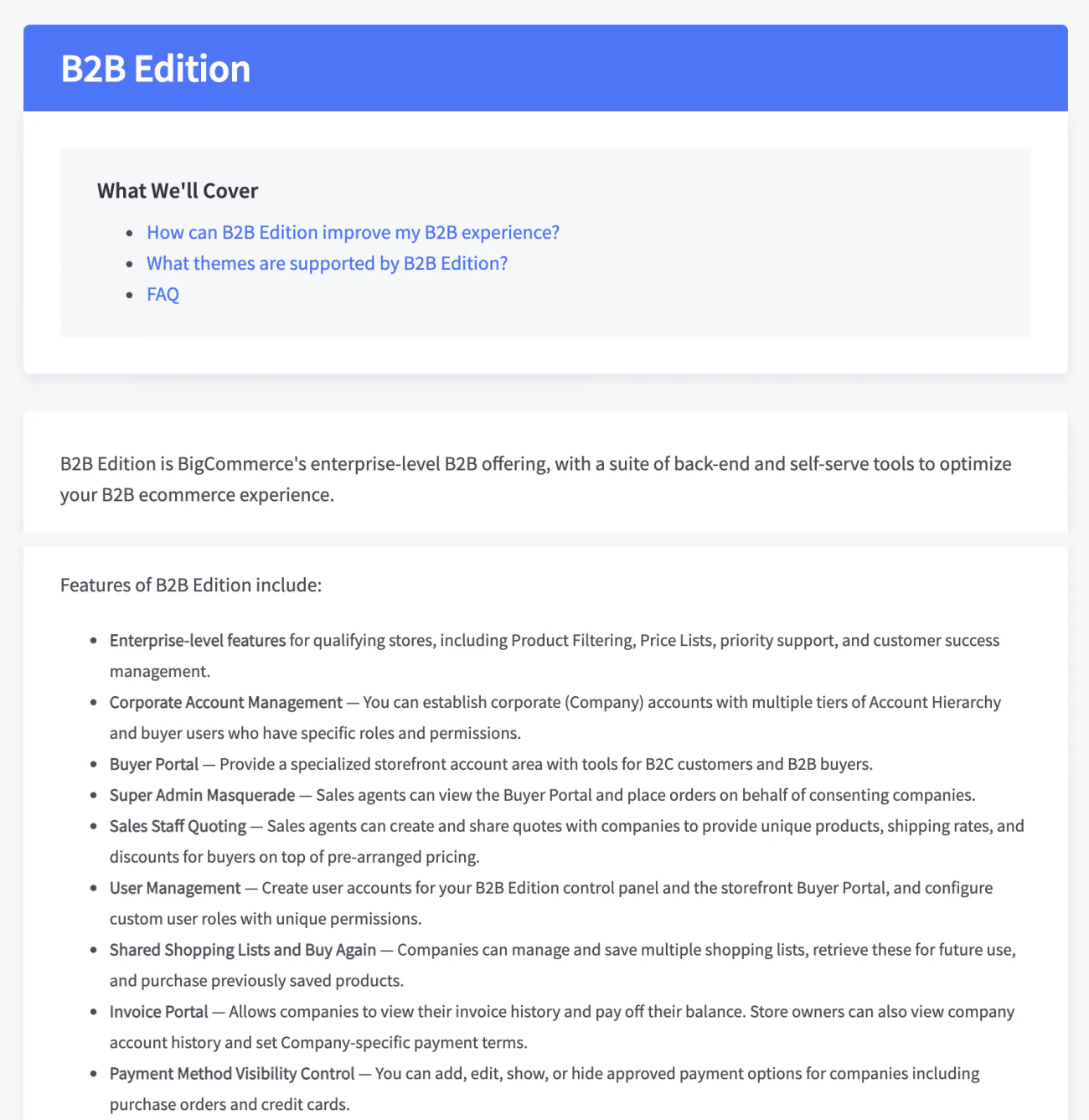
Plus adds a catalog for each company, deposits and partial payments. B2B Edition has no published price: you request it through your BigCommerce Customer Success Manager, or through BigCommerce's sales team if you have none.
On BigCommerce, paying by purchase order can cost a fee. It counts orders paid offline, purchase orders included, in its fee for providers outside its list. The fee runs on 90% of each order's value, so a $500 school order on Core adds 2% of $450, or $9. Shopify records the PO number on the wholesale order on every plan that has B2B.
Cart size is the last check. BigCommerce caps a guest's cart at 50 items and a signed-in customer's at 600, so bulk buyers order from an account. To set up Shopify's side, Shopify B2B has the steps by plan.
Can you run more than one store, or sell one abroad?
BigCommerce adds storefronts inside one account for a monthly fee per plan, while Shopify below Plus opens each store on its own plan.
| Plan | More than one storefront |
|---|---|
| BigCommerce Core | $30 a month for each one added, up to 3, as its table prints it |
| BigCommerce Growth | $50 a month for each one added, up to 5 |
| BigCommerce Scale | $100 a month for each one added, up to 8 |
| BigCommerce Performance | Through its sales team |
| Shopify Basic, Grow and Advanced | A separate store, created in the admin, on its own plan |
| Shopify Plus | Up to 9 expansion stores, and each live one needs its own theme license |
From BigCommerce's pricing page and Shopify's Help Center, read November 9, 2026.
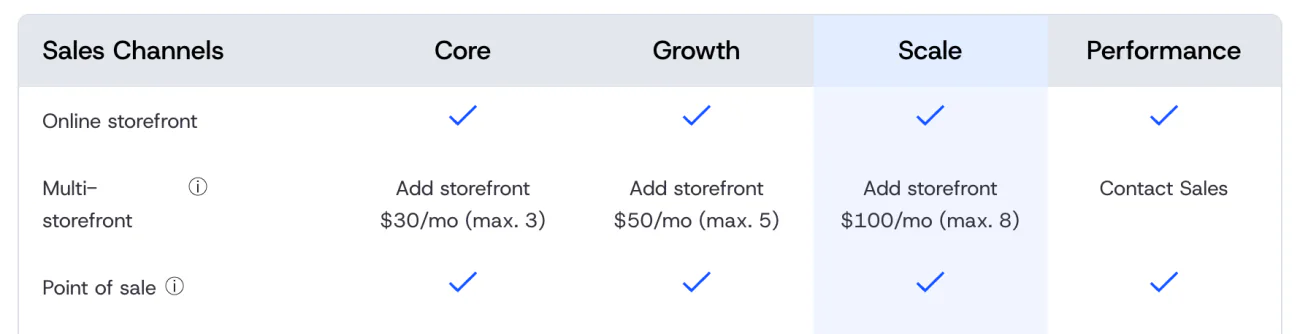
Below Plus, a new Shopify store starts in "Settings > Organization", the admin page that lists the stores in your organization. Take a store with two brands, paid yearly: on BigCommerce Core that is $29 plus $30, or $59 a month. Two Shopify Basic stores come to $58 a month, and you run each from its own admin.
One brand selling abroad is a different job. A single Shopify store sells into several markets in up to 20 languages, or 30 on Plus. Charging shoppers in their own currency works in full only through Shopify Payments. BigCommerce offers several currencies on every plan and 5 languages per storefront. Shopify multi currency covers the setup.
How many products and options can each hold?
Shopify allows 2,048 variants on a product with up to three options, and BigCommerce allows 600 with up to 250 values per option.
Each variant is one choice a shopper can pick, such as a medium blue shirt. A shirt in 12 colors, 8 sizes and 3 fits makes 288 variants, inside both limits. A fourth option, such as sleeve length, needs an app on Shopify. Older comparisons still give Shopify a limit of 100 variants. Its Help Center now gives 2,048 and warns only that some themes and apps show no more than 100.
Stock can sit in 10 locations on Shopify's Basic to Advanced plans and 200 on Plus. On BigCommerce the count is 4 on Core, 5 on Growth and 8 on Scale.
Apps fill the rest. Shopify's App Store says it has over 16,000, and BigCommerce says it has over 1,200. Add up the paid ones you would need before you compare plans: cutting your Shopify app bill shows where the money goes.
What moves when you switch from BigCommerce to Shopify?
Products and customers move by spreadsheet, while past orders and gift cards need a migration app, and Shopify's own guides have no BigCommerce page.
Gift certificates are the part that slips, because a spreadsheet won't carry them. Export everything BigCommerce lets you before you cancel, and note what it won't hand over. Then save a list of every old page address. Shopify imports a spreadsheet of old and new addresses and redirects each one, so old links and search results still land on the right page.
The move runs the other way too: BigCommerce's own menu offers to switch you from Shopify. Our guide to migrating to Shopify has the steps for keeping your search traffic.
FAQ
Questions, answered
-

14-day free trial
Explore Sledge on your store before you decide to commit.
-

No credit card required
Start improving your store with no upfront commitment.
-

Setup in minutes
Get Sledge running without a lengthy setup process.
-

Built to grow sales
Turn shopper behavior into actions that help you sell more.
Shopify vs BigCommerce: which is better?
It depends on the job. Shopify puts wholesale tools on its $29 Basic plan, sells one store in up to 20 languages and lists no sales limit. BigCommerce adds storefronts inside one account, takes no fee of its own on 21 named payment providers and moves you up a plan at $30,000 of counted sales.
Is Shopify or BigCommerce better for B2B?
Shopify includes company accounts, payment terms, PO numbers and up to 3 wholesale catalogs on Basic, Grow and Advanced, and Plus adds a catalog per company and deposits. BigCommerce adds customer groups on Growth and price lists on Performance. Its B2B Edition, with quotes and a buyer portal, comes by request with no published price.
Can Shopify run several stores like BigCommerce Multi-Storefront?
Yes, in a different way. Below Plus, you create each new store from Settings, then Organization, and it gets its own plan and its own admin. Shopify Plus includes up to 9 expansion stores. BigCommerce adds storefronts inside one account for $30, $50 or $100 a month each, depending on the plan.
How many variants can a product have on Shopify and BigCommerce?
Shopify allows up to 2,048 variants and three options on each product. BigCommerce allows up to 600 variants, with up to 250 values in each option. Older reviews that give Shopify a limit of 100 variants are out of date. Shopify's Help Center now warns only that some themes and apps show no more than 100.
How do I move from BigCommerce to Shopify?
Export your products and customers as spreadsheets and import them, or use a migration app from the Shopify App Store, which can also move past orders and gift cards. Shopify's free Store Migration app does not list BigCommerce. Before you cancel, save a list of your old page addresses and redirect each one. Our migration guide has the steps.
Picking Shopify? See what your store is missing.
Sledge doesn't pick a platform for you or change what either one charges, and it runs only on Shopify. There, it adds search, filters and offers to your store. Start free for 14 days, then pay from $29.99 a month, with no cut of your sales. Growth Intelligence turns on when you pick a paid plan and totals the fixes it lists in one dollar figure labeled "Est. potential".