
Shopify Capital is Shopify's own funding for stores that sell on it. In the US it is a loan from WebBank: you get a lump sum, agree a fee, and repay a fixed share of each day's sales within 18 months. You can't apply for it cold. Offers appear on your admin's Finance page.
A banner on your Finance page offers $15,000, about what next season's stock will cost. Then the questions start. What does it really cost, how much of each sale goes back, and what happens if a quiet month lands halfway through?
What is Shopify Capital?
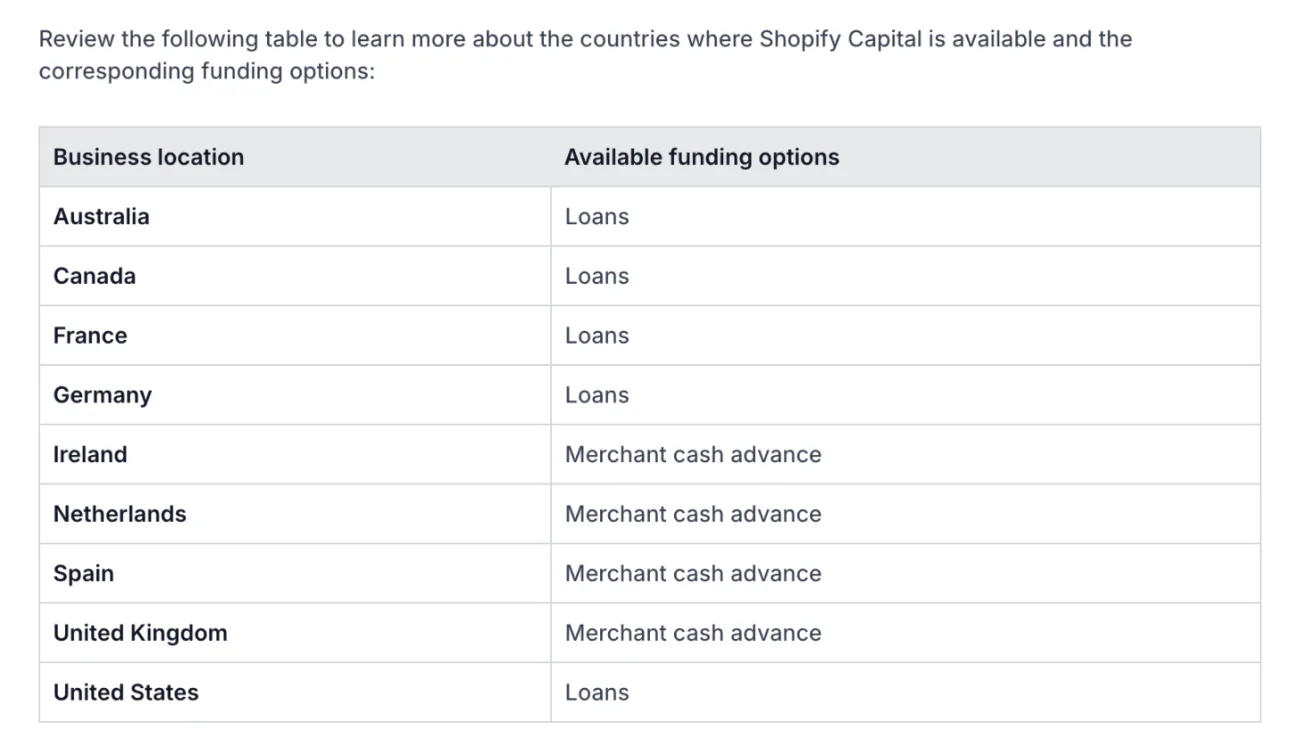
Shopify Capital is funding repaid from your sales, and where your business is based decides whether you get a loan or a cash advance. A loan is money you owe and pay back with a fee. A merchant cash advance sells part of your future sales for cash now.
| Where your business is | What you get | Deadline to repay |
|---|---|---|
| United States, Canada, Australia, France, Germany | A loan, with a set fee | 18 months at most |
| United Kingdom, Ireland, the Netherlands, Spain | A merchant cash advance | None |
In the US, every loan is issued by WebBank. The UK, Irish, Dutch and Spanish cash advances go through YouLend. In France, loans come from Banking Circle with YouLend.
Your store's currency has to match the country: US dollars in the US, pounds in the UK, Australian dollars in Australia, US or Canadian dollars in Canada and euros in the other five, as Shopify's eligibility page sets out.
How does Shopify Capital work?
Shopify makes the offer, you pick an amount, and a fixed share of each day's sales pays it back.
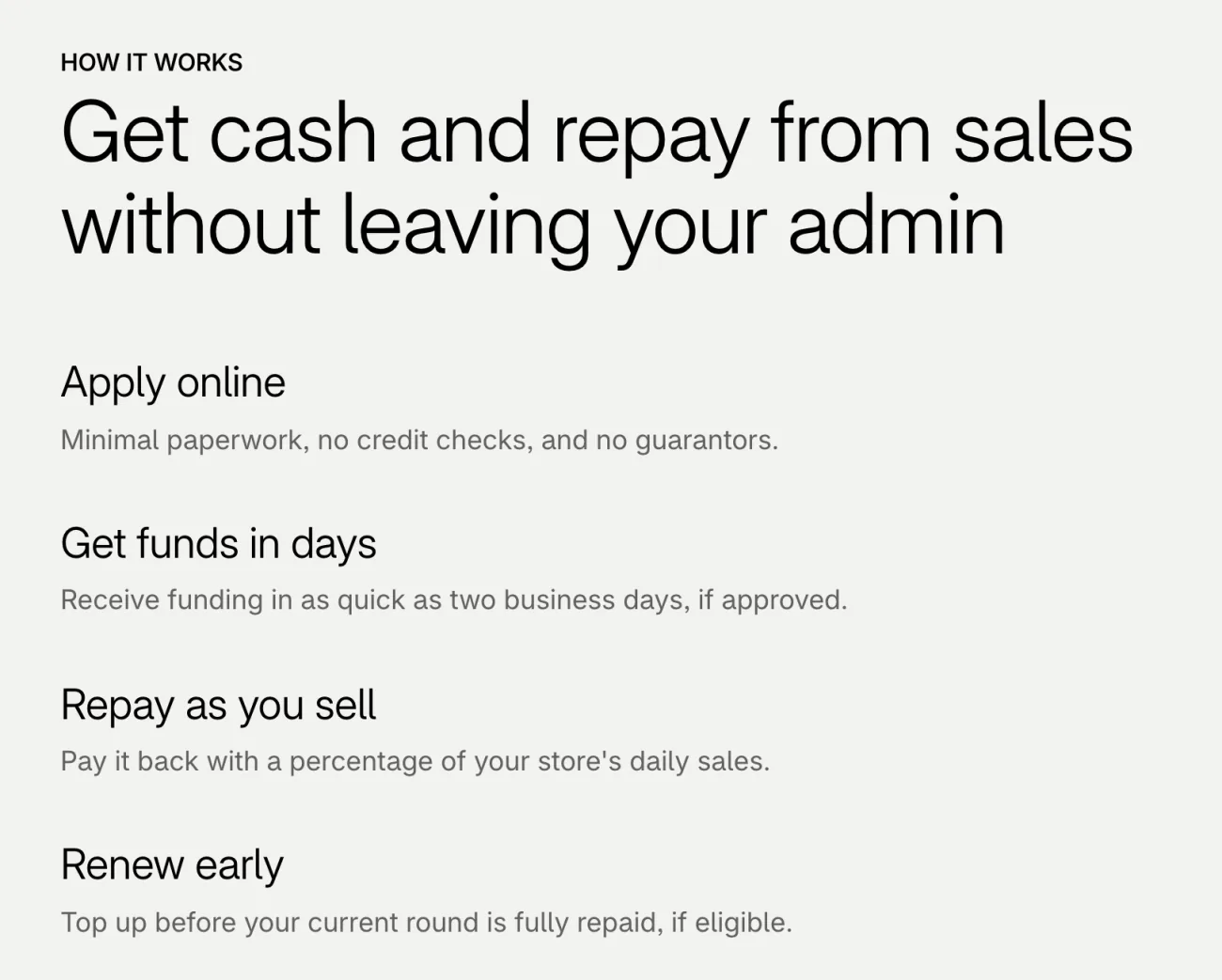
- An offer arrives. Shopify sends an email and posts a message on your Finance page.
- You pick an amount. On the Finance page, click "Capital" in the Accounts section, the list of your money accounts. In the US you first choose the fixed-fee or the monthly-fee plan. Then pick one of the offers or type your own amount. The fee and the daily share move with the amount, and you can't change the amount once you apply.
- You apply. Verify your identity, read the loan agreement and submit it.
- Shopify reviews it. That usually takes 1 to 3 business days.
- The money lands. It goes to your business bank account. The daily share starts within two business days.
These are Shopify's own steps for a US loan, as its Help Center lists them.
A second offer can come before the first one is repaid. Its repayments wait until the first is done.
How much does Shopify Capital cost?
You see the fee before you sign, and it never compounds like interest. In the US you pick one of two plans, and only one of them gets cheaper when you repay faster.
| Plan | Repaid in 3 months | Repaid in 11 months |
|---|---|---|
| Fixed fee of 13% | $13,000 | $13,000 |
| Monthly fee of $1,400 | $4,200 | $15,400 |
The fee alone in Shopify's examples for a $100,000 loan, in USD. Checked November 9, 2026, on Shopify's Help Center.
On the fixed fee, paying early does not cut the cost. Shopify's US page says the cost of funds stays the same even if you clear the whole balance. On the monthly fee, every month you finish sooner is a fee you skip. The first monthly fee is charged on the day the funding is confirmed.
A cash advance costs one set amount, like the fixed fee. In Shopify's UK example, you get £5,000 and pay back £5,650, at 10% of gross daily sales. The Irish, Dutch and Spanish pages use the same figures in euros. Your own fee and share depend on your risk profile, and Shopify publishes no standard rate.
The daily share comes from every order marked paid that day, with shipping, handling and tax included. Sales from other channels and apps count too, such as Shopify Marketplace Connect and Shopify Collective, and test orders do not. An order you refund or cancel later still counts, so you can repay a share of money you have already handed back.
Who is eligible for Shopify Capital?
A store in one of nine countries, open at least three months, with steady sales and a clean record with Shopify. Shopify checks every store on its own and keeps checking. It weighs these:
- Ownership. Only the store owner can apply.
- Location. The business and its bank account must be in one of the nine countries. For a loan, the person named on your Shopify Payments account must live there too.
- Age. The store has been active on a plan for at least three months, or made its first sale more than three months ago.
- Business type. Trusts and partnerships are not supported.
- Sales. Shopify says sales performance is the main factor.
- Your record. Disputes, returns, chargebacks and a reserve on your payouts all count, and so do failed payments of Shopify bills, Shopify Credit included.
- Products. Some products rule your store out whatever their legal status, cannabis and drug paraphernalia among them.
- A store for sale. Listing the store on Shopify Exchange, or selling it there recently, makes it ineligible.
Shopify also looks at how you use its platform, your payment providers, your payout schedule and whether you follow its terms. No email and no message on the Finance page means no offer today. There is no form to ask for one.
What happens to Shopify Capital if your sales drop?
A day with no sales takes no payment, but a loan still has to be paid off within 18 months. Shopify also checks a loan twice along the way. You need about 30% repaid by month 6 and 60% by month 12. Missing either check can put the loan in default under its agreement. If sales slow, Shopify suggests watching the balance and making a manual payment.
A made-up example. You borrow $10,000 on a 13% fixed fee and owe $11,300, at 10% of daily sales. Selling $1,000 a day, you finish in under four months. Drop to $150 a day and you repay $15 a day, about $2,730 by month 6. That falls short of the first check, so you would need a manual payment.
A cash advance has no deadline to finish. Paused or failed payments can still put it in default.
Repayment timing changed on March 9, 2026. New US loans now come out of your Shopify Payments balance, so the repayment no longer leaves your bank before the payout arrives. Shopify tries the balance several times before it debits your bank, and your payout details list the repayment under "Adjustments". Loans accepted before that date keep their bank debits. In Texas the change began on September 1, 2025, with no bank debit if the balance attempts fail.
Why did my Shopify Capital offer disappear or shrink?
Shopify recalculates offers every day, so an offer can grow, shrink or vanish. Shopify says an offer can expire without notice. After you apply, the review can lower the amount, and a lower amount can come with a different share of sales. You then apply again for the revised offer.
Paying a balance off early does not by itself qualify you for more, Shopify says. Shopify Credit can also cost you a Capital offer. A late Credit account rules your store out, and breaking Credit's terms can make open Capital funding due at once.
Some US stores may also see a Capital flex account, or a Capital account in the Shopify Balance app. Both are in early access.
Shopify Capital or a bank loan?
Capital follows the sales that already run through Shopify. A bank loan usually follows a fixed payment schedule.
| Question | Shopify Capital | A bank loan, usually |
|---|---|---|
| How you get it | Only through Shopify's offer | You apply |
| Cost | A fee, set before you sign | Interest over the term |
| Payments | A share of each day's sales | A fixed monthly amount |
| Credit check | None, says Shopify's Capital page | Yes |
| Security | In the US, business assets | Depends on the loan |
| Term | 18 months at most on a loan, no deadline on a cash advance | Varies |
The no-credit-check line comes from Shopify's Capital page, which also promises no effect on your personal credit score. The Help Center still asks you to verify your identity, and some offers ask for financial documents. In the US the security covers business assets, never your personal property. A UCC-1 statement may also be filed, a public notice of the lender's claim on those assets.
What changes while you owe Shopify Capital?
While a balance is open you can't switch off Shopify Payments or transfer your store. Moving your main payment provider to another company is restricted until the total is repaid. If you already use a third-party provider, you can change it at any time.
Selling the store waits as well. Shopify's ownership transfer page says a transfer cannot go through while you use Capital or Shopify Credit. Changing your bank account follows your country's rules, and in the UK it goes through Shopify Support.
FAQ
Questions, answered
-

14-day free trial
Explore Sledge on your store before you decide to commit.
-

No credit card required
Start improving your store with no upfront commitment.
-

Setup in minutes
Get Sledge running without a lengthy setup process.
-

Built to grow sales
Turn shopper behavior into actions that help you sell more.
Is Shopify Capital a loan?
In the US, Canada, Australia, France and Germany, yes: a loan with a set fee, repaid from a share of daily sales within 18 months. In the UK, Ireland, the Netherlands and Spain it is a merchant cash advance: Shopify buys part of your future sales for a lump sum now, with no deadline to finish.
Does Shopify Capital check your credit?
Shopify's Capital page says there is no credit check and no effect on your personal credit score. Offers come from your store's own record instead: sales, disputes, refunds, reserves and whether past Shopify bills were paid. In the US the loan is secured by business assets, and a public UCC-1 filing may be made.
How long does Shopify Capital take to fund?
Shopify reviews an application in 1 to 3 business days, sometimes longer. If it is approved, the money goes to your business bank account, and Shopify's Capital page says that can be as quick as two business days. Repayments from your daily sales start within two business days of the money arriving.
Can I request Shopify Capital if I have no offer?
No. Shopify checks every store on its own and shows offers on the Finance page of your admin and by email. No offer means your store is not eligible today. Shopify recalculates offers daily, so sales, disputes, reserves or a failed Shopify bill can bring one, change its size or take it away.
Can I pay off Shopify Capital early?
Yes. Under Finance, then Capital, click Make a payment and pay any amount over $1 or the full balance. On a fixed fee, paying early does not cut the fee: Shopify's page says the cost of funds stays the same. On the US monthly-fee plan, each month you owe nothing is a month without a fee.
What happens if you can't pay back Shopify Capital?
On a loan, slow sales stretch the payments, but you still owe about 30% by month 6, 60% by month 12 and all of it by month 18. Missing those can put you in default under the agreement, and Shopify suggests a manual payment to stay on track. A cash advance in the UK, Ireland, the Netherlands or Spain has no deadline, though failed payments can also mean default.
Planning what to stock? Find the next fix first.
Sledge doesn't lend money or change a Capital offer. It runs your store's search, filters and offers instead, with a 14-day free trial. Growth Intelligence turns on when you pick a paid plan. It reads your orders and searches, suggests what to fix next, and sums those fixes up as a single total in your store's currency, labeled Est. potential.