Referral marketing is a program that rewards a customer when a friend they sent places a first order. The usual deal is two-sided: the friend gets a discount and the customer gets store credit. On Shopify, a discount code and store credit can run a small program by hand, and a referral app counts at scale.
A customer tells her sister about your candles, and the sister orders. Nothing on your side links the two, so neither is thanked and nobody says it again. A referral program is the rule that links them and pays both.
What is referral marketing?
Referral marketing is a rule that rewards a customer when a friend they sent places a first order. It comes in two shapes. In a two-sided program both people are rewarded, and in a one-sided program only one is.
Shopify's guide says a two-sided program draws more engagement and suits most stores, and a one-sided one fits when margins are tight.
Talk with no reward attached is word of mouth. A creator who earns a commission on each sale is an affiliate, which Shopify Collabs covers. This page is about your own customers and a reward you set.
What are the benefits of referral marketing?
You pay only when a friend buys, and referred customers can be worth more.
- The reward is the main cost. A new customer costs what you promised, paid after the order, plus any app fee.
- A friend arrives with a person's word behind the visit. That is often a warmer start than an ad.
- The reward cannot fix a store people don't like. It pays for a recommendation. It does not create one.
One study is worth reading, with its limits. Researchers followed 10,000 customers one German bank won in 2006, about half through its referral program. In Wharton Knowledge's write-up, referred customers were about 18% more likely to stay, and their long-term value was 16% to 25% higher. Their margin edge faded to zero after about 1,000 days.
A bank is not a store, so read it as a direction, not a forecast.
How much should a referral reward cost you?
Set the reward from what you keep on a first order, not from what looks generous. Say a friend's first order is $80 and you keep about $32 of it after product cost, shipping and card fees. Three sample rules, as of November 2026:
| Shape | Friend gets | Customer gets | What the reward costs | Left of your $32 |
|---|---|---|---|---|
| Two-sided, flat | $10 off an order of $70 or more | $10 store credit | $20 | $12 |
| Customer only | Nothing | $15 store credit | $15 | $17 |
| Friend 15% off, customer credit | 15% off, or $12 on $80 | $10 store credit | $22 | $10 |
Count credit at face value. A credit never spent costs you nothing, but you can't know which credits those will be.
If the friend orders again at the same $80, the first row has earned $12 plus $32, or $44 across two orders. Cap how many credits one customer can earn, and put an end date on the code.
Store credit has its own rules, which Shopify's Help Center lists:
- The customer must be signed in, through customer accounts or Shop Pay, to use it.
- The full balance applies at checkout, never part of it.
- On stores created on or after May 12, 2025, credit paid at checkout is charged third-party transaction fees on the amount paid with it.
- You set an expiry each time you issue credit, and the screen warns that expiry law varies by country.
How do you run a referral program on Shopify without an app?
You look in your admin for a Referrals setting and find none. A friend orders on a customer's word, and nothing in the admin remembers whose.
Shopify has no referral setting of its own, but a discount code, a report and store credit can run a small program by hand. Shopify's own guide says you can build the rewards with discount codes and a report on how often each code is redeemed, and its Help Center lists store credit as a reward for a referral program. Steps 2 and 4 were checked in a Shopify admin on November 19, 2026. Steps 3 and 5 follow Shopify's Help Center, read the same day.
- Pick the reward. Use the table above and write the rule in one sentence.
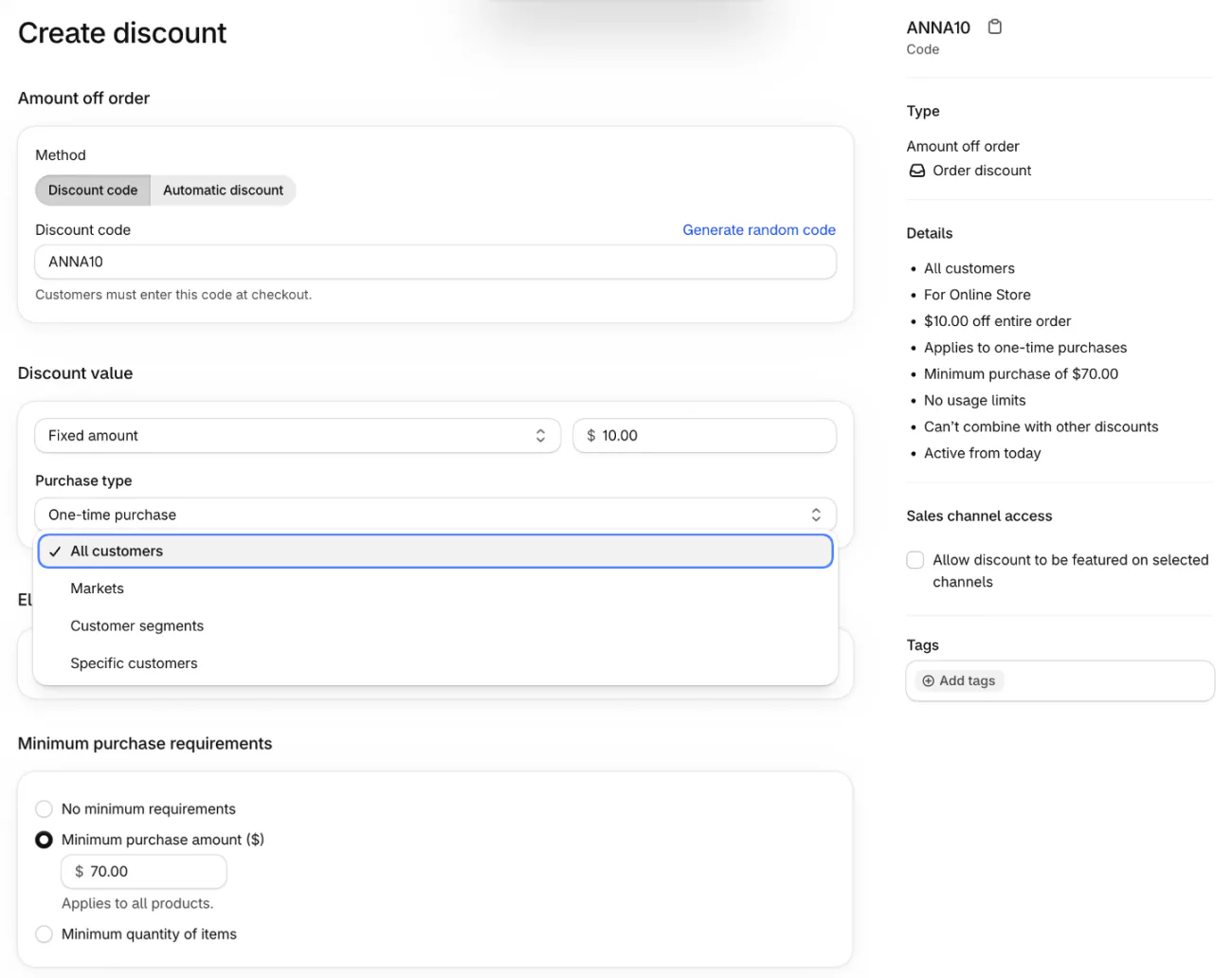
- Make one code per customer. In Discounts, click "Create discount", then choose "Amount off order", which discounts the total order amount. Name the code after the customer, choose "Fixed amount" under "Discount value", and under "Minimum purchase requirements" pick "Minimum purchase amount ($)". Keep "Eligibility", the choice of who can use it, on "All customers". One code per customer is how Shopify tells referrers apart, because its report groups sales by discount name.
- Give each customer a link. Open the code, click "Promote", then "Get a shareable link", and copy it. The code lands on the friend's cart when she arrives, and the link carries one discount. The customer can forward a message like this: "I found a shop you'd like. This link gives you $10 off your first order of $70 or more."
- Count the uses. Open Analytics, then Reports, then "Sales by discount codes". In its "Controls" panel, group by "Discount name" and read "Discounted orders" and "Total sales" for each code. A sale that uses two combinable discounts can be listed twice. The report doesn't say whether an order is the friend's first, so open the order and check.
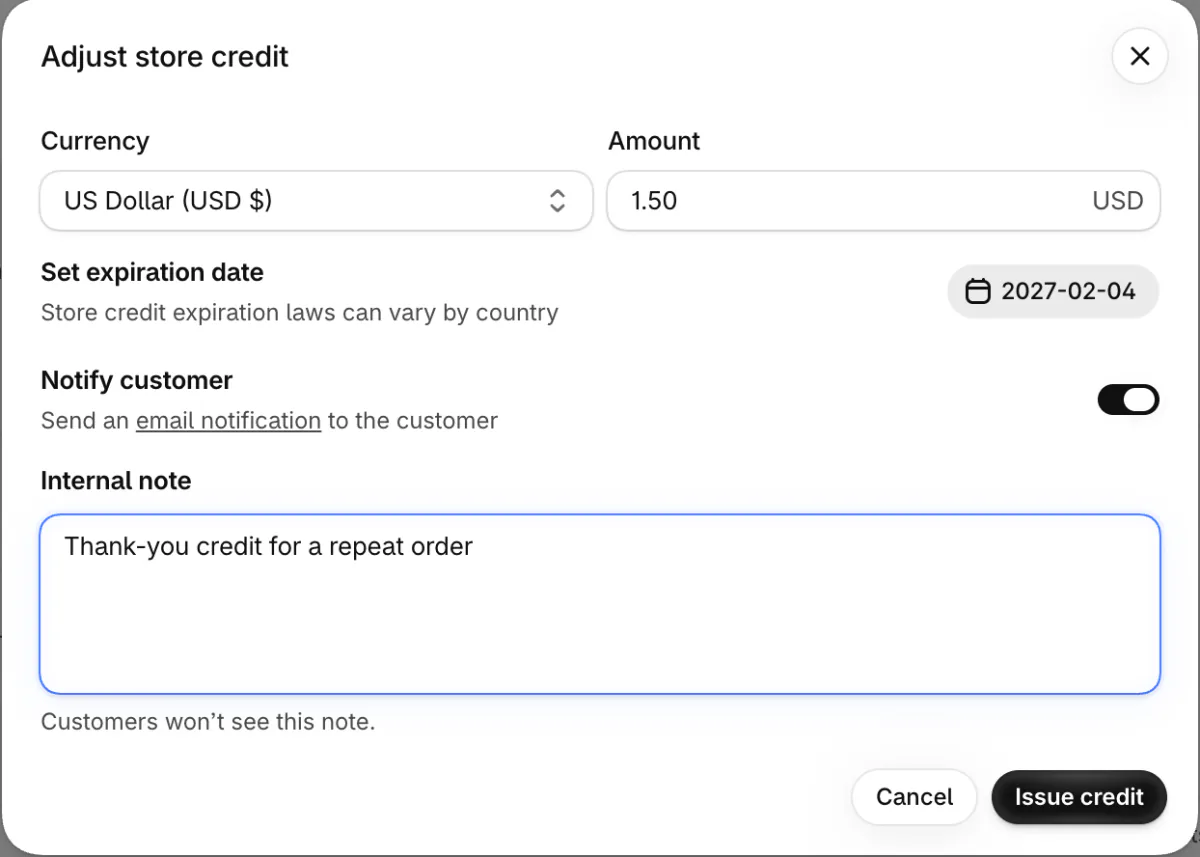
- Pay the customer. In Customers, open her profile, find "Store credit" and click "Edit". Enter the amount, set an expiry, switch on "Notify customer" and add a note such as the friend's order number. Then click "Issue credit".
When does an app earn its fee?
An app starts to pay for itself when you make codes by hand every week, or want each customer to get a link without you. A referral app can give each customer their own link, count it, pay the reward and check for self-referral.
You can start without one. If you switch later, a code made by another app gets no shareable link from your Shopify admin.
How do you stop people gaming a referral program?
A customer uses her own code. Three emails turn up with the same address book behind them.
Shopify checks the limits you set on a code, so set them before the first friend uses it. Each check is one idea:
- One use per customer. "Limit to one use per customer" tracks an email address or phone number, so a second email counts as a second customer. Pair it with "Limit number of times this discount can be used in total", set to what you would pay for. Shopify's mobile steps say the one-use limit applies to fixed-amount codes, so test a percentage code before you rely on it.
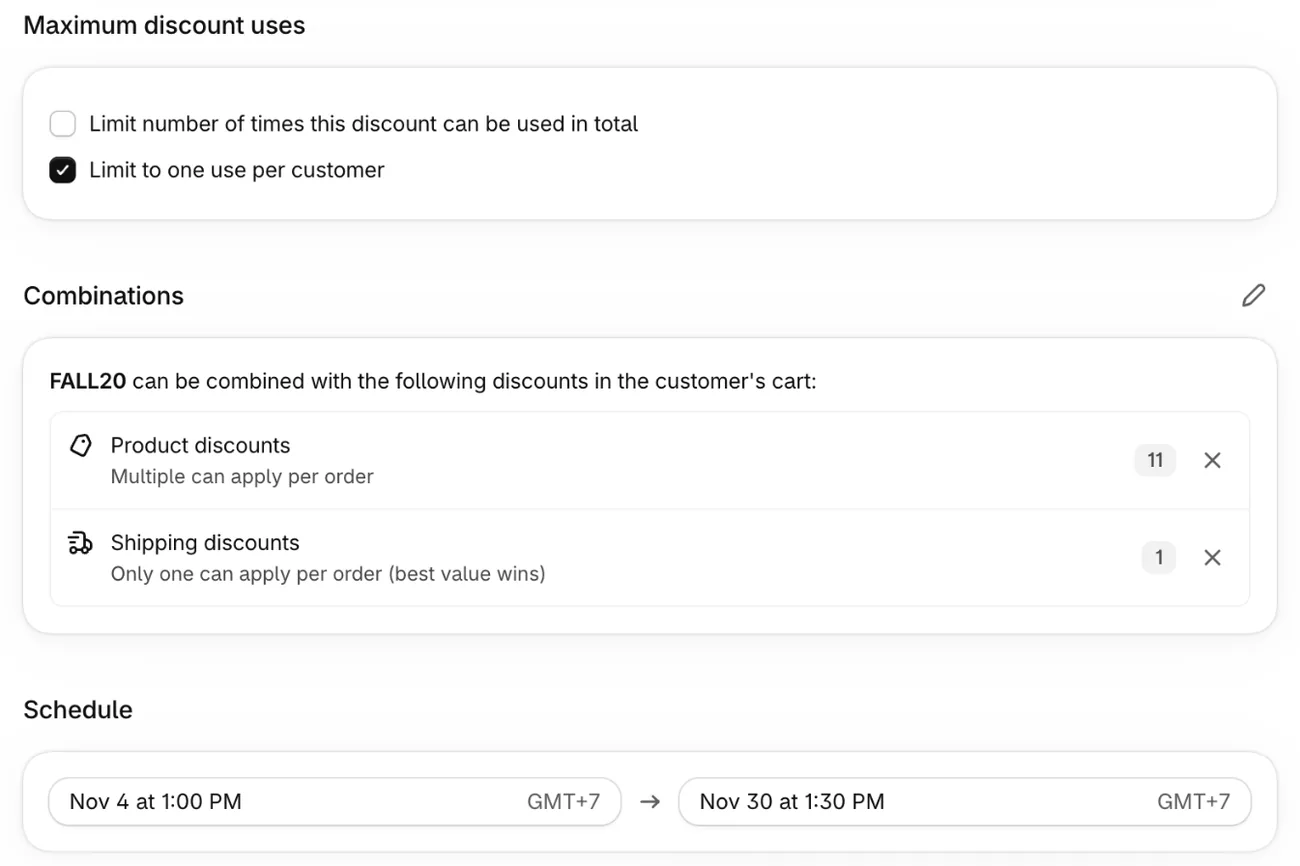
- A minimum purchase. It keeps a $10 code from covering most of a small order, and it counts product prices only, not shipping or taxes.
- First order only is not something a customer group can guarantee. A code limited to a customer segment, a saved group of customers, reaches people who already have a profile. Shopify's discounts FAQ says a first-time shopper has no profile until the first order is complete. So open the order and check it is the friend's first before you pay.
- Pay after the order ships and the return window passes. Make it a rule that a refunded order earns no credit.
- Cap what one customer can earn. Dropbox's own referral page does it: on its Basic plan a referrer earns 500 MB per referral, up to 16 GB.
- Combinations. If a sale runs, decide on purpose whether the code stacks with it. A customer can use up to 5 product or order codes and 1 shipping code on one order.
- Disclosure. A customer who gets a reward for posting about you should say so, as the FTC advises. This is not legal advice, and the word of mouth guide has the details.
Shopify's "Eligibility" list holds "All customers", "Markets", "Customer segments" and "Specific customers". None of them is "everyone except the code's owner", so checking the order against the code's owner is your step, or an app's.
What do referral marketing examples look like?
Four rules show the main choices: who is rewarded, when, and with what ceiling. The first three are samples, as of November 2026. The fourth is Dropbox's own, read November 19, 2026.
| Example | Friend gets | Referrer gets | Limit it sets |
|---|---|---|---|
| A candle shop | $10 off $70 or more | $10 store credit once the return window passes | One use per customer, an end date |
| A skincare shop | 15% off a first order | A free sample sent with the next order | At most 3 samples a year |
| A coffee roaster | Nothing | $5 credit after the friend's second order | Credit expires in 90 days |
| Dropbox, from its own page | Extra storage when the referral creates a new account | 500 MB per referral on Basic | Up to 16 GB on Basic |
The first three differ in who is paid and when. The fourth caps the total a referrer can earn. For points and tiers, see the loyalty program types, where a referral rule is one of eight.
Where does a friend enter a referral code?
A friend who arrives with a code has one job: find where it goes. Shopify's checkout shows the code box only while at least one discount code is active, and a shareable link puts the code on her cart for her.
Sledge makes no referral codes and counts no referrals. If you use it, its cart drawer has a "Discount code" block, the box where a shopper types a code, which stays off until you switch it on in the drawer's settings. It passes the code to Shopify's own discount, so Shopify still checks your limits at checkout. The steps are in the guide to discount codes in the cart.
FAQ
Questions, answered
-

14-day free trial
Explore Sledge on your store before you decide to commit.
-

No credit card required
Start improving your store with no upfront commitment.
-

Setup in minutes
Get Sledge running without a lengthy setup process.
-

Built to grow sales
Turn shopper behavior into actions that help you sell more.
What is referral marketing?
Referral marketing is a program that rewards customers for bringing in new ones. A customer shares a link or code, a friend places a first order, and both get a reward, usually a discount for the friend and credit for the customer. Affiliate marketing differs: partners earn a commission on each sale they send.
What are the benefits of referral marketing?
You pay only when a friend buys, so the main cost of a new customer is the reward you set. One study of about 10,000 customers of a German bank found referred customers stayed longer and were worth 16% to 25% more over time. A bank is not a store, so read it as a direction, not a forecast.
How much should a referral reward be?
Set it from what you keep on a first order. If you keep about $32 of an $80 order, a $10 discount for the friend and $10 credit for the customer leaves about $12 on that first order. Count credit at face value, pay it once the return window closes, and cap how many a customer can earn.
Can you run a referral program on Shopify without an app?
Yes, a small one. Shopify's own guide says you can build the rewards in your admin with discount codes and a report on how often each is redeemed, and its store credit page lists referral rewards as a use for credit. You create each code and issue each credit by hand, so an app takes over the counting as referrers grow.
Does referral marketing work for B2B?
It can, with a different reward. In Wharton's write-up of the bank study, one of its authors says paid referral programs are likely to stay with consumers, because paying a business customer's employees could be seen as a bribe. If you sell wholesale, reward the company with credit or a discount, not the person.
Can Sledge run a referral program?
No. Sledge makes no referral codes, counts no referrals and pays no rewards. It works on the visit after the click, with search, filters, product cards and a cart drawer that can show a box for the friend's code. Use Shopify's discounts and store credit, or a referral app, to run the program itself.
A friend arrives with a code. Does your store finish the sale?
Sledge doesn't run a referral program. It makes no referral codes, counts no referrals and pays no rewards, so use Shopify's discounts and store credit or a referral app for that. It works on the visit after the click: search, filters, product cards and a cart drawer that can show a box for the friend's code. Try it free for 14 days. Growth Intelligence turns on when you pick a paid plan, and its suggested fixes add up to one dollar figure, labeled Est. potential.