
Gross sales are what the items you sold add up to at their selling price. Net sales are gross sales minus discounts and sales reversals, which take back refunds, returns, cancellations and edits. In Shopify, both sit in the Finance summary's Total sales breakdown, and net sales leave out shipping and tax.
Say one month's report shows $12,600, $10,220 and $12,210 for what looks like the same thing, your sales. All three are right. Each one is a different line of the same report, and each line counts something else.
What is the difference between net sales and gross sales?
Gross sales are what your items sold for before anything comes off, and net sales are what is left after discounts and sales reversals. Shopify's Help Center gives the formulas in the table.
| Line | How Shopify works it out |
|---|---|
| Gross sales | The selling price times the quantity ordered. |
| Net sales | Gross sales minus discounts, then minus sales reversals. |
| Total sales | Net sales plus shipping charges, taxes and fees. |
Shopify renamed Returns to Sales reversals in March 2026, so older guides still say returns. A reversal covers a refund, a return, a cancellation or an edit to an order.
Textbook definitions take off returns, allowances and discounts, and they differ by source: one guide also subtracts taxes. An allowance is a price cut you give after the sale, such as for a damaged item. Shopify has no allowance line, so Discounts and Sales reversals cover it, and a goodwill refund lands in Sales reversals. For the climb from net sales to profit, read revenue vs profit.
How do you calculate net sales?
Net sales equal gross sales minus discounts minus sales reversals. Gross sales are the first line only: the price times the quantity, before anything comes off.
Say 300 items sell at an average of $42, so gross sales are $12,600. Discounts take off $1,540 and sales reversals take off $840. The table walks from gross sales to total sales.
| Line | Example month | What happens to it |
|---|---|---|
| Gross sales | $12,600 | The start |
| Discounts | $1,540 | Taken off |
| Sales reversals | $840 | Taken off |
| Net sales | $10,220 | What is left |
| Shipping charges | $1,210 | Added |
| Return fees | $0 | Added |
| Taxes | $780 | Added |
| Total sales | $12,210 | Net sales with all three added |
Net sales stop at $10,220. Product costs come off next, in gross profit, and card fees and ads come off on the way to profit margin. A profit and loss template for Shopify works from net sales down to profit.
Where do you find gross sales and net sales in Shopify?
Open Analytics, then Reports, filter the Category to Finances and open Finance summary.
- In your Shopify admin, open Analytics, then Reports.
- Click the Category filter and pick Finances.
- Click "Finance summary", the report that adds up your sales.
- Read the card "Total sales breakdown", which Shopify's Help Center describes as the key figures that add up to total sales.
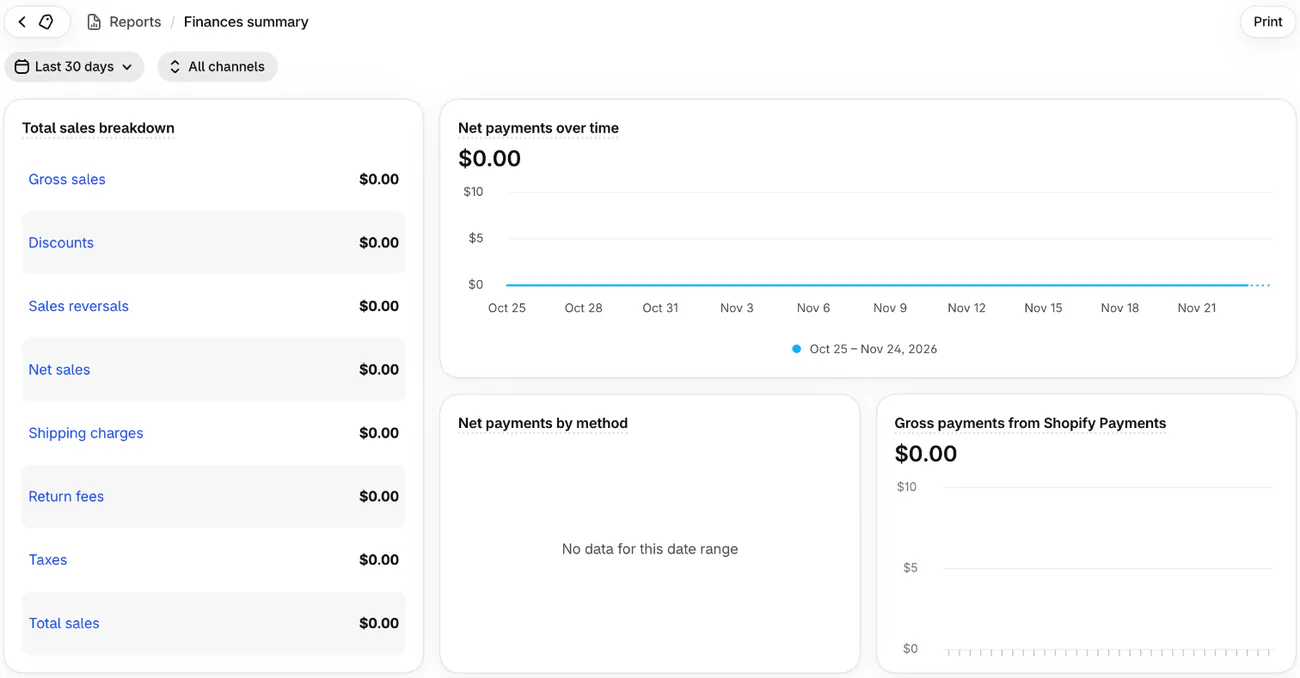
The card links to a report for gross sales, discounts, sales reversals, net sales, shipping and taxes, says Shopify's Help Center. The same source says the Total sales figure also shows in the overview on Shopify Home, so that figure adds shipping, taxes and fees to net sales. Its Analytics page says the main features are available on any plan, and its Finance reports page names no plan for the Finance summary.
Shopify's Help Center says its sales reports use these same terms.
Filtering, saving and exporting a report are covered in Shopify reports: which to open for each question.
What do gross sales and net sales leave out in Shopify?
Tax, shipping and fees are in neither number. Shopify's sales reports count unpaid and pending orders in both, and a canceled order in gross sales.
- Tax, shipping and fees. The Help Center says gross sales leave out all three, and net sales leave out shipping charges and taxes. Shopify's Finance reports page says a refunded shipping charge and its taxes show in the shipping and taxes figures, not in Sales reversals.
- Unpaid, pending and canceled orders stay in. The sales reports count them, and a canceled order comes off net sales later, as a sales reversal. Test orders and deleted orders are left out.
- Gift cards you sell. Sales reports leave a gift card you sell out, and it shows in its own finance report, "Net sales from gift cards". An item paid for with a gift card counts at its full value.
- A price you cut yourself. Shopify says discounts come from discount codes, not the crossed-out compare-at price, so a price you mark down yourself shows as lower gross sales and not as a discount. A flash sale run as a discount lands in Discounts, and one run by lowering prices lands in gross sales.
- Card fees and product costs. Neither number holds them. Credit card processing fees shows what a card fee is made of.
Which month does a refund count against?
A sale counts on the day the order was placed, and a refund counts on the day you process it.
Say a $60 scarf sells on November 29 and you refund it on December 4. November keeps the $60 in gross sales and net sales. December gets a sales reversal of $60, so December's net sales fall.
Shopify dates the reversal on the day it is processed, not back in the month of the sale, and a day with more reversals than sales can show negative total sales. When returns run high, set two months side by side to see which one carried the refunds.
Your payouts will not match net sales either, because sales and payments run on different clocks. The Sales finance report counts an order when it is placed, and the Payments finance report counts a payment when the customer makes it, so an order placed in May and paid in June sits in two months. A Shopify Payments payout also reflects payout timing, card fees, refunds and held funds, not only order dates.
To cut the refunds themselves, see ecommerce returns and how to reduce returns.
Should you use gross sales or net sales?
Use gross sales to see demand and net sales to see what stayed.
| Question | Read this | Why |
|---|---|---|
| What did your items sell for before any discount? | Gross sales | Discounts and refunds do not shrink it. |
| What did the promotion bring in after discounts and refunds? | Net sales | It is gross sales with both taken off. |
| Why are net sales far below gross sales? | Discounts, then Sales reversals | Those two lines are the whole gap. |
| What did customers pay, and when? | The Payments finance report | It counts payments when customers make them. |
Neither number is profit. Which one goes on a tax form, or in front of someone buying your business, is a question for your accountant. Shopify's average order value, for example, uses gross sales minus discounts, which is neither of these two numbers, as ecommerce KPIs explains.
FAQ
Questions, answered
-

14-day free trial
Explore Sledge on your store before you decide to commit.
-

No credit card required
Start improving your store with no upfront commitment.
-

Setup in minutes
Get Sledge running without a lengthy setup process.
-

Built to grow sales
Turn shopper behavior into actions that help you sell more.
What are net sales in Shopify?
Net sales are gross sales minus discounts and sales reversals. Shopify's Help Center says net sales leave out shipping charges and taxes. Find the figure under Analytics, then Reports, then Finance summary, on the card named Total sales breakdown, where it sits beside gross sales, discounts and sales reversals.
Does net sales include tax or shipping?
Not in Shopify. Net sales stop before shipping charges and taxes, which Shopify adds back to reach Total sales. Other sources define net sales differently, and at least one also subtracts taxes, so check which definition a report, or whoever is buying your business, uses before comparing two figures.
Is net sales the same as revenue or profit?
Net sales are not profit. They come before product costs, ads and card fees, so profit is smaller. Shopify's revenue guide treats net sales and revenue as one figure when a product company reports net sales as its only operating revenue. Your accountant may use other terms, so ask which one they want.
Why doesn't my net sales match my payouts?
Sales reports count orders on the day they are placed, whatever their payment status. Payouts count money Shopify Payments deposits later, after card fees, refunds and held funds. Net sales also leave out tax and shipping. To reconcile them, use Shopify's payments finance reports and its Shopify Payments activity report.
Which date does a refund count against?
The day you process it. Shopify shows a sale on the day the order was placed and a sales reversal as a negative number on the day it was processed. A November sale you refund in December lowers December's net sales, and November keeps the sale.
Does Sledge report net sales?
No. Shopify's Finance summary reports net sales. Sledge Analytics has a card named Revenue from Sledge, which counts sales of products bought in a Sledge bundle or clicked in a Sledge tool in the week before the order. It is not your net sales or your profit.
Which of your sales came through Sledge?
Sledge does not calculate net sales or profit. Shopify's Finance summary reports net sales. Sledge runs your search, filters and bundles. In its Analytics, "Revenue from Sledge" counts sales of products bought in a Sledge bundle, or clicked in a Sledge tool, in the week before the order. Try it free for 14 days. Growth Intelligence turns on when you pick a paid plan. Its suggested fixes add up to one dollar figure, labeled Est. potential.