Revenue vs profit: what is the difference?
Revenue is the money your sales bring in before any cost comes off, which is why it is called the top line. Profit is what stays after you pay for the products, shipping, ads, apps, wages and income tax: the bottom line. The revenue vs profit difference is your costs: a $14,000 month might keep $1,050.
Revenue vs profit example: one month, line by line
Start with revenue, subtract what the items you sold cost you, then subtract everything else. Say a month brings $14,000 in net sales, and every order ships free.
| Line | One month |
|---|---|
| Revenue: net sales, after discounts and returns | $14,000 |
| Minus what the items you sold cost you | $6,160 |
| Minus shipping labels, card fees, ads, apps, wages and income tax | $6,790 |
| Profit | $1,050 |
The $7,840 left after product cost is your gross profit. The $1,050 at the bottom is net profit, also called net income. As a share of revenue it is a 7.5% profit margin.
Which Shopify number is your revenue?
Open Analytics, then Reports, and choose "Finance summary". The "Total sales breakdown" card starts with "Gross sales", what your items sold for. "Discounts" and "Sales reversals", such as returns and refunds, come off next, leaving "Net sales". Shopify's revenue guide treats net sales as revenue when product sales are all you earn. "Total sales" reads higher, because it adds shipping, tax and any extra fees customers paid. That tax goes to the government.
A Shopify Payments payout is neither revenue nor profit. It is what customers paid, tax included, minus card fees, refunds, chargebacks and any funds held back. Shopify's help says the Shopify Payments activity report "isn't a statement of revenue". In the month above, shoppers paid $14,910 with tax, and $480 of card fees leaves $14,430. That is more than your revenue and nearly 14 times your profit, because tax, products, ads and apps are still paid from it. Under Finance, click "View payouts" to see each one's charges, refunds and fees.
Can a store have revenue but no profit?
Yes, whenever costs outrun sales. Add $1,500 of ads to that month with no extra orders, and the $1,050 profit turns into a $450 loss while revenue still reads $14,000. A sale adds profit only when it leaves something after its own costs, its contribution margin.
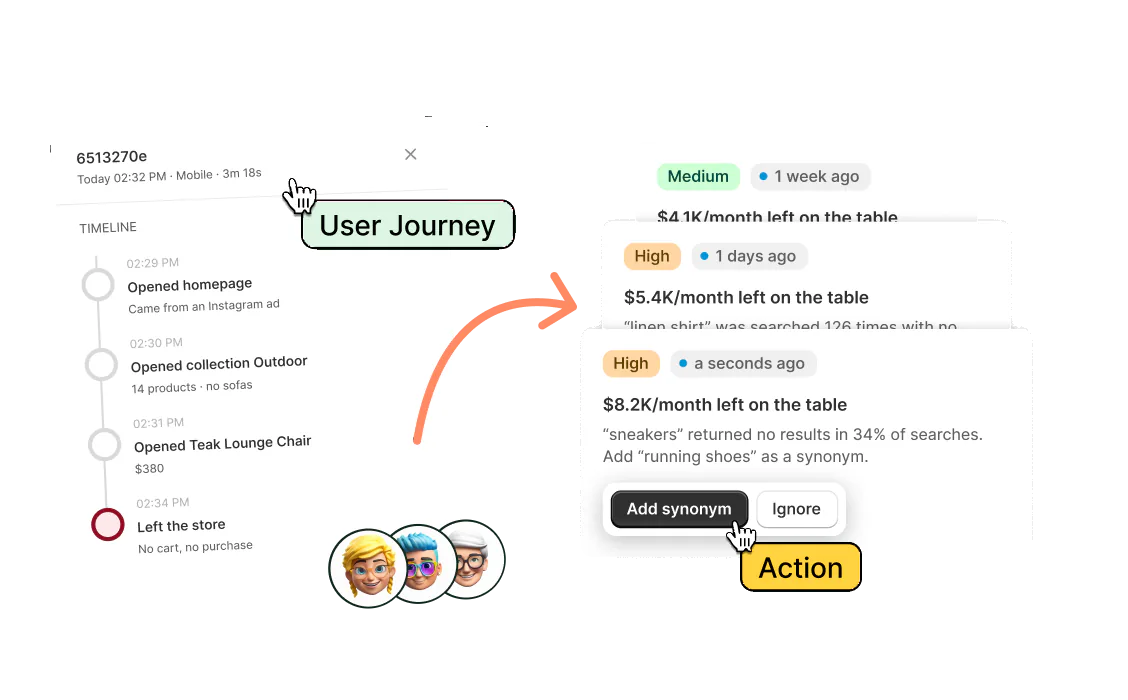
Sales from search and bundles, with Sledge
Sledge does not read your costs, so it shows no profit. It runs your search, filters and bundles. In Sledge Analytics, "Revenue from Sledge" counts sales of products bought in a Sledge bundle, or clicked in a Sledge tool, such as search, in the week before the order. That figure is revenue, not profit. Growth Intelligence turns on when you pick a paid plan. It suggests fixes, and one figure, labeled "Est. potential", estimates the sales they could add in total.