How to price handmade items starts with your cost to make: your materials, your hours at a pay rate you choose and your share of monthly bills. Double it as a starting price, then compare similar pieces. In Shopify, type the cost under Cost per item and the Price card shows your margin.
Say you've sold 40 hand-stitched card holders at $24. Leather, thread and a box cost $8 each, Etsy fees took $2.73 and your monthly bills add $2 a piece. Each one took an hour. That leaves $11.27 an hour, and $24 looked like a fair price.
What goes into the cost of one handmade item?
Your cost to make is three lines: materials and packing, your hours at a rate you choose, and your share of monthly bills.
Say you make hand-stitched leather card holders. Here is one piece.
| Line | How you work it out | Per piece |
|---|---|---|
| Leather, thread and box | What you pay for one piece | $8.00 |
| Your pay | 1 hour at $20 an hour | $20.00 |
| Share of monthly bills | $80 of bills across 40 pieces | $2.00 |
| Cost to make | The three lines added up | $30.00 |
After the leather, the Etsy fees and your share of the bills, the $24 price paid you $11.27 for an hour you priced at $20.
Time one piece from the first cut to the taped box, photos and messages included. Time three and use the average. For the bills line, divide a month's bills by the pieces you sell in a month. Overhead costs lists what counts.
How do you price handmade items once you know your cost?
Double the cost to make for a starting price, then check it against what shoppers pay for similar pieces.
A $30 cost makes a $60 price. That is a 100% markup and a 50% margin, and markup vs margin explains why the two percentages differ. Your pay is already inside the $30, so the other $30 is what the business keeps before fees, ads and slow months.
Doubling is a rule of thumb, so treat it as a place to start. The method is called cost plus pricing.
For the market check, look up similar pieces. Then say in your product description what is different about yours, such as the materials and the craftsmanship, as Shopify's pricing guide advises. That is value-based pricing. If similar pieces sell for less than $60, look at the materials and the hours before you lower your pay rate.
How do you add your cost in Shopify?
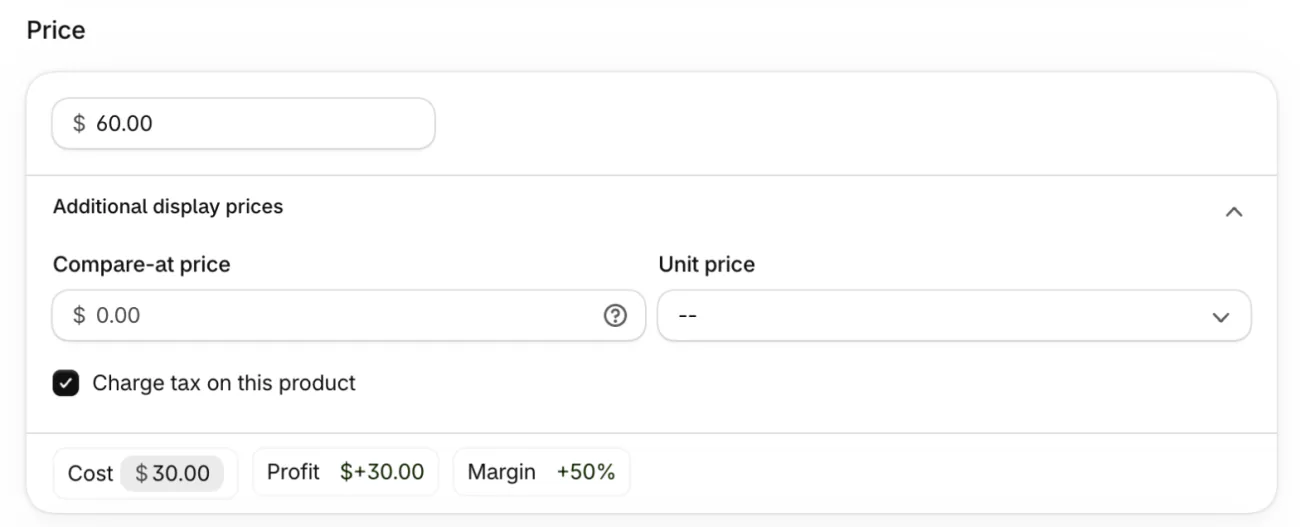
Type the cost to make in the Cost per item box, and Shopify prints your profit and margin on the product.
Shopify's Help Center says a product you make yourself can carry a value based on your labor and material costs. Put your pay in it, and the profit Shopify shows is what is left after you are paid.
- In your Shopify admin, click Products, then the piece.
- In the Price section, click "Cost per item", the chip for what one piece costs you.
- Type 30.00 in the "Cost" box.
- Click Save.
- Read Profit and Margin in the Price section. At a $60 price, they show $30.00 and 50%.
A few rules come with the box:
- Each size or color needs its own cost.
- A changed cost leaves past orders as they were, so update it when the leather price rises.
- To fill in many pieces at once, use the bulk editor, or import a product spreadsheet with a Cost per item column.
- Shopify hides Profit and Margin when tax is charged on the product and your prices include tax.
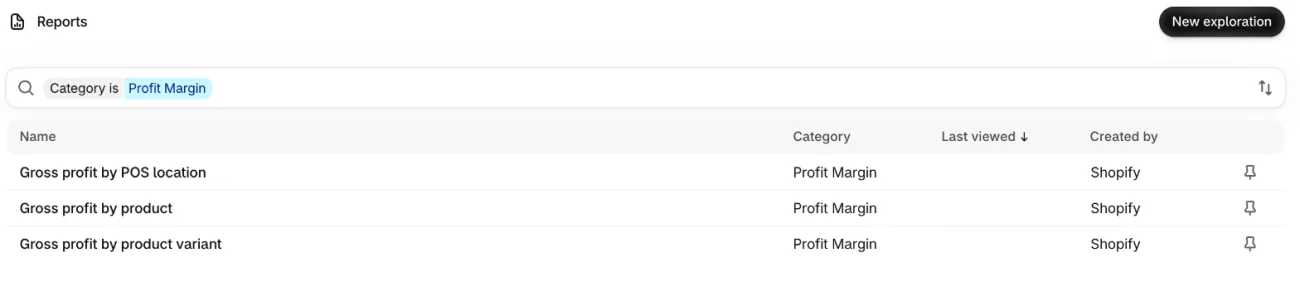
Once your pieces have costs, Analytics, then Reports, filtered to the Profit Margin category, lists three reports, "Gross profit by product" among them. That one counts only pieces that had a cost when they sold. Review your costs every few months.
What do Etsy and Shopify fees take out of your price?
On a $60 piece, Etsy's fees come to $6.15 and a Shopify store's card fee to $2.04, and both come out of your $30 margin.
These are US figures as of November 2026, for a buyer paying by a standard US card with no shipping charged.
| On a $60 sale | Etsy | Shopify store |
|---|---|---|
| Listing | $0.20 | $0 |
| Transaction fee | 6.5%, $3.90 | $0 |
| Payment processing | 3% + 25 cents, $2.05 | 2.9% + 30 cents, $2.04 |
| Fees on the sale | $6.15 | $2.04 |
| Left of the $30 margin | $23.85 | $27.96 |
| Monthly plan | $0 | $39, or $29 paid yearly (Basic) |
The Shopify column uses Shopify Payments on the Basic plan. Etsy's 6.5% and its processing fee also count any shipping you charge. An order that comes from an Etsy Offsite Ad adds 15%, or 12% once a shop passes $10,000 in sales in 365 days.
Etsy's fees buy a place in its marketplace. Shopify's plan is due whether or not anyone orders. Price with the fee in view, since the price tag never shows it.
The full comparison, with the break-even point, is in Etsy vs Shopify fees, and Shopify vs Etsy sets the two platforms side by side.
Does your price still work if a shop buys it wholesale?
At double your cost, half of retail pays your cost to make and nothing more.
Shopify's wholesale guide gives the keystone rule, wholesale at half of retail, and warns that it may not leave enough margin. Run it on the card holder. A $60 retail price makes a $30 wholesale price, and your cost to make is $30. Your hours are paid and the business earns nothing.
You have three ways out. Raise the retail price so half of it still leaves a margin. Take wholesale only in larger orders. Or sell retail only.
Shopify's B2B tools on the Basic plan and above hold a wholesale price in a catalog, as a percentage adjustment to your store prices or as a fixed price. Wholesale pricing covers the math, keystone pricing the half rule, and Shopify B2B the setup.
Should a handmade price end in .99 or a round number?
Test both, because round prices did better for purchases driven by feelings in one 2015 study.
Shopify's guide defines odd-even pricing as setting a price just below a round number, such as 19.99 instead of 20.00. In that study, a camera for a family vacation did better at a round price, and a camera for a class project did better at a non-round one. Our reading is that a handmade gift is a purchase driven by feelings. That makes a round $60 worth testing against $59.99 on a few pieces, though the study did not test crafts.
You change the price in the same Price card. Psychological pricing covers the other studies, and A/B testing prices shows how to run the test.
How do you price pieces you make after the order?
Price it at the same cost to make, then let the product stay buyable at zero stock.
The cost to make has the same three lines. Leather bought per order means no stock sitting on a shelf. Put the making time in the product description, so shoppers know how long to wait.
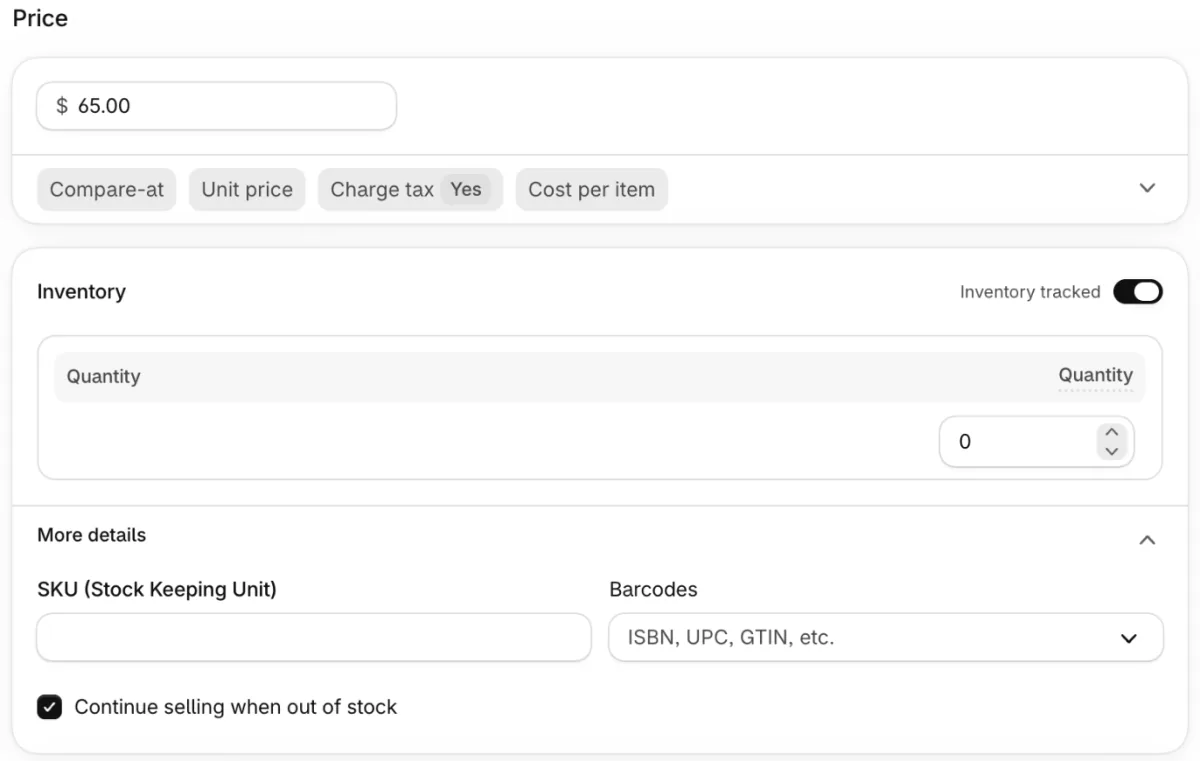
In Shopify, open "More details" in the Inventory card and tick "Continue selling when out of stock", the box that lets customers buy at zero. Shopify's Help Center names it for made-to-order items. It does not apply to Shopify POS.
A pre-order app such as Sledge turns that setting on for the products you pick, adds a "Pre-order" button, and shows a note in the cart, at checkout and in the order email. Closing the campaign switches back only what it changed.
FAQ
Questions, answered
-

14-day free trial
Explore Sledge on your store before you decide to commit.
-

No credit card required
Start improving your store with no upfront commitment.
-

Setup in minutes
Get Sledge running without a lengthy setup process.
-

Built to grow sales
Turn shopper behavior into actions that help you sell more.
How much should I charge for handmade items?
Start from your cost to make: materials and packing, your hours at a pay rate you choose and a share of monthly bills. Double it for a first price, which leaves a 50% margin, then compare similar pieces and adjust. Doubling is a rule of thumb, so test it against what shoppers pay.
How do you price your labor on handmade items?
Pick an hourly rate you would accept from an employer. Then time one piece from the first cut to the taped box, photos and messages included, and multiply hours by the rate. Time three pieces and use the average. That figure goes into the cost to make, before any markup.
What is odd-even pricing, and should handmade items use it?
Odd-even pricing ends a price just under a round number, like $49.99, or on one, like $50. A 2015 Journal of Consumer Research study found round prices did better when a purchase is driven by feelings. A handmade gift may be that kind of purchase, so test a round price against .99 on a few pieces.
How much do Etsy fees take from a $60 handmade item?
In the US, $6.15 as of November 2026: $0.20 to list it, $3.90 in transaction fees (6.5%) and $2.05 to process the payment (3% plus 25 cents). Offsite Ads add 15% on orders that come from an ad. Shipping you charge counts toward both percentages. Our fee comparison works a whole sale.
What should you charge wholesale for a handmade item?
Shopify's wholesale guide gives the keystone rule: the wholesale price is half the retail price. If you doubled your cost to make, half of retail only covers that cost, your hours included, and leaves nothing over. Raise the retail price, or take wholesale only in bigger orders.
Do you put your own pay in Shopify's Cost per item?
Yes, if you want Profit and Margin to show what the business keeps after paying you. Shopify's Help Center says a product you make yourself can carry a value based on your labor and material costs. Each size or color needs its own cost, and a changed cost leaves past orders as they were.
Gift sets and made-to-order pieces, with Sledge
Sledge does not read your costs or suggest prices. It can group pieces you hand-pick into a fixed bundle, a gift set at a percentage or fixed amount off, and open a pre-order on made-to-order pieces, with a "Pre-order" button and a note shoppers see in the cart, at checkout and in the order email. Growth Intelligence turns on when you pick a paid plan, and its suggested fixes add up to one figure, labeled Est. potential.