What is customer lifetime value (LTV)?
Customer lifetime value, or LTV (also CLV), is the total one customer spends with your store across every order. The formula is average order value times orders a year times years of buying. Three $45 orders over two years make a customer worth $135.
How do you calculate customer lifetime value?
Say last year brought $54,000 from 1,200 orders by 800 customers. Average order value is revenue divided by orders: $45. Purchase frequency is orders divided by customers: 1.5. Lifespan is the years a customer keeps buying, say two. Lifetime value is $45 × 1.5 × 2 = $135.
Multiply by gross margin for profit instead of sales. A young store has no lifespan yet: guess one or two years, then adjust.
Why does customer lifetime value matter?
Lifetime value caps what you can pay to win a customer. If an ad costs $40 per new customer, the $45 first order barely tops that $40, and the $135 over two years more than triples it. Shopify's blog calls a 3:1 ratio of lifetime value to acquisition cost the benchmark, though your target depends on your margins and costs. Lifetime value also shows where the next dollar goes: new shoppers, or bringing back the ones you have.
Historical vs predictive customer lifetime value
Historical lifetime value adds up what customers already spent: exact, but backward-looking. Predictive lifetime value forecasts future orders from how often, how much and how recently each customer buys. Start with historical: a forecast needs years of orders to mean much.
Where does Shopify show customer lifetime value?
Shopify's closest numbers sit under Analytics, then Reports, with the Category filter set to Customers. In "Customer cohort analysis", switch the metric to "Amount spent per customer": each row shows the average historical lifetime value of one month's new buyers. With 24 months of data, a "Show projections" toggle adds a forecast. "Returning customers" lists each repeat buyer's total spend, taxes and shipping included. "Predicted spend tier" sorts customers into High, Medium and Low once your store tops 100 sales. To skip the math, compare Shopify analytics apps or profit and lifetime value apps.
Customer lifetime value with Sledge
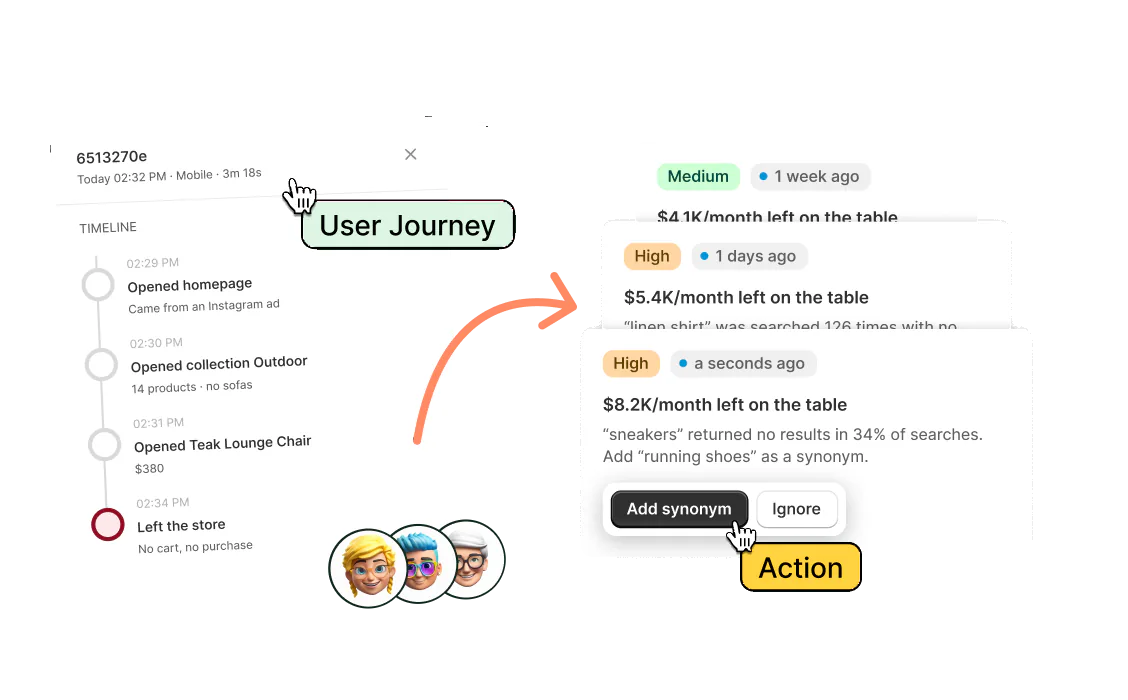
A shopper's page in Sledge Analytics shows a "Lifetime value" tile: that one shopper's spend so far. Sledge does not calculate lifetime value for your store. Growth Intelligence turns on when you pick a paid plan. From your last 90 days of orders, it can flag when too few customers order again and suggest a fix, under its goal "Increase repeat purchase". It totals what its fixes could add in one dollar figure, labeled "Est. potential", then measures the result against real sales.