A line sheet is a short document that lists each product you sell wholesale with its photo, SKU, wholesale price, MSRP, minimum order and lead time, so a shop can order from it. A sell sheet pitches one hero product on one page. Copy both templates below, then build the line sheet from a Shopify export.
A boutique owner replies to your message: "Love the candles. Send me your line sheet." You have product pages, an order history and the price shoppers pay. You don't have one page a shop can order from.
What is a line sheet, and how is it different from a sell sheet?
A line sheet lists your products with prices and terms so a shop can order, and a sell sheet is one page that sells one product.
| Document | What it does | What it covers | Prices |
|---|---|---|---|
| Line sheet | Lets a shop order | Your range, or one collection | Wholesale price and MSRP, with minimums and terms |
| Sell sheet | Opens the conversation | One hero product on one page | Sources disagree, see the sell sheet section |
| Price sheet | Quotes numbers fast to a shop that already knows you | Every product as a row | Wholesale price, MSRP, minimum and effective date, no photos |
| Lookbook | Shows the look of your brand | Styled photos | None |
Send a line sheet to a new buyer and a price sheet to one who is reordering, as JOOR and Brandboom, two wholesale platforms, both advise.
Shopify's own wholesale glossary treats a catalog as another name for a line sheet, so ask a buyer which one they mean, and read what a product catalog is for the catalog side. Jump to the sell sheet template.
What goes on a line sheet?
Each product needs what a shop orders from: a photo, a style name, a SKU, a case pack, the wholesale price, the MSRP and a minimum.
Free to use. Replace each highlighted bracket and delete what you don't need. The terms, the six candles and their prices are made up, so set your own.
Line sheet
Brand. [Your brand name], [website], [contact name, email, phone].
Collection. [Spring 2027]. Prices good from [January 15, 2027]. Version [1].
Ordering terms. Opening order minimum [$200]. Reorder minimum [$100]. Payment [Net 30 for approved shops; first order paid at checkout]. Lead time [5 business days for stock items]. Shipping [buyer pays shipping]. Returns [damaged goods replaced if reported within 7 days].
Photos. [One clean photo of each style, beside its row]
| Style | SKU | Barcode | Case pack | Wholesale | MSRP | Minimum |
|---|---|---|---|---|---|---|
| Cedar Grove candle, 8 oz jar | CND-CED-8 | [barcode] | 6 | $14.00 | $28.00 | 12 |
| Lavender Field candle, 8 oz jar | CND-LAV-8 | [barcode] | 6 | $14.00 | $28.00 | 12 |
| Fig Leaf candle, 8 oz jar | CND-FIG-8 | [barcode] | 6 | $14.00 | $28.00 | 12 |
| Cedar Grove travel tin, 2 oz | CND-CED-2 | [barcode] | 12 | $6.00 | $12.00 | 24 |
| Lavender Field travel tin, 2 oz | CND-LAV-2 | [barcode] | 12 | $6.00 | $12.00 | 24 |
| Gift set, three 2 oz tins | CND-SET-3 | [barcode] | 4 | $18.00 | $36.00 | 8 |
Written for this page, November 2026. Shopify Help Center checked November 24, 2026.
Each wholesale price above is half its MSRP, which is called keystone pricing. Wholesale pricing covers how to set yours.
- Give each size or scent its own row and SKU, so a shop orders exactly what it wants.
- Add a barcode if you have one, because Shopify's help says barcodes might be required when you sell wholesale to retail stores. A UPC code is the common kind.
- Put the MSRP beside the wholesale price, so a shop sees what it earns: 12 jars cost it $168.00 and sell for $336.00 at full price.
- Date every copy and number the versions. An old copy in a buyer's inbox can still quote old prices.
- Keep it as short as your range allows and split a large one by collection, because one maker guide says two pages at most.
- Wholesale prices don't belong on a public page, so send the file to each buyer or put the prices behind Shopify B2B's sign-in.
How do you build a line sheet from your Shopify products?
Shopify's export gives you the product rows, and you add the wholesale columns it doesn't have.
- Show only the styles you sell wholesale. In Products, use "Search and filter", the box above the list, to show one collection or one tag.
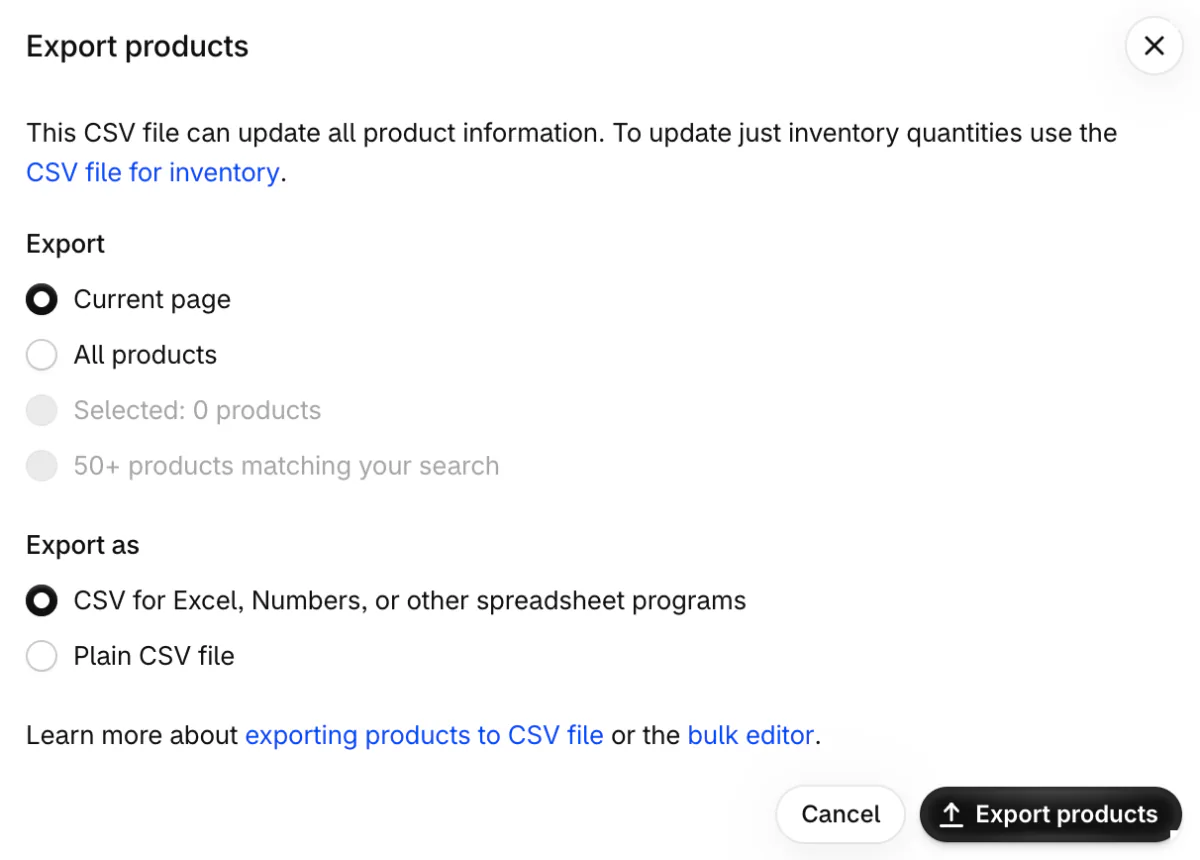
- Click Export. In the "Export products" window, pick the products matching your search, keep "CSV for Excel, Numbers, or other spreadsheet programs", and click "Export products". Shopify downloads the file or emails it to you, as its help describes.
- Trim a copy of the file in a spreadsheet. Keep the title, SKU, barcode, size or scent, price and photo link, and delete the rest. Shopify's sample product file has a "Cost per item" column, so look for it in yours and delete it first. It holds what each product costs you, and a shop must never see that. Never import the trimmed copy back, because sorting the file can scramble sizes and photos.
- Add what Shopify doesn't have. The file has your retail price, so use it as the MSRP, then add columns for the wholesale price, case pack, minimum and lead time. It has no collections and no pictures, only photo links, so filter by collection and export one file per section, and drop in one clean photo per style.
- Save it as a PDF. Name it with your brand, the season and the date, and send that file to each buyer.
Many products to fix before you export? The bulk editor changes them in one table.
Can an app build the line sheet for you?
Several Shopify apps build a line sheet from your live products. These five are examples, listed A to Z.
- B2B Catalog & Linesheet Maker publishes an online catalog with an order form and sends buyers' orders to Shopify as draft orders.
- Catalogs + LineSheets Pro B2B makes PDF catalogs and line sheets as spreadsheet files.
- Line Sheet Studio shares one link to a line sheet that stays current.
- Linesmith Line Sheets makes PDF line sheets, and its paid plans put the wholesale price beside the suggested retail price and add an Excel order form.
- MakeSheet makes line sheets and price lists as PDFs, with spreadsheet order forms on its paid plans.
On November 24, 2026, three of the five offered a free plan and three had no reviews yet, so read each listing before you install. You can also skip the apps and do it by hand, as above.
How do buyers order once they have your line sheet?
You send the line sheet first, and Shopify B2B takes the order at your wholesale prices once the shop signs in. Shopify B2B runs on the Basic, Grow, Advanced and Plus plans, not on Starter or Retail, and the Shopify B2B guide has the full setup.
| Line sheet column | Where it lives in Shopify |
|---|---|
| Wholesale price | Markets, then Catalogs. Take a percentage off your prices, or set a fixed price per product. A fixed price wins. |
| Case pack | The "Increment" rule, in the catalog's "Quantity rules" column. Set it to 6 and a shop orders 6, 12 or 18. |
| Minimum | The "Minimum" rule. It counts each size or scent alone, so two scents don't add up to one minimum. |
| Opening order minimum | Not part of a catalog. Shopify's free Checkout Blocks app sets a minimum order value, for all customers or only for B2B companies. |
| Price breaks | Volume pricing, up to 10 price breaks per product. |
| Payment terms | On each company location: net 7, 15, 30, 45, 60 or 90, "Due on fulfillment", or none. |
| The shop | Customers, then Companies, then "Add company". |
Keep these numbers the same as the ones on your PDF, so a shop orders what you quoted. Quantity rules and price breaks come with all four B2B plans.
A shop sees B2B prices only after it signs in, so the PDF is the page you send before it has an account. On Basic, Grow and Advanced you get up to 3 active catalog assignments across your B2B markets, and one catalog on two markets counts as two. Plus has no limit.
Shopify's Quick order list, a section its free themes can add to the product page, lets a buyer add several sizes or scents in one go.
A shop that orders from your line sheet may send a purchase order, and a free template shows what one holds. Shopify's own B2B checklist points you to apps for quotes and downloadable invoices, and what an invoice is covers the bill that follows.
What goes on a sell sheet?
A sell sheet is one page about one hero product, written to win a shop's interest before it opens your line sheet.
Copy this and fill in each bracket.
Sell sheet
Headline. [One line on why a shopper buys it]
Photos. [Your best photo of the product] and [one photo of it in use].
The product. [Name], [size], [materials or scent notes].
Why it sells. [A real number, such as units sold or reviews, with the dates it covers]
Key facts. [SKU], [barcode], [case pack], [case size and weight], [lead time].
Price. [Leave off, or wholesale price and MSRP]
How to order. [Link to your line sheet or wholesale sign-in], [email], [phone].
Written for this page, November 2026.
Guides disagree on prices. One guide for brands moving from online to retail says never to print wholesale pricing on a sell sheet. Another says usually not, because prices differ by buyer and the sheet gets forwarded. A glossary lists wholesale and retail price among its contents. Paper size varies too, so check what your print shop and your buyers expect.
For the "Why it sells" line, Shopify's "Total sales by product" report, under Analytics, then Reports, gives you real units sold, and which Shopify report to open covers the rest.
FAQ
Questions, answered
-

14-day free trial
Explore Sledge on your store before you decide to commit.
-

No credit card required
Start improving your store with no upfront commitment.
-

Setup in minutes
Get Sledge running without a lengthy setup process.
-

Built to grow sales
Turn shopper behavior into actions that help you sell more.
What is a line sheet?
A line sheet is a wholesale document that lists each product you sell with its photo, SKU, wholesale price, suggested retail price, minimum order and lead time. Shop buyers use it to compare your range and decide what to order. Unlike a lookbook, which sells your brand's look, it sells the numbers.
What is the difference between a line sheet and a sell sheet?
A line sheet covers your whole range with prices, minimums and terms, so a buyer can order from it. A sell sheet is one page about one hero product, written to win interest. You can send the sell sheet first to open the conversation, and the line sheet once the buyer is ready to order.
What should a line sheet include?
For each product: a photo, name, SKU, barcode, sizes or scents, case pack, wholesale price, suggested retail price and minimum. Once at the top: your opening order minimum, payment terms, lead time, shipping, returns, contact details, and the date the prices take effect. Put a date or version on every copy you send.
Should a sell sheet show wholesale prices?
Guides disagree. Two say to leave wholesale prices off, and one adds that prices differ by buyer and a sell sheet gets passed around. A third lists wholesale and retail price among its contents. If you leave them off, put them on your line sheet or a separate price sheet, and share that with the buyer directly.
How do I make a line sheet from my Shopify products?
Go to Products and filter the list to the styles you sell wholesale. Click Export, keep the CSV for Excel, Numbers, or other spreadsheet programs, and open the file in a spreadsheet. Delete the Cost per item column. Then add columns for wholesale price, case pack, minimum and lead time, and save the sheet as a PDF.
Does Shopify B2B replace a line sheet?
No. Shopify B2B holds your wholesale prices in catalogs and lets approved shops order once they sign in, and a shop can't see those prices before it signs in. A line sheet is the document you send first. Keep its numbers the same as the catalog's, so the shop orders what you quoted.
Shops get a line sheet. What do your shoppers get?
Sledge doesn't build line sheets, set wholesale prices or manage company accounts. It runs search, filters, volume discounts and bundles in your Shopify store, and the first 14 days are free. Growth Intelligence turns on when you pick a paid plan. It reads your store's searches, carts and orders, suggests fixes, and shows what they could add as one dollar total, labeled "Est. potential".