How to prepare Shopify search for Black Friday shoppers
Part 4 of 10 in the Black Friday series
Summarize with AI
Shopify search matches fields on your products, so a query like black friday has nothing to match against, and the results page cannot return a collection at all. Pull last year's eight-day search window, separate the words that name products from the words that name an intent, and give the second group a destination.
Someone types black friday into your search bar on the morning of the 27th. The biggest sale of your year is live, sitting in a collection with that exact name on it. The results page has no way to hand it to them.
Which words spike only in the sale window?
The ones a monthly review flattens into noise. Shopify's behavior reports hold searches by query, top searches with no results, and searches with no clicks, on any custom date range back to 2 September 2022.
Set that range to the eight days around last Black Friday. The same window you read your orders in works here: eight days of sale behavior look nothing like eight days of November.
Reading last year rather than watching this year is not caution, it is the only option. Shopify's search reports run up to 72 hours behind, so the terms shoppers typed on Black Friday can reach you as late as Cyber Monday, with the weekend already spent.
What separates an intent word from a product word?
Whether anything in your catalog is called that. Hoodie is a product word: somewhere you have a product with hoodie in the title. Deals is not. Neither is gift, half price, or black friday.
Shopify search matches against title, body, product type, tag, vendor, variant title, SKU, and barcode. Every one of those describes a product. An intent word describes a reason to buy, so no amount of tuning makes a product field contain it, and the fix has to be a destination rather than a match.
Baymard Institute's 2026 ecommerce search benchmark rates non-product queries the weakest query type it audits, with 66% showing issues. Worse than abbreviations, worse than use cases.
Why does one misspelling find your sale and another finds nothing?
Two rules, both published, and neither one obvious from the outside. A search term has to differ by a single letter or carry two letters in swapped order. The first four letters have to be right.
Typo tolerance also does not run on every field. For products it reads title, product type, variant title, and vendor, and stops there.
So tagging every product in the sale black-friday is invisible to typo tolerance, because tags are not one of the four fields it looks at. The tag still works for an exact query. A slipped letter walks straight past it.
Worth testing the same way a shopper would fail: search your best seller with the second letter dropped, then with the fifth letter wrong, and watch which one still lands.
| What they typed | What Shopify can match it against | Where it should land |
|---|---|---|
| black friday, bf sale, deals | Nothing. No product field contains it | The sale collection, by redirect |
| gift, gift set, present | Only products carrying the word in a field | Your gift entry point |
| jackt, sneakrs | The four typo-tolerant fields, if the first four letters hold | The product, by typo tolerance |
| half price, cheap, 50 off | Nothing. Price is a filter, not a word | A filtered view of the sale |
Can a shopper search their way to your sale collection?
Not from the results page. It returns products, pages, and articles, and a collection is not among them.
The predictive dropdown is a different engine, which is why this looks half broken rather than clearly broken. It can suggest collections, but only by matching the collection title, only in your store's primary language, and only when your theme asks for that resource type. It also prefix-matches, while the results page wants complete words.
So the suggestion appears as someone types, then vanishes the moment they press enter.
Shopify has no native search redirect either: the URL redirect tool works on paths, not on search queries, so nothing in the admin can point black friday at the page built to answer it. There is no warning to find. Just a setting that does not exist.
Sledge search closes that gap from the other end. A keyword redirect sends a query like black friday straight to the collection you choose, before a search even runs. When a query does come back empty, the no-results screen fills with your store's most-searched terms and your best sellers rather than a dead end. Typo tolerance corrects on titles and brand names, so a slipped letter in a product name still lands. Manual synonym groups carry no 20-per-group or 1,000-per-store ceiling.
What happens to your boosted hero when it sells out?
It stops being boosted, silently. Shopify product boosts apply to available products only.
You boosted one product for gift back in October. On the Friday it does exactly what you hoped, and by early afternoon it is gone. The boost lapses with it. The query it was answering falls back to default ranking, and nothing tells you.
Decide the understudy now. One product carries at most 10 boosted search terms, so the replacement needs its own. Shopify also lets you display, hide, or place out-of-stock products last across both search and predictive search. Check that setting before the traffic, not during it.
What comes down after the sale?
More than you remember adding. Synonyms are capped at 20 per group and 1,000 for the whole store, each one unique store-wide, and every seasonal phrase you map spends part of that permanently.
Synonyms have two blind spots as well. They do not apply to SKU or barcode matching, and a query using search syntax ignores them.
Which is why the January note gets written in November. Note what you added, what earned its place, and what came back empty across the BFCM weekend. Repairing an empty term is its own job, and next November it starts from that list instead of a blank page.
Before the traffic arrives, all of this has to be true
- Last year's eight-day search window is open, not last month's report.
- Every term on it is marked as a product word or an intent word.
- Each intent word has a destination written beside it, and that page exists.
- Your top product words survive a wrong fifth letter, tested rather than assumed.
- Nothing important depends on a tag being read by typo tolerance.
- Each boosted product has a named replacement for when it sells out.
- The seasonal terms carry an end date, and someone owns taking them down.
FAQ
Questions, answered
-

14-day free trial
Explore Sledge on your store before you decide to commit.
-

No credit card required
Start improving your store with no upfront commitment.
-

Setup in minutes
Get Sledge running without a lengthy setup process.
-

Built to grow sales
Turn shopper behavior into actions that help you sell more.
Can I see what shoppers searched for during last year's Black Friday?
Yes. Shopify's behavior reports cover searches by query, top searches with no results, and searches with no clicks, with data available from 2 September 2022 onward and a custom date range. Set that range to last year's sale window rather than reading a monthly total.
Why does Shopify search find one misspelling but not another?
Two documented rules decide it. A term has to differ by one letter or have two letters transposed, and the first four letters have to be correct. Typo tolerance also runs on only four product fields: title, product type, variant title, and vendor.
Can a shopper search their way to a collection page on Shopify?
Not from the results page, which returns products, pages, and articles. The predictive search dropdown can suggest collections, but it matches on the collection title only, in your store's primary language only, and only when your theme requests that resource type.
Does Shopify have a search redirect feature?
No. Shopify's URL redirect tool works on paths rather than search queries, and the Search and Discovery app does not document a redirect. Sending a query like black friday to your sale collection needs theme code or an app that redirects a search term to a page you choose.
Should black friday be a search synonym or a redirect?
A redirect, or a collection built to answer it. A synonym maps one word onto another word your products contain, and no product in your catalog is called black friday. Save the synonym budget for words that name real things you sell.
What do I do with search terms that only appear once a year?
Treat them as scheduled work rather than permanent settings. Note the term, the destination, and the date it stops being true. Shopify caps synonyms at 20 per group and 1,000 per store, each unique store-wide, so seasonal vocabulary you never remove quietly spends that budget forever.
Do shoppers really search for BFCM terms on my store?
Some do, and not one of those queries can match a product. Deals, sale, and black friday name a reason to buy rather than a thing you stock, so they need a destination instead of a keyword match. Pull last year's sale window and you will see which of them your own shoppers typed.
How far before Black Friday should search changes go live?
Early enough to read the result, which in practice means weeks rather than days. The no-results report runs up to 72 hours behind, so a change made on the Friday of the sale cannot be judged until the Monday after it. Anything you want to measure has to ship before the traffic does.
The words are already in last November's report.
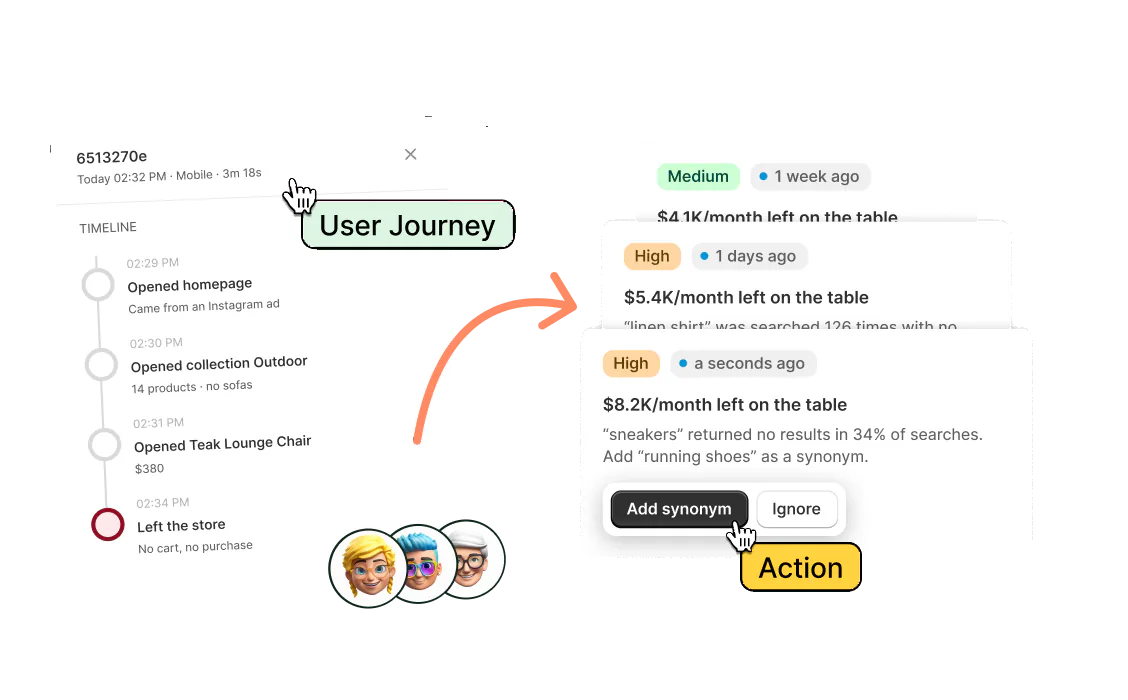
Install free. On a paid plan, Growth Intelligence reads the terms your shoppers typed, names which ones came back empty, and prices the fix in dollars from your own sales and published uplift rates. Then it measures what that fix earned against the two weeks before.