
Back in stock app alternatives for Shopify (2026)
A shopper found the exact thing they came for, in their size, and the button read "Out of stock." They left. Nothing logged that the sale was attempted, and nothing will call them back the day the box lands.
Shopify still ships no notify-me form in August 2026, so this is a decision about what to bolt on. Five alternatives below, ranked by what they cost to start and how the bill behaves as the waitlist grows, beginning with a route Shopify can run for free.
// How we picked
How we chose these five
Every option here puts a notify-me control on a sold-out product page, watches the stock, and sends on its own when it returns. We ranked by what it costs to start and how the bill moves as the waitlist grows, then by review record and by what runs beyond the alert itself. Order reflects what you likely want first, not who pays us, because nobody does.
// Comparison table
Back in stock alternatives at a glance
| Option | Best for | Standout | Starting price | Rating (reviews) |
|---|---|---|---|---|
| Shopify's own route | More time than budget | Collects the demand with no app bill | Free, and you send the alerts | not an app listing |
| STOQ | The cheapest real start | Free plan, then $10 for 1,000 alerts | Free, then $10 | 5.0 (3,510) |
| Swym | Alerts that must run through your ESP | Klaviyo, Omnisend, Mailchimp, and Meta | From $19.99 | 4.7 (419) |
| Amp | Big lists and preorders together | Unlimited notifications at $99 | Free, then $19 | 4.9 (834) |
| Sledge | Restock alerts inside one selling app | Waiting count beside available stock | $199 on Accelerate | 4.5 (14) |
// Option 1 · Shopify's own route
Shopify's own route: free up to the send
There is no back-in-stock feature in Shopify, and two free parts get you most of the way. Shopify Forms is free to install and puts an email box on the page. Shopify Flow, free on Basic and up, has a trigger that fires the moment a variant goes from zero back in stock.
The standout is the price. Collecting restock demand on Shopify costs nothing beyond your existing plan. No app bill, no cap on how many people sign up.
The honest limit is the send. Flow's two email actions go to your team, not to a shopper, and Shopify says so on the page that documents them. It points you to a marketing automation instead, and the automation types Shopify lists are abandoned browsing, abandoned cart and checkout, a welcome, a post-purchase note, and customer appreciation. Restock is not among them.
The form has its own ceiling. A Shopify form takes no conditional logic and a store holds 25 of them, so it cannot tell which sold-out product the shopper was looking at when they typed their address. Some themes include a "notify me when available" box, and it usually just emails you, leaving you to write back by hand.
So the free route collects the addresses and tells you stock is back. Mailing the people who asked, about the product they asked about, is the part you do yourself.
Best for: one or two products you restock, and a morning you are willing to spend in your inbox rather than $10 a month.
// Option 2 · STOQ
STOQ: the cheapest start that still looks finished
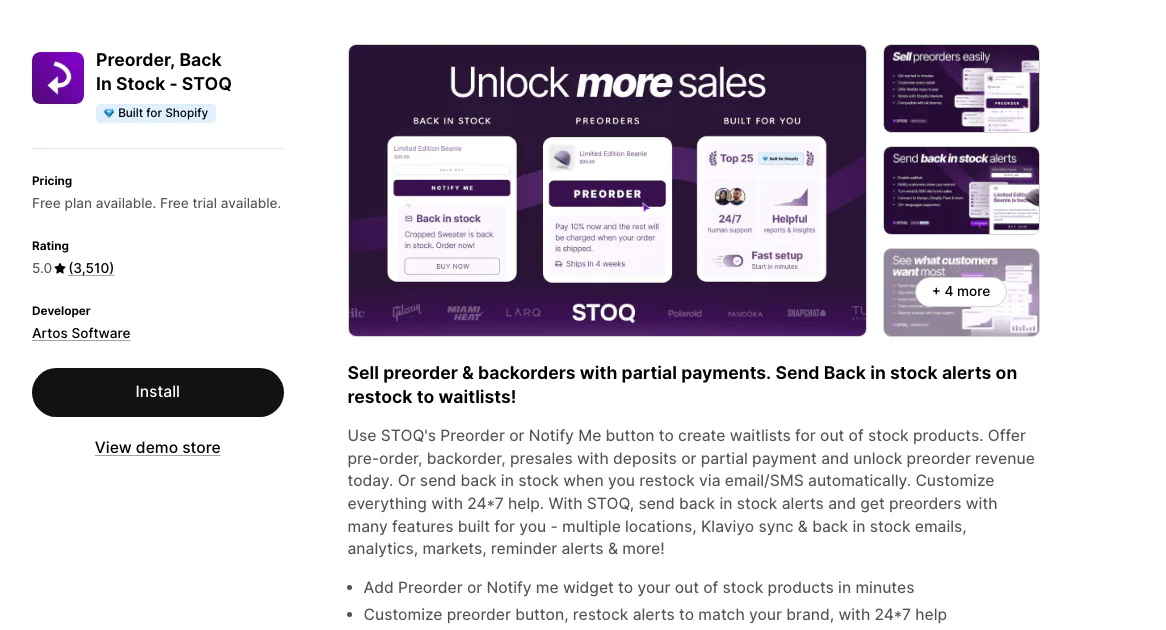
5.0 stars from 3,510 reviews and the Built for Shopify badge as of August 2026. A notify-me widget drops onto product pages and collection cards without code, and the same app runs preorders, backorders, and waitlists, so one install covers the sold-out page in both directions.
The standout is the ladder into paying. The free plan sends 30 alert emails and takes 10 preorders a month, which is enough to see whether anyone actually waits. Lite is $10 for 1,000 emails or texts and 100 preorders, the lowest real entry price on this page. Pro is $29 and Unlimited is $69.
The honest limit: the plans are metered, so a viral restock burns through an allowance in a morning, and SMS is charged separately at about $0.025 a message. It is a stock-alert app, so search, filters, offers, and reviews live elsewhere.
Best for: you want a finished notify-me experience today, at a price you barely have to think about.
// Option 3 · Swym
Swym: when the alert has to leave through your ESP
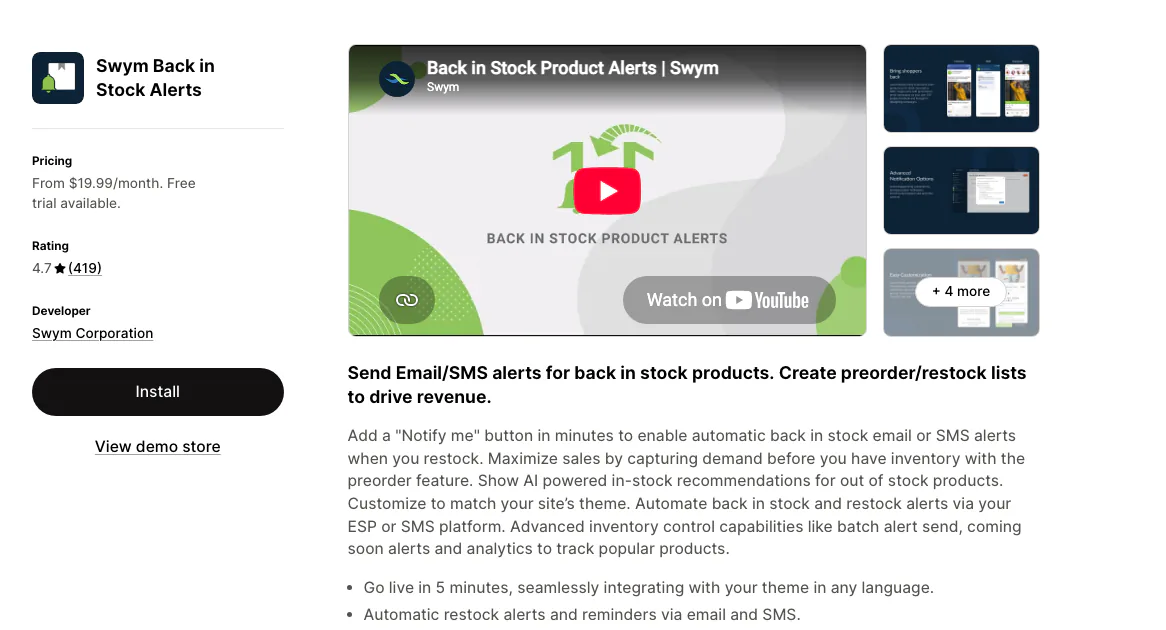
Running on Shopify since 2016, at 4.7 stars from 419 reviews as of August 2026. Email and SMS alerts, a notify-me button styled to the theme, batch sending, multi-location inventory, coming-soon alerts, and a REST API on the top plan.
The standout is integration depth. Klaviyo, Omnisend, and Mailchimp on the lower plans, plus a Meta pixel audience, so a restock can trigger a flow and a retargeting audience rather than only an email. If your restock alert has to become a Klaviyo flow rather than a standalone email, Swym is the one built for that.
The honest limit: it is the most expensive place to begin. There is no free plan, Starter is $19.99 for 1,000 alert requests, Pro $59.99 for 10,000, and Premium $99.99 for 25,000, so the cost per alert only makes sense once volume is real.
Best for: your email platform is the centre of your marketing and the restock has to feed it.
// Option 4 · Amp
Amp: built for lists that get long
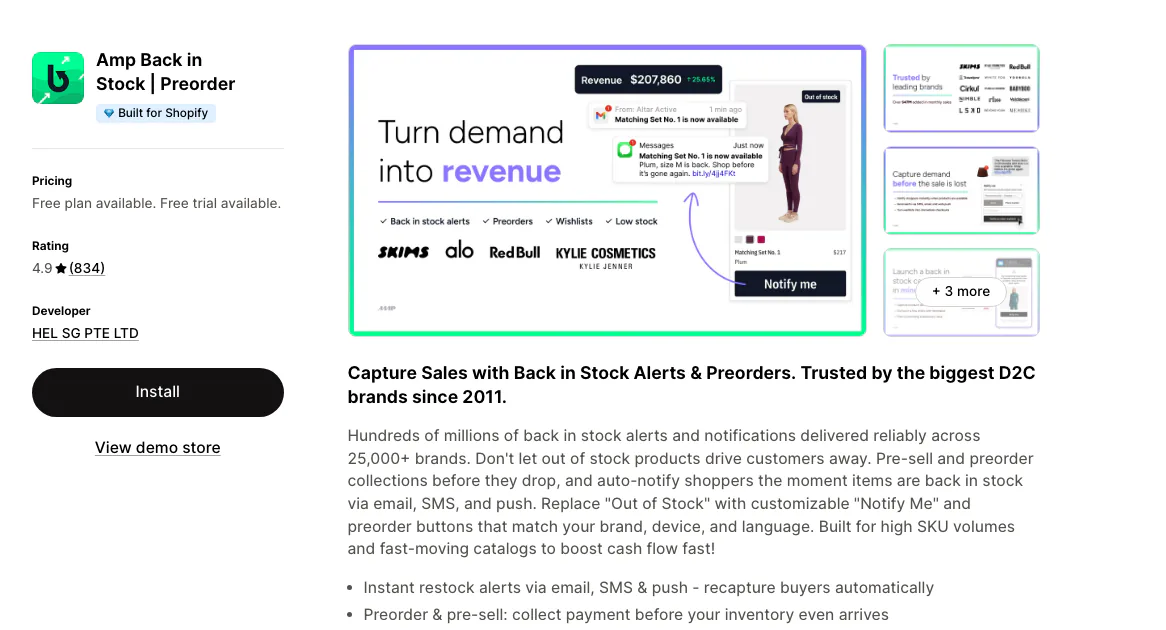
4.9 stars from 834 reviews and Built for Shopify as of August 2026, with a listing that claims hundreds of millions of alerts across more than 25,000 stores since 2011. Back in stock, preorders, wishlists, and low-stock badges share one install.
The standout is the ceiling. Amp's $99 Pro plan sends unlimited notifications, which is where metered pricing stops making sense. Below it, free covers 10 notifications a month, Starter $19 covers 500, and Growth $49 covers 2,000.
The honest limit: the free plan is small enough to be a demo rather than a trial, and SMS is billed on top at about $0.015 a message. Like the others here it stops at the stock alert, so the rest of your storefront stays on other apps.
Best for: a fast-moving catalog where drops sell out and the waiting list is long enough that per-alert pricing hurts.
// Option 5 · Sledge
Sledge: the alert arrives with everything else
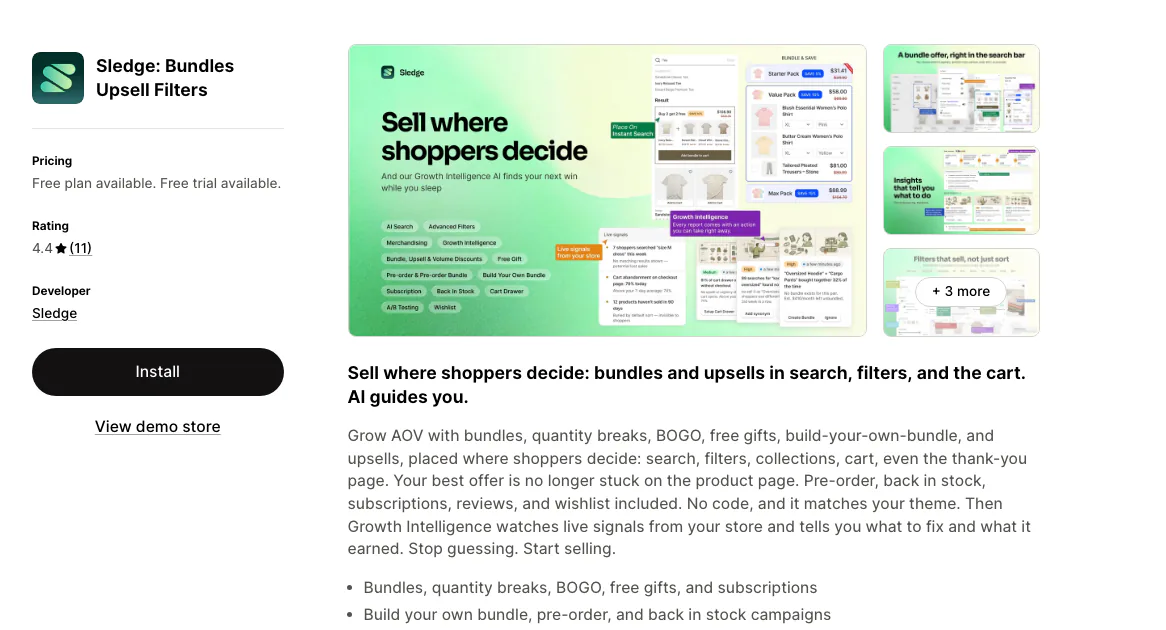
Sledge Back in Stock puts the notify-me field where the add-to-cart button used to be, on four surfaces rather than one: the product page, the product card in collections, search results, and instant search. Each is geo-gated to the regions you ship to, and the email sends itself the moment the product is back in stock.
Where it pulls ahead of the free route is the list. Submissions gives you a row per signup, with the product, the date requested, the last notification, and a Resend button. The second tab counts the subscribers on each product and sets your available quantity right next to that number. That is the difference between a mailing list and a reorder decision: forty waiting against two in stock reads differently from two against two. Export it, import one from another app, or add a subscriber by hand.
The standout is what surrounds it. The same install runs AI search, filters, merchandising, nine offer types, a cart drawer, reviews, and wishlist, on one flat plan, with Growth Intelligence reading your orders and naming the next move with a dollar estimate attached.
The honest limit, and it matters here. Back in Stock is on the Accelerate plan, $199 a month, so if a restock alert is genuinely all you need, STOQ at $10 is the better buy and we would rather say so. Alerts go out by email; a phone number is stored on the subscriber record and comes out in the export, but Sledge does not send the SMS itself.
Best for: you are already replacing a search app, a filter app, a bundle app, and a reviews app, and you want restock alerts to stop being a fifth subscription.
// Already paying for email
What if your email platform already does this?
Klaviyo and Omnisend both include back-in-stock, and if one of them is already running your marketing, that is the cheapest integration you will find: no new app, and the flow sits beside the ones you have. Read the pricing before you scale it, though. Klaviyo bills on the number of profiles you store, and every restock signup is a profile, so a waiting list raises the bill on the way in and only pays you back on the way out. Worth checking which side of that line your restocks fall on.
// Which one fits you
Which back in stock alternative fits your situation?
- You have more time than budget. Shopify's own route. Forms and Flow cost nothing and gather the names, and every alert leaves your inbox by hand.
- You want the most-reviewed app, cheaply. STOQ. 3,510 reviews at 5.0, a free plan to test on, and $10 for a thousand alerts plus preorders.
- Your waitlist runs into the tens of thousands. Amp. $99 buys unlimited notifications, where per-alert caps get expensive fast.
- Alerts have to flow through Klaviyo, Omnisend, or Meta. Swym. That integration depth is the reason to pay $19.99 rather than $10.
- You want the waiting list to tell you what to reorder. Sledge. It counts subscribers per product beside your available quantity, and the alerts arrive with search, filters, bundles, and the cart on the Accelerate plan.
Questions, answered
Does Shopify have a native back in stock notification?
No. Shopify tracks inventory and shows Out of stock, but ships no notify-me form and no restock email. Shopify Forms can collect the address and Shopify Flow can spot the restock, and neither one mails the shopper back. An app closes that last step in a few minutes.
Can I do back in stock alerts on Shopify for free?
Collecting the demand is free: Shopify Forms and Flow cost nothing on Basic and up. Sending the alert is where free ends, because you write those by hand. A free app plan sends them for you instead: STOQ covers 30 alert emails a month and Amp covers 10, enough to prove the idea before you pay.
Which Shopify back in stock app is cheapest?
STOQ, on the numbers as of August 2026. Its free plan sends 30 alert emails a month, and Lite is $10 for 1,000 emails or texts plus 100 preorders. Amp's free plan is smaller at 10 notifications, and Swym starts at $19.99 with no free plan.
Do restock alerts need SMS?
Usually not at first. Email carries most of a restock, and SMS is billed per message on top of the plan: about $0.025 with STOQ and $0.015 with Amp. Start on email, read the open and click rates, and add SMS only for the drops that sell out in hours.
One more subscription, or one fewer?
If restock alerts are the only gap, STOQ starts free and Shopify's own Forms and Flow gather the names for nothing. If you are counting five app bills and wondering which of them could be one, Sledge carries the notify-me form beside search, filters, and offers, and Growth Intelligence tells you which move is worth the most next month.
14-day free trial · No code · Works with any theme · Uninstalls clean