What is operating margin?
Operating margin is the share of your sales left after you pay for your products and for running the store, before interest and tax. The formula is operating profit ÷ net sales × 100. A store that sells $26,000 in a month and keeps $2,340 after product cost, shipping, card fees, ads, apps and wages has a 9% operating margin.
How is operating margin calculated?
Start with net sales, your sales after discounts and returns. Take off the cost of the products you sold and you have gross profit. Take off the cost of running the store too and what remains is operating profit, also called operating income. Divide it by net sales and multiply by 100. Profit margin sets this beside gross and net margin.
Operating margin example: one store month
| Step | Result |
|---|---|
| Net sales | $26,000 |
| Minus $11,440 of product cost | $14,560 gross profit, 56% |
| Minus $12,220 of running costs: $3,380 shipping, $810 card fees, $4,700 ads, $430 apps, $2,900 wages | $2,340 operating profit |
| $2,340 ÷ $26,000 × 100 | 9% operating margin |
Say ads cost $1,300 more and sales stay put. Operating profit falls to $1,040, a 4% margin.
What counts as an operating expense in a store?
Anything you pay to keep the store selling, apart from the product itself: shipping labels, card fees, ads, apps, your plan and wages. Labels and card fees grow with every order, while the plan and wages stay put, the split behind fixed and variable costs. Some bookkeepers file shipping and card fees under cost of goods sold instead, so count them the same way each month.
What does operating margin mean?
It is what each sales dollar leaves after product cost and running costs: at 9%, you keep 9¢. If sales hold and the margin slips, product cost or running costs have risen. Compare it with your own earlier months. The profit margin page has sector figures.
Where does Shopify show operating margin?
It does not. Shopify's profit reports, under Analytics then Reports, start from the "Cost per item" you enter on each product, what one unit cost you. The Finance summary report there shows gross profit in its "Gross profit breakdown" card. These count product cost, and one adds shipping costs and duties, but none lists ads, apps or wages. Settings then Billing lists your plan, app charges and shipping labels. Shopify Payments card fees come out of your payouts, as Shopify's help notes.
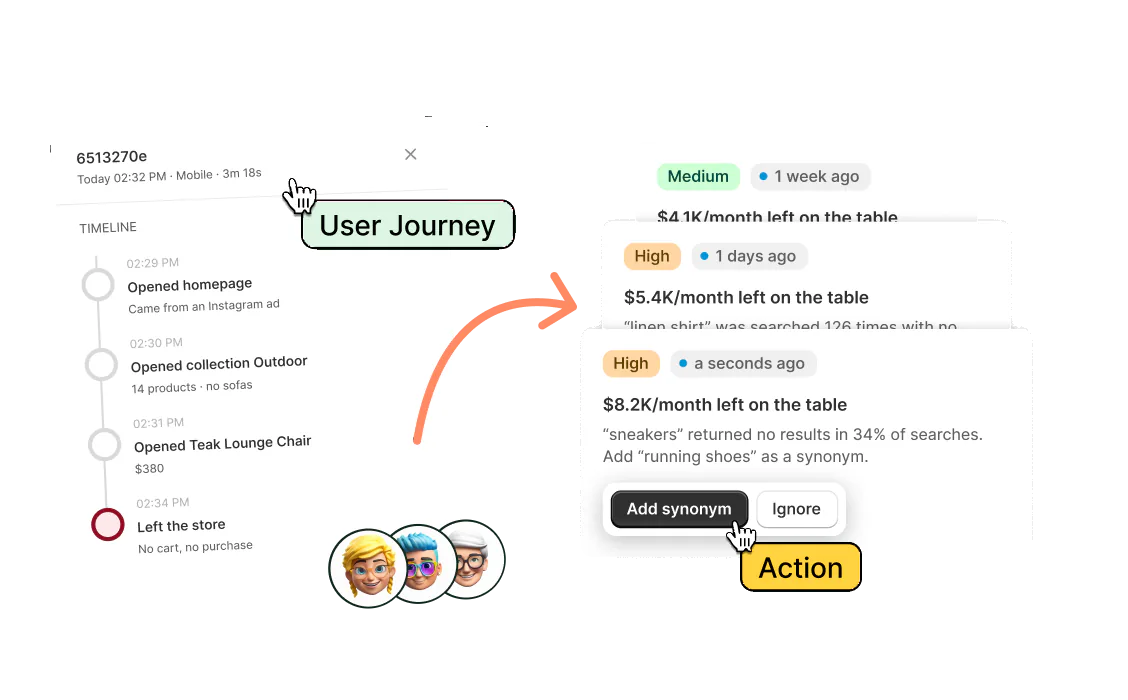
What each visit sells, with Sledge
Sledge does not read your costs or work out operating margin, and its analytics report sales, not costs. It runs search, filters, bundles and upsells on your storefront, where each visit turns into an order or does not. Growth Intelligence turns on when you pick a paid plan. It suggests fixes, and one figure, labeled "Est. potential", adds up the sales they could bring. It counts sales only, never costs.